12 min
Zach Chmael
In This Article
AI crawlers now dominate classified crawler requests on Cloudflare's network. Here is the measurement ladder that keeps a request from becoming a fake visibility or revenue claim.
Updated
TL;DR
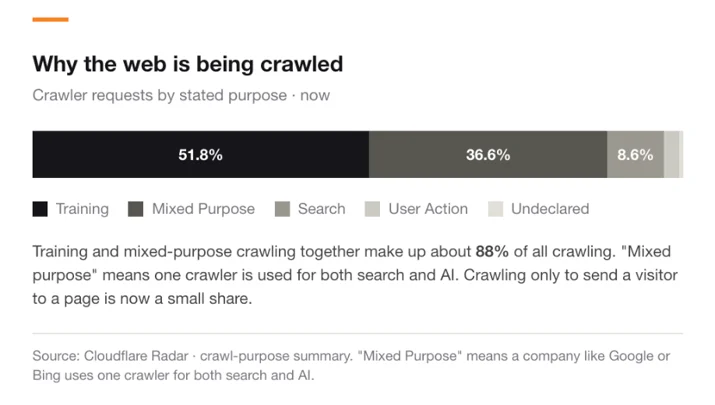
🤖 Cloudflare says AI training represented 52% of classified crawler requests in June 2026, versus 22% in spring 2025.
🧩 Mixed-use bots accounted for more than 36% of crawler activity, so crawl intent often cannot be separated cleanly.
🌐 Cloudflare says its network sits in front of more than 20% of the web, which is broad coverage but still not an Internet census.
📏 Radar labels bot scores 1 through 29 as likely automated and 30 through 99 as likely human.
🔍 A useful report keeps at least 7 observable stages separate: request, access, indexing, retrieval, citation, recommendation, and business outcome.
A Crawl Is Not An Audience
Cloudflare reports that AI-training systems produced 52% of crawler requests it classified by purpose in June 2026, up from 22% in spring 2025. That is a large infrastructure shift. It is still one event near the bottom of the evidence chain: a machine requested a URL.
A crawl does not prove that the page entered an index, appeared in retrieval, shaped an answer, earned a citation, influenced a shortlist, or created revenue. When a dashboard turns that request into "AI reach," it has skipped the work between infrastructure and outcome.
TL;DR
🤖 Cloudflare says AI training represented 52% of classified crawler requests in June 2026, versus 22% in spring 2025.
🧩 Mixed-use bots accounted for more than 36% of crawler activity, so crawl intent often cannot be separated cleanly.
🌐 Cloudflare says its network sits in front of more than 20% of the web, which is broad coverage but still not an Internet census.
📏 Radar labels bot scores 1 through 29 as likely automated and 30 through 99 as likely human.
🔍 A useful report keeps at least 7 observable stages separate: request, access, indexing, retrieval, citation, recommendation, and business outcome.
What does a crawler request actually prove?
A crawler request proves that your infrastructure observed a request associated with a user agent, signature, IP pattern, or classification rule. With good logs, you can usually say which URL was requested, when it happened, whether the server responded, and how many bytes were sent.
That is useful. It can reveal wasted crawl budget, broken redirects, blocked paths, stale sitemaps, and sudden changes in automated demand. Cloudflare's report says non-human traffic crossed more than 50% of Internet traffic on its view of the network. Site owners need to see that traffic instead of hiding it inside a human-looking pageview total.
The line stops at the edge. A 200 response says the server returned content. It does not say the crawler stored the content, a retrieval system selected it later, or an answer model used it.
A 403 says access was denied, while a 404 says the requested resource was missing. Neither status code describes a buyer.
I downloaded Cloudflare's full report and checked the methodology rather than lifting the 52% headline. The reported unit is crawler requests classified by purpose on Cloudflare's network. It is not people, sessions, citations, answers, or sales.
How representative is Cloudflare's view of the web?
Cloudflare's view is broad enough to matter and selective enough to require a label. The company says its network spans 330+ cities in 100+ countries and sits in front of more than 20% of the web.
Its 2026 Investor Day deck gives two more coverage markers: 36% of the top 10,000 sites and 42% of the Fortune 500 use Cloudflare. Those numbers explain why its observations deserve attention. They also describe a customer and network sample, not a random draw from every site on the Internet.
Large publishers, major brands, security-sensitive companies, and high-traffic properties may be overrepresented. Sites behind other networks, private communities, mobile apps, authenticated products, and content never exposed to Cloudflare are absent. The safe phrase is "on Cloudflare's network," not "across the whole web."
The same discipline applies to industry comparisons. The deck reports 35% to 40% declines in absolute non-bot request volume across retail, software, IT and services, and financial services between June 2025 and April 2026. That is an observed change across 4 categories. It does not isolate AI as the cause.
Why is crawler identity harder than reading a user agent?
Crawler identity is hard because a name in a request is a claim, while classification is an inference. User agents can be copied, mixed-use systems can combine several purposes, and browser automation can execute JavaScript while looking more human than an old crawler.
Cloudflare reports that mixed-use crawlers generated more than 36% of crawler activity. A mixed-use bot may support search discovery, agent retrieval, and training. The site owner sees the request but cannot reliably allocate it among those jobs when one identity covers all of them.
Radar adds a statistical classification layer. Its documentation groups scores 1 to 29 as likely automated and 30 to 99 as likely human. "Likely" is doing real work there. A score is evidence from a detection system, not a verified statement of intent.
Cloudflare's newer session detection makes the distinction sharper. Precursor evaluates behavior across an entire session and builds on a network that analyzes more than 1 trillion requests per day. Turnstile runs nearly 3 billion times per day.
Those systems are designed to detect automation and abuse. They do not identify which automated session belongs to a serious buyer acting through an agent.
That buyer may be economically valuable even when the traffic is automated. An abusive scraper may be worthless despite requesting every page. Bot versus human is a security class, not an intent score.
Which stages must an AI visibility report keep separate?
An honest AI visibility report keeps each observable stage separate and names the instrument that can support it. The stages form a chain, but evidence at one step does not automatically move up the chain.
Stage | What you can observe | Suitable evidence | What it does not prove |
|---|---|---|---|
Request | A URL was requested | Edge or server log | Content was returned |
Access | Content and status were returned | Response code, bytes, policy log | Content was stored |
Indexing | A system says the page is eligible or indexed | First-party engine tool or verified index check | The page was retrieved |
Retrieval | The page or passage appeared in an answer run's source set | Raw answer trace, cited URL, retrieval log | The source changed the answer |
Citation | The answer displayed a source reference | Saved answer and exact citation | The brand was recommended |
Recommendation | The answer endorsed or shortlisted the brand | Repeated runs with prompt, engine, date, and rubric | A person acted |
Business outcome | A qualified person or account progressed | Analytics, CRM, sales evidence, time window | The AI exposure caused the outcome |
The first 2 stages belong mainly to infrastructure. Stages 3 through 6 need engine-side or repeated answer evidence. Stage 7 needs business systems and a cautious attribution model.
This is where crawler dashboards often get carried away. They can measure stage 1 well and sometimes stage 2. Then the label jumps to "AI visibility," a phrase broad enough to imply all 7.
A better dashboard refuses the shortcut. It can say, "GPTBot requested 148 URLs, 132 returned 200, and 16 returned 404." It cannot say, "148 pages reached AI buyers" unless another instrument observed those buyers.
Source: Cloudflare's Agentic Internet Bot Report.
What methodology should sit beside every crawler chart?
Every crawler chart should show the unit, classifier, period, sample, transformation, and missing causal links. Without that note, a clean graph can make an unstable denominator look settled.
Cloudflare Radar documents 6 normalization states: percentage, percentage change, overlapping percentage, min-max, min-zero-max, and raw values. It also says Radar does not normally return raw values. A value may describe share or relative position rather than request count.
Aggregation changes the picture too. Radar defaults a 1-day request to 15-minute intervals. A range longer than 1 month defaults to 1-day intervals. Comparing a short spike with a monthly series without stating that aggregation is an easy way to create a false trend.
Radar publishes 5 confidence levels. Level 1 means the time range or location lacks enough data and looks erratic. Level 5 means no known data-quality issue. Cloudflare's blog report does not provide confidence metadata or uncertainty intervals beside the headline crawler shares.
I checked the linked Investor Day deck for the footnotes behind the broader claims. One attention chart is explicitly labeled "illustrative / directional" and "not a single measured series." The blog turns that into a clean statement that only 15 minutes of each online hour is spent on the open web. I would not use that number as a measured benchmark.
Use this chart note instead:
Requests classified by crawler purpose on [network/sample], observed from [start] to [end]. Values are [raw/percentage/normalized], aggregated by [interval]. Classifier version and known mixed-use traffic: [details]. A request does not establish indexing, retrieval, citation, recommendation, or human action.
Should crawler growth change your content strategy?
Crawler growth should change your observability and access policy before it changes your editorial calendar. More requests can justify better logs, cleaner status codes, explicit bot rules, and a decision about which content each crawler may access.
Cloudflare says more than 50 publisher-AI agreements have been signed since 2023. It also introduced a private-beta payment mechanism built around HTTP 402 in 2025. Those developments show that access rights are becoming a business decision, especially for publishers whose content is the product.
A lean B2B SaaS company has a different model. Its public product facts, comparisons, documentation, and evidence may be useful precisely because buyers and their agents can retrieve them. Blocking every AI crawler can make the company harder to understand. Allowing every purpose can give away material the company meant to keep gated.
Set policy by content class and purpose:
Content class | Default access question | Evidence needed before changing policy |
|---|---|---|
Public product facts | Does retrieval reduce buyer confusion? | Crawl logs plus answer traces |
Documentation | Does agent access help users complete work? | Support outcomes and retrieval evidence |
Original research | Is discovery worth uncompensated reuse? | Referral, citation, licensing, and cost data |
Customer evidence | Is public permission explicit? | Approval record and expiry |
Paid or private material | Should any automated system receive it? | Contract, authentication, and access policy |
Do not publish another 20 articles because crawler volume rose. First ask whether the requests reached the right pages, whether those pages returned correctly, and whether repeated answer tests show the evidence being used.
What should a small team report to leadership?
A small team should report a ladder of observed facts, not one blended visibility score. Start with requests and access health, then add answer evidence and business outcomes only when the required instrument exists.
A useful monthly report can fit on one page:
Automated demand: requests by verified or classified crawler, URL group, response code, and week.
Access quality: successful responses, redirects, errors, blocked paths, and stale content.
Answer evidence: repeated prompts, engines, citations, mentions, recommendations, and run variance.
Business evidence: AI referrals where observable, assisted conversions, qualified meetings, and the attribution caveat.
Decisions: fix access, refresh evidence, change permissions, run a bounded test, or do nothing.
Keep the language literal. "Crawler requests rose 38%" is an infrastructure finding. "Citation rate moved from 6 of 40 runs to 11 of 40" is an answer finding.
"Two qualified meetings mentioned ChatGPT research" is buyer evidence. It should not be rewritten as "AI revenue grew" without a defensible bridge.
Trovance's measurement principle is the same one this report demands: a mention is not a citation, a citation is not a recommendation, and a recommendation is not revenue. Add one more distinction at the front. A crawl is not an audience.
Source: Cloudflare's Agentic Internet Bot Report.
How Does Trovance Connect Crawl Signals To Answer Evidence?
Trovance does not turn a crawler request into an inflated visibility claim. Crawl and access data can show whether important evidence pages were requested and returned correctly. Trovance's job begins where that infrastructure signal stops: observing how AI systems actually explain, cite, compare, and recommend the company, then diagnosing the evidence gap behind the result.
That distinction gives a small team a practical workflow. Use server or edge logs to find access failures. Use preserved answer runs and citations to see whether the right proof entered the answer.
Then use Trovance to turn a supported gap into the page, comparison, proof asset, or correction that should exist. The system carries the decision from observed answer to evidence-backed production instead of stopping at another score.
Use Trovance when your crawler dashboard says activity increased but cannot tell you what AI systems learned, cited, or recommended. It helps connect the answer to its source trail, identify the missing evidence, and create the asset intended to improve the next run without pretending the crawl itself was the outcome.
See How Trovance Connects AI Answers To Evidence And Production.
FAQs
Does an AI crawler request mean my page entered a model's training data?
No. A request shows that an automated system asked your server for a URL. A successful response may show that content was returned, but it does not reveal whether the crawler stored, deduplicated, filtered, licensed, indexed, or trained on that content. Those later steps require evidence the server log cannot provide.
Is Cloudflare's 52% figure a measure of all Internet traffic?
No. The figure is Cloudflare's reported share of crawler requests classified as AI training in June 2026. It is not 52% of human and bot traffic combined, and Cloudflare's network is broad rather than universal. Cite the company, request unit, classifier purpose, network sample, and observation month together.
Can server logs prove that an AI answer used my content?
Server logs can show that a crawler or user-agent identity requested a page near the time of an answer. They cannot prove the answer retrieved that page or used its claims. Preserve the raw answer, citation URL, prompt, engine, run time, and repeated-run result to support an answer-level finding.
Why do mixed-use crawlers create a measurement problem?
A mixed-use crawler may support search discovery, AI retrieval, and training under one identity. The site owner sees access without a reliable purpose label for each request. Cloudflare says these bots exceed 36% of crawler activity, so treating every request as training or every request as discovery will misclassify a large share.
Should a B2B company block AI training crawlers by default?
There is no universal answer. A company should classify its content first. Public product facts may benefit from retrieval, while paid research, customer material, and private documentation need stricter rules. Decide by content value, buyer usefulness, permission, licensing terms, and observed access rather than copying a publisher policy designed for another business model.
What is the minimum useful crawler dashboard?
Show requests by crawler identity or class, URL group, response code, and time period. State whether values are raw or normalized, how bots were classified, and how mixed-use traffic is handled. Add indexing, answer, citation, and conversion data only as separate panels with their own instruments and denominators.
How do I connect crawler data to revenue without overstating it?
Build the chain one observed step at a time: request, successful access, answer retrieval, citation or recommendation, human visit where visible, qualified action, and sales outcome. Record dates and repeated runs. If a link is missing, label the relationship as unknown or assisted instead of assigning causal revenue to the crawl.
Related Resources
See how Trovance turns an observed answer into an evidence decision: https://app.trovance.ai/sign-in?mode=create
