7 min
Zach Chmael
In This Article
AI agents crawl more than they refer. Build inspectable claims, sources, ownership, and update paths before adding another page to the web.
Updated
TL;DR
🤖 Training and mixed-purpose bots made up about 88% of Cloudflare's displayed crawler mix.
🔎 Search accounted for 8.6% of crawler requests in that first-party snapshot.
📉 Cloudflare's modeled crawl-to-return series ended at 1 visitor per 9.6 pages crawled, not a universal referral rate.
🧾 W3C PROV-O centers three provenance concepts: Entity, Activity, and Agent.
🏗️ The evidence contract proposed here has seven fields: claim, source, scope, owner, date, URL, and update path.
Why More Content Won't Make AI Agents Trust Your Brand
The agentic web does not need another flood of pages. It needs claims that a buyer or machine can inspect, trace, date, and challenge.
Cloudflare's July 2026 report makes the access problem plain. Its displayed crawler mix attributed 51.8% of requests to AI training, 36.6% to mixed-purpose bots, and 8.6% to search. Access is abundant. Intent is murky, and a request is not proof that anyone read, cited, trusted, or acted on the page.
A B2B team should build a smaller number of inspectable evidence objects: one bounded claim, its primary source, scope, owner, date, public URL, and update path. Pages still matter. Their job changes. A page becomes a reliable container for evidence instead of a bet that more surface area will create understanding.
Why does more crawler access fail to prove market understanding?
More crawler access fails to prove market understanding because access, use, citation, recommendation, and buyer action are separate events.
Cloudflare reports that training's share of classified crawler requests rose from 22% in spring 2025 to 52% in June 2026. The company's current figure puts training at 51.8%, mixed purpose at 36.6%, and search at 8.6%. Its mixed-purpose category means the same crawler may support both search and AI, so the site owner cannot infer intent from the visit alone.
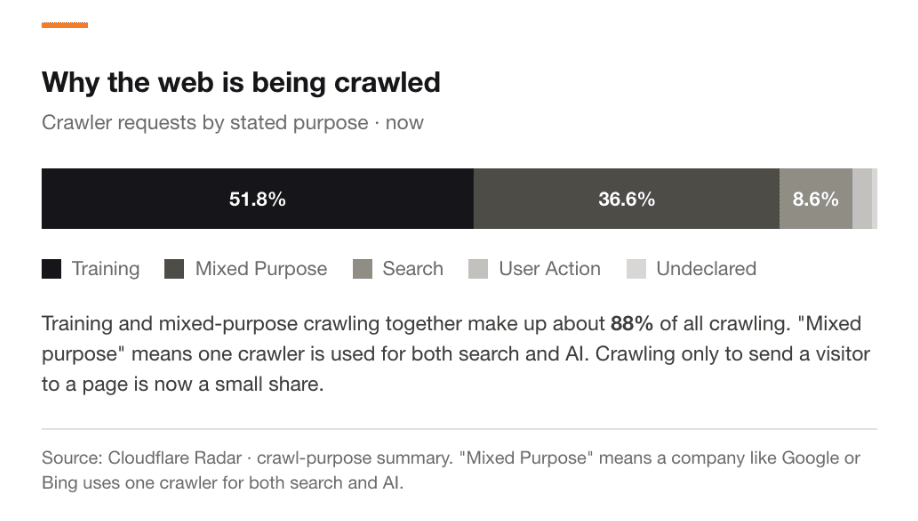
Source: Cloudflare.
The chart is useful because it refuses a lazy equivalence. A training request does not mean a page appeared in a current answer. A search request does not guarantee a click. A mixed request may support several purposes that the publisher cannot separate.
Cloudflare has a commercial stake in this argument. It sells bot controls, attribution, and content-market infrastructure. Its network view is still unusually broad: the company says it sits in front of more than 20% of the web, across more than 330 cities in over 100 countries. But the article does not disclose the raw request count, exact site denominator, confidence intervals, or classification error for the crawler-purpose snapshot.
So use the percentages as a first-party view of traffic composition, not a census of the entire Internet. The durable point survives that boundary: a server request is an access event. Market understanding has to be observed elsewhere.
What changes when a crawl no longer implies a returned visitor?
When a crawl no longer implies a returned visitor, the page must carry value even when its claim travels without the visit.
Cloudflare's second figure estimates visitors returned per pages crawled. The series ends at 1 visitor for every 9.6 pages crawled. The falling line means fewer visitors came back for each page accessed.
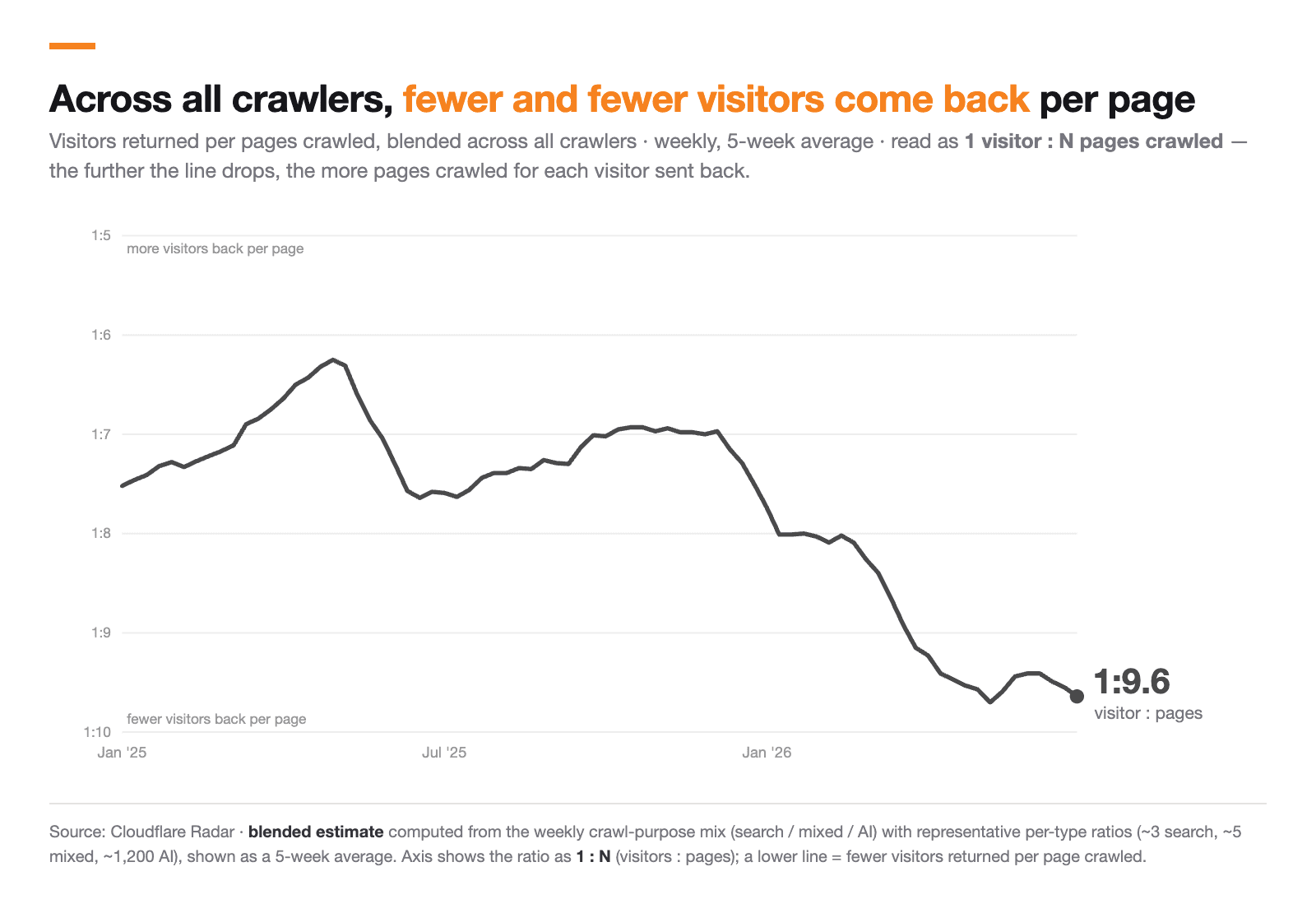
Source: Cloudflare.
That 1:9.6 endpoint needs its method attached. It is a blended estimate, not a direct universal count. Cloudflare computed a five-week average from the weekly purpose mix and representative ratios of about 3 pages per visitor for search, 5 for mixed-purpose crawling, and 1,200 for AI crawling.
I downloaded the full-resolution figure because the method sits in small type under the chart. Remove that line and the image looks like a measured referral series. Keep it, and the figure supports a narrower claim: under Cloudflare's stated model, crawler access and returned attention moved farther apart from January 2025 into 2026.
The distinction matters for a software company, even if it is not a publisher selling ads. A product fact may shape an answer without earning a session. A comparison may be summarized before the buyer sees the page. A stale claim may circulate with no clean feedback from analytics.
That makes traffic incomplete, not useless. Teams still need visits, conversion, and revenue measures. They also need to inspect the answer itself: what was said, which source was attached, whether the scope survived, and whether the company belonged in the recommendation.
What is an inspectable evidence object?
An inspectable evidence object is a bounded claim with enough provenance and ownership to verify, use, update, or retire it.
The idea is older than generative AI. The W3C's PROV-O Recommendation organizes provenance around Entity, Activity, and Agent: the thing being described, the process that produced or changed it, and the person or system responsible. PROV-O is not a GEO study, and using it does not improve rankings by itself. It gives teams a clean vocabulary for the source trail.
For editorial work, I would make the minimum contract seven fields:
Evidence field | Question it must answer | Failure it prevents |
|---|---|---|
Claim | What exactly are we asserting? | A paragraph that drifts between several promises |
Source | Which primary artifact supports it? | A citation chain that ends at another vendor's summary |
Scope | For which product, segment, geography, and condition is it true? | A narrow result presented as a universal fact |
Owner | Who is accountable for accuracy and public use? | An orphaned claim nobody can approve or correct |
Date | When was it observed, published, and last checked? | Old evidence presented as current product truth |
Public URL | Where can a buyer inspect the proof? | A claim backed only by a private deck or inaccessible file |
Update path | What event changes, qualifies, or retires it? | A page that remains technically live after the fact expires |
This is a proposed content contract, not a benchmark-validated ranking method. Its value is operational. It lets a marketer decide whether the existing proof is usable before asking a writer or agent to make another asset.
It also exposes uncomfortable answers early. Sometimes the source is weak. Sometimes the claim is true only for one plan. Sometimes legal cannot approve the detail.
Sometimes the offer does not fit the buyer's condition. An evidence system should make those limits easy to see, not smooth them into confident prose.
How should a team turn evidence into a public asset?
A team should turn evidence into a public asset only after the buyer question and missing proof are clear.
Start with the observed explanation, not a keyword list. Record the full question, answer, engine, date, source URLs, and repeated-run policy. Then separate what the answer mentioned from what it cited, compared, or recommended. Those are different outcomes, and none proves revenue.
Next, map each decision condition to the seven-field evidence contract. A security requirement may belong in documentation. A product limit may need a clear feature page.
A disputed category claim may need original research. A missing customer outcome may require an interview and public approval before any page can exist.
The production decision follows the gap:
Diagnosed state | What should happen | What should not happen |
|---|---|---|
Current proof exists and is surfaced accurately | Preserve it, monitor it, and set a review date | Publish a duplicate article |
Current proof exists but is buried or disconnected | Repair access, wording, linking, or placement | Assume the claim itself is missing |
Claim is true but public proof is absent | Produce the smallest asset that can carry the proof | Inflate a thin fact into a long generic guide |
Claim is stale, disputed, or too broad | Correct, qualify, or retire it | Ask an agent to make it sound certain |
Offer does not meet the buyer condition | Record legitimate bad fit | Manufacture content to force inclusion |
This is where the volume reflex usually breaks. A page count cannot tell you whether the missing object is a product fact, independent validation, comparison boundary, current documentation, or no content at all.
Cloudflare reports that some heavily crawled categories saw human traffic fall by as much as 40% in less than one year. That source-reported maximum does not prove the same decline for B2B SaaS.
It does make one thing harder to defend: treating visits as the only place where the market explanation can be inspected.
How should evidence be measured after publication?
Evidence should be measured as a chain of distinct observations, with the denominator and uncertainty preserved at every step.
Begin with availability. Is the asset live, reachable, current, and connected to the intended company, offer, and buyer condition? Then inspect answer behavior. Across a declared prompt set and repeated runs, was the claim absent, mentioned, cited, compared, or used in a recommendation?
Do not collapse those states into one score. Report the raw run count, engine, prompt, persona, dates, source pattern, and variance. If a claim appears in 4 of 10 observed runs, say 4 of 10. Do not translate that into a universal visibility percentage.
Then keep business outcomes in their own layer. Visits, qualified meetings, pipeline, and revenue need their own observation window and attribution method. A changed answer beside a changed conversion rate is still not automatic causation.
I also checked Cloudflare's stronger market statements before deciding what not to inherit. The report cites more than 50 publisher-AI agreements since 2023 and says Google accounts for about 88% of referral traffic. Those figures describe publisher economics and Cloudflare's network view. They do not establish the return on an evidence page for a lean B2B team.
The honest scorecard is less dramatic:
Layer | Useful measure | Claim boundary |
|---|---|---|
Evidence | Current claim-source pairs with named owners | Shows readiness, not retrieval |
Access | Successful fetches by declared bot class | Shows access, not use |
Answer | Mentions, citations, comparisons, and recommendations by run | Shows observed model behavior, not buyer action |
Buyer | Visits, assisted research, meetings, and sales stages | Shows behavior, with attribution limits |
Business | Customer and revenue outcomes over a stated period | Requires causal restraint |
The chain gives a team somewhere useful to look when the result fails. A universal score mostly gives it somewhere to stare.

How can Trovance help teams build evidence for AI agents?
Trovance helps teams connect an observed AI answer to the evidence gap and the proof-backed asset that should exist.
A team can use Trovance to observe how AI systems explain, cite, compare, and recommend the company for a defined buyer question. That preserved answer shows whether a claim was absent, attached to the wrong source, stripped of its scope, or used to compare the company for a condition it does not meet.
Observation alone does not fix the problem. Trovance helps diagnose whether the gap is missing proof, stale product truth, unclear comparison language, weak access, a product issue, or legitimate bad fit. The seven-field evidence contract gives that diagnosis something concrete to inspect before production starts.
When a public asset is justified, Trovance helps the team produce and publish the proof-backed page, clarification, comparison, FAQ, or source-backed article that should exist. Claims and sources remain attached, and a person keeps the final decision. A later rerun can test whether the explanation changed without promising a citation, recommendation, or sale. Use Trovance to connect an AI answer to the evidence action.
FAQs
What does content for AI agents mean?
Content for AI agents is public information that remains clear when retrieved, summarized, or compared outside its original page. It uses bounded claims, primary sources, explicit scope, current dates, stable URLs, and named ownership. The same structure helps human buyers verify the claim, so it should not become a separate layer of bot-only prose.
Does more AI crawler traffic improve AI visibility?
No direct conclusion follows from crawler volume alone. A request shows that a bot accessed a URL under a stated or inferred identity. It does not show whether the page entered training, retrieval, an answer, a citation, or a recommendation. Teams must inspect answer behavior separately and preserve the prompt, engine, date, sources, and repeated runs.
Is Cloudflare's 1:9.6 ratio a measured referral rate?
No. Cloudflare labels the chart a blended estimate built from weekly crawler-purpose shares and representative per-type crawl-to-return ratios. The endpoint is useful as a directional model, but the article does not publish the raw numerator, denominator, site mix, or uncertainty. It should not be applied as a universal rate for a company or industry.
What is the minimum evidence contract for a claim?
Use seven fields: the exact claim, primary source, scope, accountable owner, observation and review dates, public URL, and update path. Regulated, security, customer, or performance claims may need more. The contract does not guarantee retrieval. It makes the claim easier for a reviewer to verify, qualify, approve, refresh, or retire before publication.
Should every evidence object become a new article?
No. The right home may be product documentation, a comparison page, pricing, a security page, an FAQ, a research report, or an update to an existing asset. If proof already exists, repair its access or connection first. If the claim is false or the offer is a bad fit, publishing more prose is the wrong response.
Can provenance markup secure AI citations?
No. W3C PROV-O provides a vocabulary for describing entities, activities, agents, and their relationships. It was not designed or validated as a citation-ranking tactic. Structured provenance can improve internal traceability and make source relationships explicit, but retrieval, model behavior, competing sources, and citation choices remain outside the publisher's control.
How should a team know whether the evidence worked?
Define the buyer question and baseline before publishing, then repeat the same observation method across a stated window. Report mentions, citations, comparisons, and recommendations separately, with raw counts and variance. Check visits and business outcomes in their own layer. A changed answer can be evidence of changed model behavior without proving that the asset caused revenue.
Related Resources
Connect an observed answer to the evidence action with Trovance