7 min
Zach Chmael
In This Article
GEO changes how content is selected after retrieval, but controlled tests show retrieval rank still matters more than common page rewrites.
Updated
TL;DR
🔎 C-SEO Bench covered 2 search tasks and 6 domains, separating product recommendations from question answering.
🧪 Researchers tested 10 content-transformation methods across 4 answer models.
📉 Only 3 of 54 unilateral cases produced a statistically significant positive citation-rank gain.
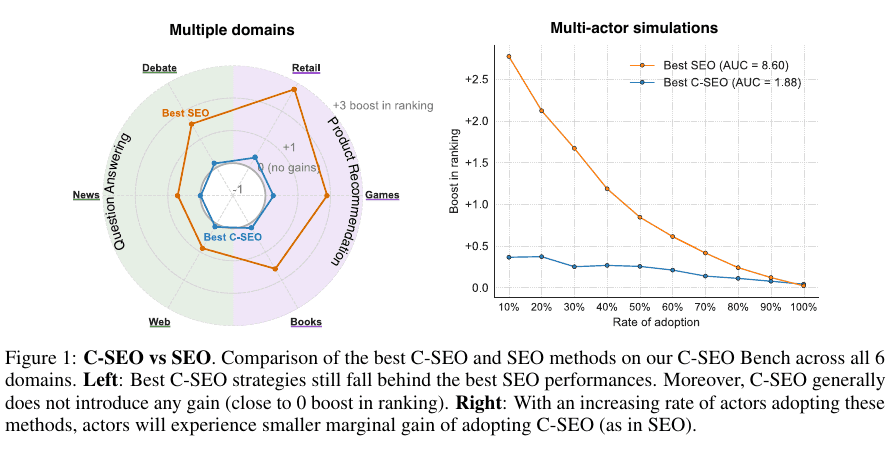
🧭 Putting a source first in context produced gains from 0.70 to 2.77 citation-rank positions across the six GPT-4o-mini domains.
🧱 The best retrieval-order method had an AUC of 8.60 versus 1.88 for the best tested C-SEO method in the multi-actor simulation.
Does GEO Replace SEO? What The Evidence Says
GEO does not replace SEO. It adds another selection problem after retrieval.
A page still has to become available and relevant enough to enter an AI system's source set. Then the answer model decides how to use it: whether to cite it, where to place the citation, what facts to extract, and whether those facts support a comparison or recommendation. The second stage is new enough to deserve its own work. It does not make the first stage disappear.
A NeurIPS 2025 benchmark tested that boundary across more than 1,900 queries and 16,000 documents. Its controlled result was blunt: moving a document higher in the supplied context changed citation rank far more than the 10 tested page rewrites. That is evidence for GEO as a complement to SEO, not a replacement for it.
What changes when search produces an answer?
AI search adds a generation layer between retrieval and the user, so visibility can now fail after a source has already been found.
In a conventional search result, retrieval and ranking largely determine which links appear and where. In conversational search, the system can retrieve several documents, synthesize them, cite only some, and present an answer that carries its own ordering. A source can therefore rank well enough to enter context and still receive a late citation, a weak paraphrase, or no visible use.
That is the part GEO should own. It asks whether the source gives the answer model enough clear, current, attributable evidence to explain the company accurately. It also asks whether the model can distinguish a product fact from an adjective, a comparison from a claim of superiority, and a credible source from recycled consensus.
But the chain still starts earlier:
Stage | Buyer-facing question | Typical failure |
|---|---|---|
Access | Can the system fetch and parse the page? | Blocked crawl, broken rendering, gated evidence |
Retrieval | Does the source match the buyer question? | Weak relevance, poor authority, missing entity context |
Synthesis | Does the answer use the source accurately? | Omission, lost scope, weak citation, stale fact |
Comparison | Can the system distinguish fit and tradeoffs? | Empty proof, vague positioning, unsupported category claims |
Outcome | Did the answer affect a real decision? | No buyer measurement, wrong prompt, legitimate bad fit |
Calling all five stages "GEO" may be convenient. Treating them as one optimization problem is not.
Why does retrieval rank still matter for GEO?
Retrieval rank still matters because an answer model can only select from the evidence placed within reach, and its ordering inside context can change citation priority.
C-SEO Bench makes that distinction unusually visible. The authors built 2 tasks: product recommendation and question answering. The recommendation side used 500 retail queries, 436 video-game queries, and 249 book queries. The question-answering side used 300 web questions, 294 news questions, and 142 debate prompts.
For each query, the benchmark supplied a bounded set of candidate documents to the answer model. It then measured citation-rank change. This is not a live search-engine test. It is a controlled way to ask whether rewriting a document or changing its position in the supplied context has the larger effect.
Source: Puerto et al., C-SEO Bench.
Figure 1 shows the split. On the left, the best SEO baseline outperformed the best C-SEO rewrite in all 6 domains. On the right, the average gain from both approaches shrank as adoption rose from 10% to 100%. When everyone adopts the same tactic, the citation order cannot improve for everyone.
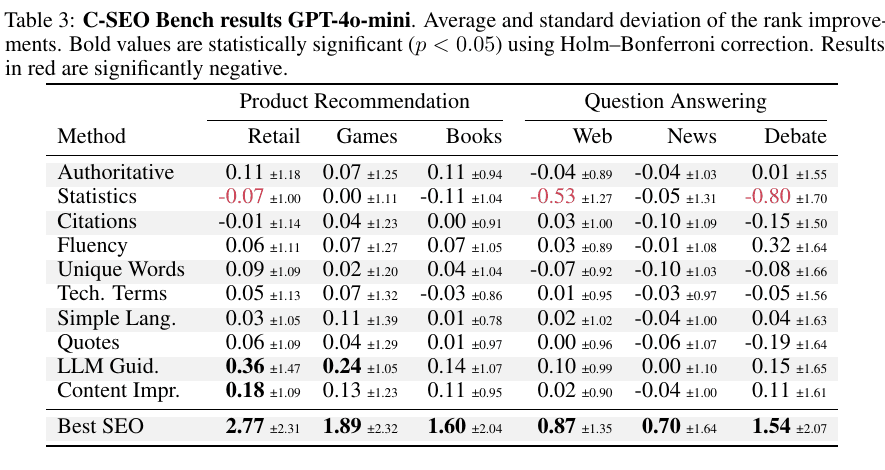
I checked the appendix table behind the chart. In the GPT-4o-mini condition, placing the target source first produced average citation-rank gains of 2.77 in retail, 1.89 in games, and 1.60 in books. The question-answering gains were 0.87 for web, 0.70 for news, and 1.54 for debate. All six first-position effects remained significant after correction.
That does not prove a particular SEO tactic will earn the first slot in a live model's source set. It shows why retrieval cannot be waved away once generated answers arrive.
Do common GEO rewrites improve citation rank?
Most common rewrites did not improve citation rank reliably in this benchmark, and several reduced it.
The researchers tested 10 methods: authoritative language, statistics, citations, fluency, unique words, technical terms, simple language, quotations, a combined content improvement, and an LLM-guidance summary. GPT-4o-mini generated the altered documents. GPT-4o-mini, Claude 3.5 Haiku, o3, and o4-mini produced the answers.
Across 54 unilateral cases, only three significant positive effects survived the corrected tests. LLM guidance worked in GPT-4o-mini retail and video games; combined content improvement worked in GPT-4o-mini retail. No tested method showed a significant gain for question answering, and none worked significantly on Haiku 3.5.
Source: Puerto et al., C-SEO Bench.
Table 3 also shows why averages can mislead. GPT-4o-mini LLM guidance left 61.0% of retail product ranks unchanged. It improved 26.2% and worsened 12.8%. Opposite movements partly canceled each other.
The negative cells deserve more attention than the category usually gives them. The statistics transformation significantly reduced citation rank in 19 of 24 settings. On Haiku product recommendation, 26 of 30 method-domain cells were significantly negative. On o4-mini question answering, 19 of 30 were negative.
This is not a reason to remove useful statistics, citations, or quotations. The study altered documents mechanically and measured citation order. A real page may need a statistic because the buyer needs the fact. The refusal is narrower: do not bolt evidence-shaped ornaments onto a page and call the edit a proven ranking tactic.
What should a team keep from both SEO and GEO?
A team should keep SEO for access and retrieval, then use GEO to diagnose what happens to the evidence after retrieval.
The practical split looks like this:
If the observed gap is | First place to investigate | Possible action |
|---|---|---|
The source never appears | Crawlability, indexability, relevance, authority | Fix access or strengthen the page's fit to the question |
The source appears but is not cited | Extractable claims, evidence clarity, source competition | Improve the proof or clarify the answer-bearing passage |
The company is cited but misrepresented | Scope, freshness, entity and product facts | Refresh the source and remove ambiguous wording |
A competitor is recommended for valid reasons | Product fit, third-party proof, comparison evidence | Improve the offer or seek independent validation |
The prompt describes a bad fit | Buyer and category boundaries | Accept the result and publish nothing |
This is where I think the "GEO replaces SEO" argument gets lazy. It treats a new output surface as proof that every upstream mechanism has changed. The benchmark points in the other direction. The answer layer creates new failure modes, while retrieval order remains consequential.
The handoff between the two practices matters more than the naming fight. Preserve the exact buyer question, source set, raw answer, citation order, engine, and date. Then decide whether the problem is access, retrieval, evidence, comparison, reputation, or fit. A score that collapses those states will prescribe the wrong work.
What can this benchmark not prove about live AI search?
The benchmark cannot prove that SEO or GEO causes visibility, citations, buyer trust, traffic, pipeline, or revenue in a production search system.
The candidate documents were supplied to the models. That removes crawling and live indexing from the experiment. Citation rank was the outcome, not recommendation quality or business impact. The content was English, the answer models were commercial snapshots, and the authors did not test pages that were irrelevant enough to miss retrieval entirely.
The paper also does not test simultaneous improvement to retrieval and content. Its authors name that interaction as future work. A page can become easier to retrieve and more useful after retrieval at the same time; the benchmark separates those effects so it can compare them.
I rendered the result pages and checked the significance tables because a simple SEO-versus-GEO verdict is too broad. The supported version is more useful: in this controlled citation-rank benchmark, context ordering beat the 10 tested white-hat rewrites across six domains. That is a foundation for a local test, not a universal law.

How can Trovance diagnose the gap after SEO?
Trovance can show whether the operational gap sits in retrieval, citation, explanation, comparison, or recommendation before a team turns the result into a content brief.
A team starts with one buyer question and observes how AI systems explain, cite, compare, and recommend the company. If the right source never appears, the work may belong upstream in access, relevance, or authority. If the source appears but the answer drops the decisive proof, the team has a different problem.
Observation alone does not resolve either one. Trovance diagnoses the evidence gap behind the result, then helps the team produce and publish the proof-backed asset that should exist. That could mean refreshing a product page, building an honest comparison, exposing a missing fact, seeking outside validation, or deciding that no new content is justified.
A team would use Trovance here to keep the buyer question, raw answer, sources, diagnosis, and production decision attached. It does not promise a citation or recommendation. It makes the next action inspectable. Use Trovance to trace an AI answer back to the evidence decision.
FAQs
Does GEO replace SEO?
No. GEO addresses how generated answers use, cite, compare, and recommend retrieved sources. SEO still supports access, relevance, authority, and retrieval. C-SEO Bench found that context ordering had a larger citation-rank effect than the 10 tested rewrites, though its controlled setup does not reproduce every live engine.
What is the difference between SEO and GEO?
SEO usually focuses on making a page accessible, relevant, authoritative, and competitive in retrieval and ranked search results. GEO adds the generated-answer layer. It examines whether an AI system can extract the right facts, preserve their scope, cite the source, and use the evidence accurately in a comparison or answer.
What did C-SEO Bench measure?
C-SEO Bench measured changes in citation rank after researchers modified one or more documents supplied to an answer model. It covered product recommendation and question answering across six domains. It did not measure live crawling, organic rankings, clicks, buyer decisions, pipeline, or revenue, so its conclusions should stay within citation selection.
Which GEO methods worked in the benchmark?
Only three of 54 unilateral method-domain cases showed significant positive gains after correction. GPT-4o-mini LLM guidance worked for retail and video games, while combined content improvement worked for retail. No method worked significantly for question answering, and no tested method produced a significant gain on Claude 3.5 Haiku.
Should marketers stop adding statistics and citations?
Useful evidence belongs on a page when it helps a buyer verify a claim. The benchmark found that mechanically adding statistics or citations did not reliably improve citation rank and often hurt it. That finding rejects decorative tactics, not evidence. Add facts because they are true, relevant, sourced, and necessary.
Why did retrieval order beat content rewrites?
The benchmark placed candidate documents inside the answer model's context. Moving the target document earlier changed what the model encountered first and how it ordered citations. That controlled effect does not identify which live SEO tactic earns retrieval position, but it shows that post-retrieval writing changes cannot compensate for every upstream discovery problem.
How should a team test GEO without abandoning SEO?
Choose one buyer question, preserve the prompt, engine, date, raw answer, and cited sources, then classify the gap. Check access and retrieval first. If the source is present, inspect evidence use and comparison quality. Make one bounded change, rerun the protocol, and report citations separately from recommendations and business outcomes.
Related Resources
Trace an AI answer back to the evidence decision with Trovance