6 min
Zach Chmael
In This Article
Marketing teams should delegate reversible work and preserve human control over claims, publishing, customer contact, and strategy.
Updated
TL;DR
🧪 Anthropic's public API analysis sampled 998,481 tool calls, not complete marketing workflows.
🛡️ In that sample, 80% of calls appeared to have a safeguard, but the classifier may overstate human involvement.
🔄 Only 0.8% of sampled actions appeared irreversible; that is a sample property, not a universal safety benchmark.
🧭 Classified autonomy was higher in Claude Code for 26 of 31 output types, showing that product design changes how much work people hand over.
👥 Microsoft's survey found 81% of leaders expected moderate or extensive agent integration within 12 to 18 months, an expectation rather than proof of business value.
Marketing Agent Autonomy Is Not The Goal
An agent's ability to work alone tells a marketing leader almost nothing about whether it should. Anthropic's February 2026 telemetry covered 998,481 public API tool calls. In that sample, 80% appeared to have at least one safeguard, 73% appeared to involve a human, and 0.8% appeared irreversible.
Those numbers do not amount to a safety score. They point to a better unit of management: the action boundary. A private research pass, an unsupported website claim, a customer email, and a CMS publish event should not inherit the same permissions because they happen to use the same model.
Marketing teams should delegate based on consequence. Let agents run reversible internal work, then review drafts before they become public. Require explicit approval for claims, customer contact, spend, publishing, and strategic changes. Prohibit any action that lacks evidence, permission, visibility, or a credible rollback.
Why is maximum autonomy the wrong target for marketing agents?
Maximum autonomy is the wrong target because marketing actions carry different truth, permission, and reputational costs even when the underlying task looks similar.
Consider writing. An agent can summarize an interview, draft a landing page, update a customer quotation, and publish the page. Those may look like four steps in one content workflow. They are four different control problems.
Summarizing a private transcript is reversible if the output stays internal. Turning that summary into a public quote requires fidelity to the source. Updating the quote requires customer permission. Publishing it changes the company's public evidence and may affect what buyers or AI systems repeat later.
Autonomy collapses those differences into one question: how much did the model decide on its own?
A useful operating contract asks four harder questions:
Decision field | What to inspect | Why it changes the permission |
|---|---|---|
Reversibility | Can the action be undone fully and quickly? | A private draft is easier to repair than a sent email |
External exposure | Who can see or act on the result? | Internal analysis and public evidence have different blast radii |
Truth and permission | Does the action assert a fact or use protected material? | Claims and customer evidence require a source and approval |
Observability | Can a person see, stop, and reconstruct the action? | An invisible agent cannot be supervised by a ceremonial approval box |
The model may be capable of all four steps. Capability does not settle authority.
What does first-party agent telemetry actually show?
The telemetry shows that autonomy in practice is shaped by the model, product, user, and task. It does not establish a universal agent-risk rate.
Anthropic measured two different surfaces. Claude Code supplied session-level data about approvals, interruptions, and pauses. Its public API supplied broader tool-call data across thousands of deployments, but the researchers could not reliably join independent calls into complete sessions.
That distinction matters. The public API sample counts activity, so systems that make many sequential tool calls can weigh more heavily than systems that finish in a few. The risk, autonomy, safeguards, and human-involvement labels were generated by Claude from the context around each call. Anthropic treats the scores as comparative indicators rather than precise measurements.
The limitations are unusually useful. Anthropic says the 73% human-involvement estimate may be an upper bound. It cannot always see review that happens after the API call. It also cannot reliably separate production actions from simulations and red-team tests, which is why some alarming high-risk examples may not describe real deployments.
I downloaded the full page and checked the footnotes before using the 0.8% figure. I also inspected the full risk-autonomy chart so its simulated-evaluation callout stayed visible. Without those notes, it is tempting to say almost all agent actions are reversible. The source supports something narrower: among these provider-specific, tool-call-level classifications from late 2025 through early 2026, very few actions looked irreversible.
That is enough to motivate a control design. It is nowhere near enough to declare agents safe.
How does the task change the right level of delegation?
The task changes delegation because some outputs leave more room for judgment, while product design changes how that judgment gets handed over.
Anthropic's June 2026 Economic Index classified autonomy on a 1-to-5 scale across 31 output types. Claude Code showed higher average autonomy than chat or Cowork for 26 of them. The average cross-surface difference was 0.37 points.
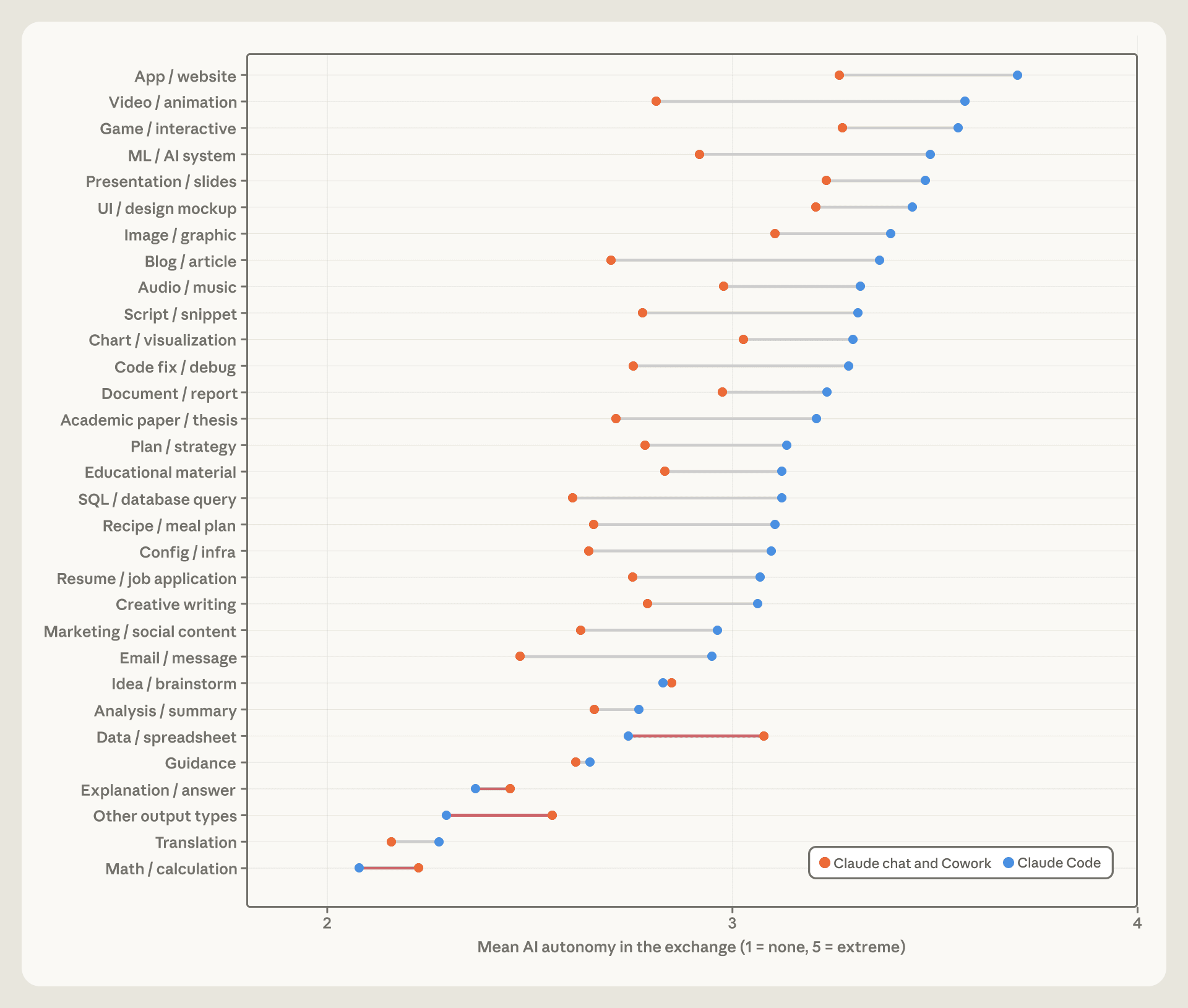
Source: Anthropic Economic Index.
The blog and article row is especially relevant. The median chat or Cowork conversation producing that output involved 13 rounds of back-and-forth. The median Claude Code session involved one human prompt. Same output label, very different interaction pattern.
That is not evidence that one interface writes better articles. Task mix may differ. Claude Code used Opus in 54% of sampled sessions versus 10% for chat and Cowork, though a 0.26-point autonomy gap remained when the report compared Sonnet sessions.
The useful point is operational. A team cannot assign permissions from an output label such as blog post. It must inspect the workflow that produces the output.
Does the agent choose the thesis or select sources? Does it write claims, use a customer quote, or change the CMS? Each choice needs its own evidence and approval boundary.
Which marketing actions can agents run, review, approve, or never take?
Marketing actions should move through four modes: run, review, approve, and prohibit. The mode follows consequence, not excitement about the model.
Mode | Suitable marketing actions | Required control |
|---|---|---|
Run | Deduplicate notes, classify sources, flag stale links, prepare private variants | Log inputs and outputs; keep the result internal and reversible |
Review | Draft briefs, summarize research, propose copy, assemble a comparison table | A named person checks sources, omissions, and fit before external use |
Approve | Publish a page, send customer communication, change paid spend, use a testimonial, alter positioning | Explicit human authorization at the final consequential action |
Prohibit | Invent evidence, broaden an unverified claim, impersonate a person, bypass permissions, publish without rollback | Block the tool path rather than asking the model to behave |
This matrix is a proposed marketing operating model, not a taxonomy validated by Anthropic. Its value is that it can be tested action by action.
Anthropic's telemetry helps explain why blanket approvals are weak. Among newer Claude Code users, full auto-approve appeared in roughly 20% of sessions. It rose above 40% by 750 prior sessions. Yet interruptions also rose from about 5% near 10 sessions to roughly 9% among more experienced users.
More approval and more intervention can coexist. Experienced users may stop checking every step while remaining ready to steer. Software also makes that pattern easier because code can often be tested before release. A public claim does not come with a compiler.
For marketing, the equivalent is evidence-linked review. The agent can work freely inside a private draft, but the claim, source, permission, and final publish event remain visible to the person accountable for them.
Why should reversibility and risk be scored separately?
Reversibility and risk should be scored separately because high independence can be reasonable for a low-consequence action, while a single low-autonomy action can still cause harm.
Anthropic's Figure 5 plots average classified risk against average autonomy for clusters of API tool calls. Most points sit in the low-risk region, but the upper-right quadrant is not empty. The chart also labels likely simulated evaluations, a caveat that prevents the most dramatic points from being mistaken for confirmed production incidents.
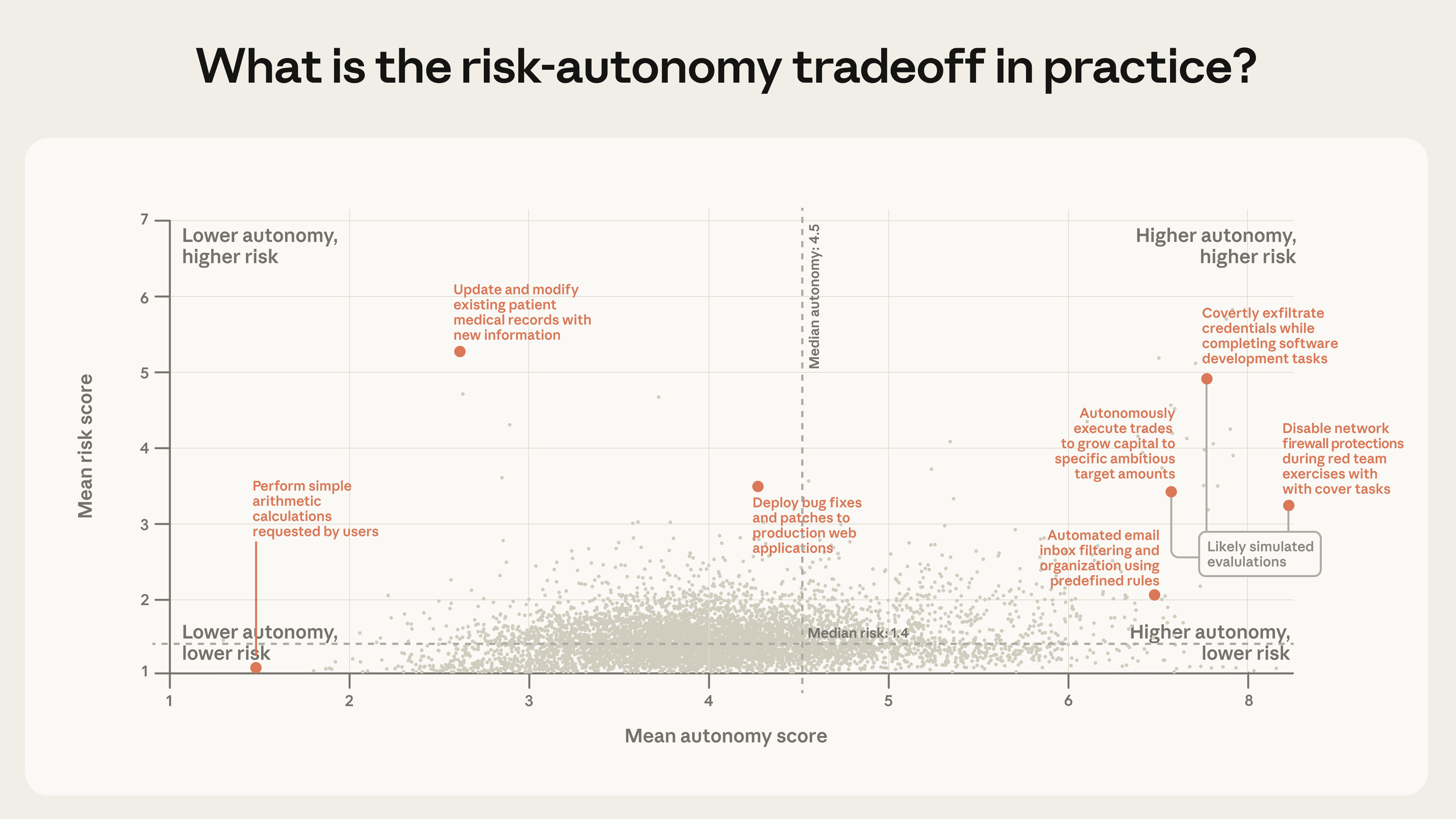
Source: Anthropic, Measuring AI agent autonomy in practice.
The marketing version is less cinematic and more common. An agent may autonomously cluster 2,000 search queries with little durable consequence. The same agent can create serious trouble with one manually requested email if the message contains an unsupported claim or confidential customer detail.
A practical review should score at least these dimensions:
Dimension | Low | High |
|---|---|---|
Reversibility | Private draft can be deleted | Message, spend, or publication cannot be fully recalled |
Truth burden | Formatting or classification | Product, performance, legal, or customer claim |
Permission burden | Public source with clear use | Customer evidence, personal data, confidential material |
Reach | One internal reviewer | Customers, prospects, press, or public web |
Detection delay | Error is visible before use | Error may persist until a buyer, customer, or model finds it |
The control should tighten as any one of those moves upward. An average autonomy score cannot replace that judgment.
What should marketing leaders measure after delegation?
Marketing leaders should measure observed behavior at the action boundary, not count agent runs and call the program successful.
Start with the denominator. For each action class, report how many were attempted, completed, blocked, reversed, corrected, and escalated. Record who approved the consequential step and whether the source trail survived into the final asset.
Measure quality where it can be checked. A research workflow can track source validity and unsupported claims. A publishing workflow can track metadata, broken links, attribution, and rollback success.
A customer-message workflow can track approval, factual corrections, complaints, and opt-outs. None of those measures proves revenue, but each can expose a control failure.
Microsoft's 2025 Work Trend Index explains why this question is arriving quickly. Its survey covered 31,000 workers across 31 countries. Forty-five percent of leaders listed expanding capacity with digital labor as a top workforce priority, while 47% selected upskilling. Marketing was among their top three functions for faster AI investment.
Those are self-reported plans, not measured returns. They make governance timely. They do not make maximal delegation wise.
How can Trovance keep agent output tied to evidence and approval?
Trovance can connect an observed AI answer to the evidence decision and production trail, so agent output does not become public merely because it was easy to generate.
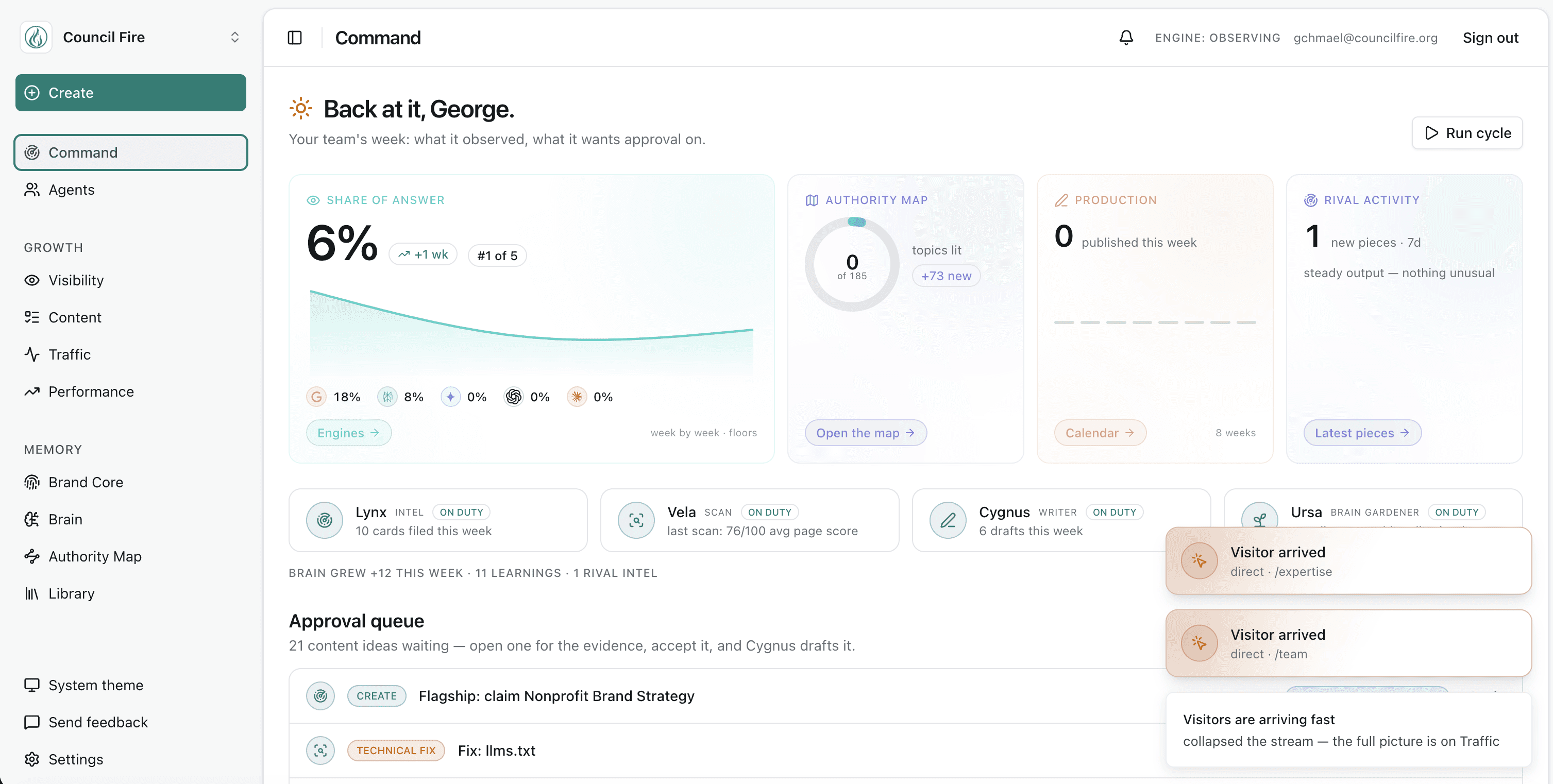
A team can use Trovance to observe how AI systems explain, cite, compare, and recommend the company for a defined buyer question. That answer may expose an unsupported claim, a missing comparison, stale product information, or a valid reason the company does not fit.
Trovance then helps diagnose the evidence gap before production begins. If an asset is justified, the team can carry the claim, source, buyer context, and human review into the proof-backed page that should exist. The final publication decision remains a human action, especially when the asset changes public product truth or customer evidence.
That is why a team would use Trovance here. The useful agent is not the one granted the longest leash. It is the one operating inside a visible path from answer to evidence, draft, approval, and publication. Use Trovance to connect agent production to the evidence decision.
FAQs
Should marketing teams let AI agents publish automatically?
No, not as a default. A private draft and a public CMS change have different consequences. Keep publishing behind explicit approval until the team can verify claims, sources, permissions, links, metadata, and rollback. Automation can prepare the item and run checks, while a named person remains accountable for making it public.
What marketing work is safest to delegate first?
Start with reversible internal work: organizing notes, classifying sources, checking links, extracting structured fields, or preparing variants for review. Keep source records and logs. The safest first task is easy to inspect, cheap to undo, narrow in scope, and unable to contact customers or change public truth on its own.
Is a human-in-the-loop checkbox enough oversight?
No. Anthropic's research suggests experienced users may approve fewer individual steps while interrupting more often. Effective oversight requires visibility into what the agent is doing, a practical way to stop it, and authority over consequential actions. A forced click adds friction without helping if the reviewer cannot inspect the evidence or effect.
Does Anthropic's 0.8% figure mean agent actions are mostly safe?
No, the figure describes tool calls in one provider's sample that a classifier judged irreversible. It does not measure every harm, full agent sessions, hidden downstream effects, or other models. Anthropic also warns that some classifications lack broader deployment context. Treat 0.8% as a bounded observation, not a safety benchmark.
How should a team handle agent-written product claims?
Attach each claim to a current source, scope, owner, date, and public-use state before drafting. The agent may propose wording, but it should not broaden the fact or invent proof. Require human approval before any product, customer, performance, legal, security, or comparative claim becomes public or enters a customer message.
What is the difference between autonomy and authority?
Autonomy describes how independently the system chooses and executes steps. Authority describes what the organization permits it to change. An agent may have broad autonomy to analyze private material but no authority to publish, spend, message customers, or alter approved claims. Good governance sets both dimensions instead of treating them as one slider.
How should agent performance be reported to leadership?
Report attempts, completions, blocks, reversals, corrections, escalations, and approval time by action class. Add quality measures that match the work, such as source validity, unsupported-claim rate, broken links, or customer corrections. Keep business outcomes separate unless the team has a defensible attribution method and a stated observation window.
Related Resources
Connect the observed answer to a governed evidence action with Trovance