10 min
Zach Chmael
In This Article
A controlled study across 11 models found staged retrieval beat ideal static evidence, showing why complex answers need evidence in sequence.
Updated
TL;DR
🧪 The benchmark tested 1,186 chemistry questions across 11 models.
📚 Mean accuracy rose from 37.16% without context to 69.14% with complete oracle evidence.
🔁 Iterative retrieval reached 80.89% mean accuracy, above every model's static-evidence result.
🧩 A missing evidence hop cut average accuracy from 77.9% to 49.2%.
⚠️ Even with every required hop retrieved, 58.6% of errors were composition failures.
Why More Evidence Can Still Produce Worse AI Answers
Complete evidence is not the same as usable evidence.
A controlled study gave 11 language models every supporting passage needed to answer 1,186 multi-hop chemistry questions. Mean accuracy reached 69.14%. When a controller retrieved evidence in steps, updated a partial answer, and decided what to search next, accuracy rose to 80.89%.
The static evidence was close to ideal. It contained the exact paragraphs from which each question had been built, with no unrelated documents added. Yet every tested model did better in the iterative condition.
The result does not prove a web-writing tactic. It does show why dropping every source into one brief or context window can leave the hardest problem untouched: the system still has to find each dependency at the right time and combine it without drifting.
What did the study actually test?
The study tested whether synchronized retrieval and reasoning could beat a static context containing all required evidence.
Astaraki and colleagues published the work in Transactions on Machine Learning Research in May 2026. The benchmark covered short-answer chemistry questions that required one to four evidence hops. Its source material came from ChemRxiv, PubChem, and Wikipedia, and the dataset exposed the intermediate entities needed to audit each reasoning path.
The researchers ran three main conditions:
Condition | Evidence available | What it isolates |
|---|---|---|
No Context | None beyond model memory | What the model already knows |
Gold Context | Every oracle paragraph supplied at once | Static evidence use and synthesis |
Iterative RAG | Up to five retrieve-reason steps | Evidence search, sequencing, stopping, and synthesis |
Gold Context was a demanding baseline. Each supporting passage averaged 188 tokens with a 56.26-token standard deviation. Even a four-hop question supplied only about 750 tokens of oracle evidence.
This was not a bloated context window full of random search results. It was the minimum correct evidence set by construction.
The iterative controller had a different job. Its first search returned the top 10 passages. At each later step, the model produced a partial answer, decided whether evidence was missing, and either issued a narrower query or finalized. The process stopped after no more than five retrieval actions.
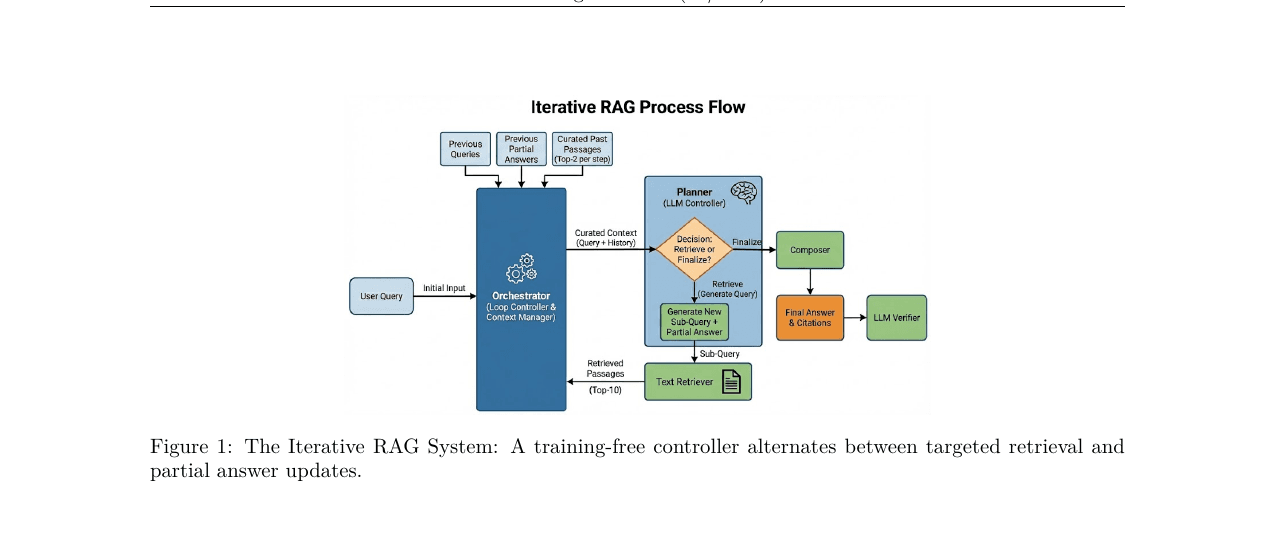
Source: Astaraki et al., TMLR 2026.
I checked the paper's system diagram against the methods section because the phrase "iterative RAG" can hide a dozen different designs. Here it means a specific loop: current evidence informs a partial answer, that state informs the next query, and a planner decides whether to continue.
Why did staged retrieval beat complete static evidence?
Staged retrieval beat static evidence because it aligned each search with the model's current reasoning state instead of requiring one-pass composition.
Across the 11 models, mean accuracy moved from 37.16% without context to 69.14% with Gold Context and 80.89% with Iterative RAG. The largest Gold-to-Iterative gain was 25.64 percentage points for GPT-4o. The smallest was 2.70 points for Mistral Large 2402, so the benefit was consistent but hardly uniform.
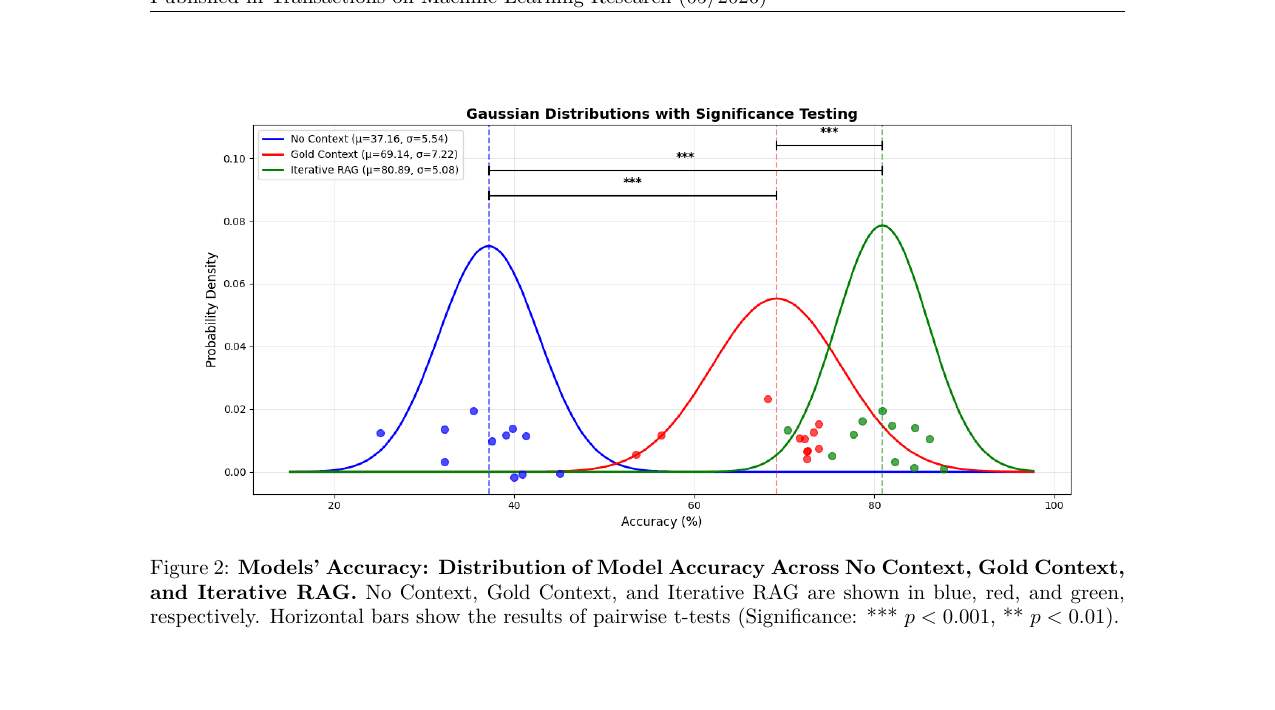
Source: Astaraki et al., TMLR 2026.
Figure 2 plots one accuracy point per model in each condition. The distributions make two steps visible: supplying correct evidence helped a lot, then coordinating retrieval with reasoning helped again. The figure supports a benchmark comparison across 11 systems. It is not a forecast for a marketing page or live answer engine.
The authors also tested whether the iterative condition simply gave models more room to think. In a Gold+CoT ablation, three models received the same oracle evidence plus explicit step-by-step reasoning, with no new retrieval. GPT-4o improved from 56.32% to 78.08%, but iterative retrieval still reached 81.96%. Claude 3.7 Sonnet Standard used 909.96 output tokens in Gold+CoT versus 714.73 iteratively, yet scored 81.45% instead of 84.49%.
I went to that ablation before accepting the paper's mechanism. More computation explained part of the gain, but not all of it. How the work was organized still mattered.
Does more evidence make an AI answer worse?
More evidence can introduce new failure paths, but this study does not show that evidence volume is generally harmful.
The Gold Context condition improved every model over no context. The paper's sharper finding is that complete evidence supplied simultaneously did not set the performance ceiling. For GPT-4o, 27.8% of questions were solved only by the iterative condition. Llama 3.3 70B had a 25.6% iterative-exclusive share.
Iteration also caused regressions. Mistral unlocked 13.8% of questions that static evidence missed, while losing about 11% that Gold Context had answered. Across models, retrieval suppressed an average of 6.7% of answers that had been correct without context. Mistral's suppression rate reached 14.1%; Claude 3.7 Sonnet's was 2.7%.
That is why the title says "can still." The lesson is not to starve a model of sources. It is to stop treating source completeness as a substitute for sequence, discrimination, and final-claim review.
Where did iterative retrieval still fail?
Iterative retrieval still failed when it missed a required hop, stopped at the wrong time, latched onto a distractor, or mishandled evidence it had already found.
The coverage result is the cleanest. When the system retrieved something for every required hop, average accuracy was 77.9%. With at least one missing hop, it fell to 49.2%, a 28.7-point penalty. At low sentence-level support, moving from low to high hop coverage raised accuracy from 30.6% to 66.7%.
Then came synthesis. Under the paper's diagnostic rule, 87.3% of incorrect answers had retrieved the final answer evidence but used it incorrectly. After restricting the analysis to runs with every oracle hop retrieved, composition failures still represented 58.6% of errors.
A wrong early path could be worse. When the controller repeatedly followed a chemically similar but irrelevant entity, accuracy dropped from 84.8% without a distractor latch to 30.9% with one. The iterative process also cost more: the authors report about three times as many output tokens as No Context on average.
Failure | What happened | Content-engineering analogue |
|---|---|---|
Coverage gap | One required hop never appeared | A claim depends on a fact the source set does not contain |
Distractor latch | A near-match redirected later searches | Similar terminology pulls the draft toward the wrong product or use case |
Composition failure | Correct evidence appeared but the answer misused it | The draft strips scope, merges claims, or picks the wrong entity |
Bad stopping | The system finalized too early or kept searching | Review ends before proof is sufficient or continues after the answer is stable |
These analogues are operating hypotheses, not outcomes the paper measured in marketing teams.
What should content teams do with this result?
Content teams should organize evidence around claim dependencies and test the final synthesis, rather than measuring source quality by document count.
Start with one consequential buyer question. Break it into the facts that must be true for an accurate answer: identity, product behavior, comparison boundary, proof, freshness, and fit. Some questions need one fact. Others need a chain, such as identifying the relevant product, checking an integration, verifying the plan boundary, and comparing the result against a buyer constraint.
Then keep three states separate:
State | Review question |
|---|---|
Coverage | Does the source set contain every fact the answer requires? |
Sequence | Can each intermediate entity lead to the next needed fact? |
Synthesis | Does the final answer preserve scope, attribution, and fit? |
This does not require turning every page into a knowledge graph diagram. It does require a brief that names the claims, sources, dependencies, and blocked conclusions. If the source set cannot support the comparison, the right production decision may be to gather proof, clarify the product, seek outside validation, or publish nothing.
The paper's unanswered-by-all-models count fell from 356 without context to 73 with Gold Context and 21 with Iterative RAG. That is a useful reason to test the process. It is not permission to claim that an iterative workflow will improve citations or revenue.

How can Trovance diagnose a multi-step evidence gap?
Trovance can keep the observed AI answer attached to the evidence decision, so a team can see whether the failure is missing coverage, bad synthesis, weak comparison, or legitimate bad fit.
A team begins with the buyer question and observes how AI systems explain, cite, compare, and recommend the company. A missing mention alone does not reveal the fix. The source may be inaccessible.
The decisive product fact may not exist publicly. The answer may retrieve the right page and still merge two plan boundaries. Or the company may not fit the request.
Trovance diagnoses that evidence gap before production, then helps the team produce and publish the proof-backed asset that should exist. For this problem, the value is a traceable path from question to answer, source, missing dependency, approved claim, and published asset. Trovance does not promise that a model will cite or recommend the result.
Use Trovance to trace an AI answer back to the evidence it needs.
FAQs
What is Gold Context in a RAG evaluation?
Gold Context is an idealized static condition where the model receives every supporting passage required to answer a question. In this study, those were the same oracle paragraphs used to construct each chemistry question. It removes retrieval misses, letting researchers inspect whether the model can reason over complete evidence supplied at once.
Did iterative RAG beat Gold Context for every model?
Yes, all 11 tested models posted higher accuracy with Iterative RAG than with Gold Context on this benchmark. The size varied sharply, from 2.70 percentage points for Mistral Large 2402 to 25.64 points for GPT-4o. That consistency applies to this chemistry dataset and controller, not every RAG system.
Does the study prove that long context windows are bad?
No. Gold Context substantially improved accuracy over the no-context condition, and its oracle evidence was fairly short. The study shows that complete static evidence did not match staged retrieval on multi-hop chemistry questions. It does not compare context-window sizes or prove that long contexts generally reduce answer quality.
Why can complete evidence still produce a wrong answer?
The model may fail to connect intermediate facts, choose the wrong entity, lose an earlier anchor, or stop before the reasoning chain is complete. In the paper, composition failures remained common even when every required hop was retrieved. Finding the facts and combining them correctly were separate problems.
Should a content brief include fewer sources?
Not by default. A brief should include enough direct evidence to support every approved claim and no unsupported filler. The stronger move is to map each source to a claim and note the dependencies between claims. Source count alone cannot tell you whether the draft has complete coverage or correct synthesis.
Can this result be applied to AI search content?
Only as a bounded design principle. The study tested chemistry questions in a controlled RAG system, not live AI search or buyer behavior. Content teams can use its coverage-sequence-synthesis distinction to design an experiment, but they should not present the benchmark's accuracy gains as expected citation, traffic, or revenue lift.
How should a team test a complex buyer question?
Preserve the exact question, model, date, raw answer, cited sources, and repeated runs. List every fact the answer requires, then mark which are present, missing, stale, or misused. Make one justified evidence change, rerun the same protocol, and report mentions, citations, recommendations, and business outcomes separately.
Related Resources
Trace an AI answer back to the evidence decision with Trovance