8 min
Zach Chmael
In This Article
A useful comparison page names the decision, uses current evidence, and admits where each option fits. Use this audit before you publish.
Updated
TL;DR
⚖️ The FTC policy has governed truthful comparative advertising since 1979.
📖 Its definition appears in section 14.15 and centers measurable attributes or price.
🧭 Google describes 3 kinds of review publishers, including merchants who guide buyers between competing products.
🧾 Google's list contains 14 review practices, including evidence, measurements, alternatives, and drawbacks.
🛑 The right output can be 1 honest hold decision when the basis of comparison is unclear or unsupported.
How to Build a Competitor Comparison Page That Can Survive Scrutiny
Publish a competitor comparison page only when buyers really face the choice and you can support the criteria with current evidence. If the page needs selective screenshots, vague superlatives, or a fake mismatch to make your company win, hold it.
A credible page does more than say how two products differ. It tells a defined buyer which option fits a defined job, links each factual claim to evidence, admits where the alternative is stronger, and records when the comparison was checked.
The legal-policy floor is older than AI search.
The Federal Trade Commission's comparative-advertising statement was published in 1979, appears in 16 CFR 14.15, and defines a comparison around objectively measurable attributes or price. Google's current review guidance adds a practical production test through 14 recommendations. Neither source promises rankings, citations, traffic, or sales.
What makes a competitor comparison page worth publishing?
A comparison page is worth publishing when it resolves a real choice with facts the reader can inspect.
Start with the sales call, evaluation thread, support ticket, or AI answer where the choice appeared. Record the buyer, job, constraints, named alternatives, and decision criteria before drafting. That keeps the page attached to an actual decision instead of a keyword pattern.
The FTC definition is useful here. It describes comparative advertising as a comparison of alternative brands on objectively measurable attributes or price, with the other brand identified by name, illustration, or distinctive information. Its policy encourages naming competitors while requiring clarity and disclosure where needed to avoid deception.
That does not mean every comparison belongs on the website. A page should pass these five questions:
Do qualified buyers actually compare these options?
Can the company state the evaluation criteria before deciding who wins?
Does each factual claim have current, public support?
Can the page say where the competitor fits better?
Can an owner review it when products or pricing change?
If the answer to one of those 5 questions is no, stop and fix the evidence before publishing.
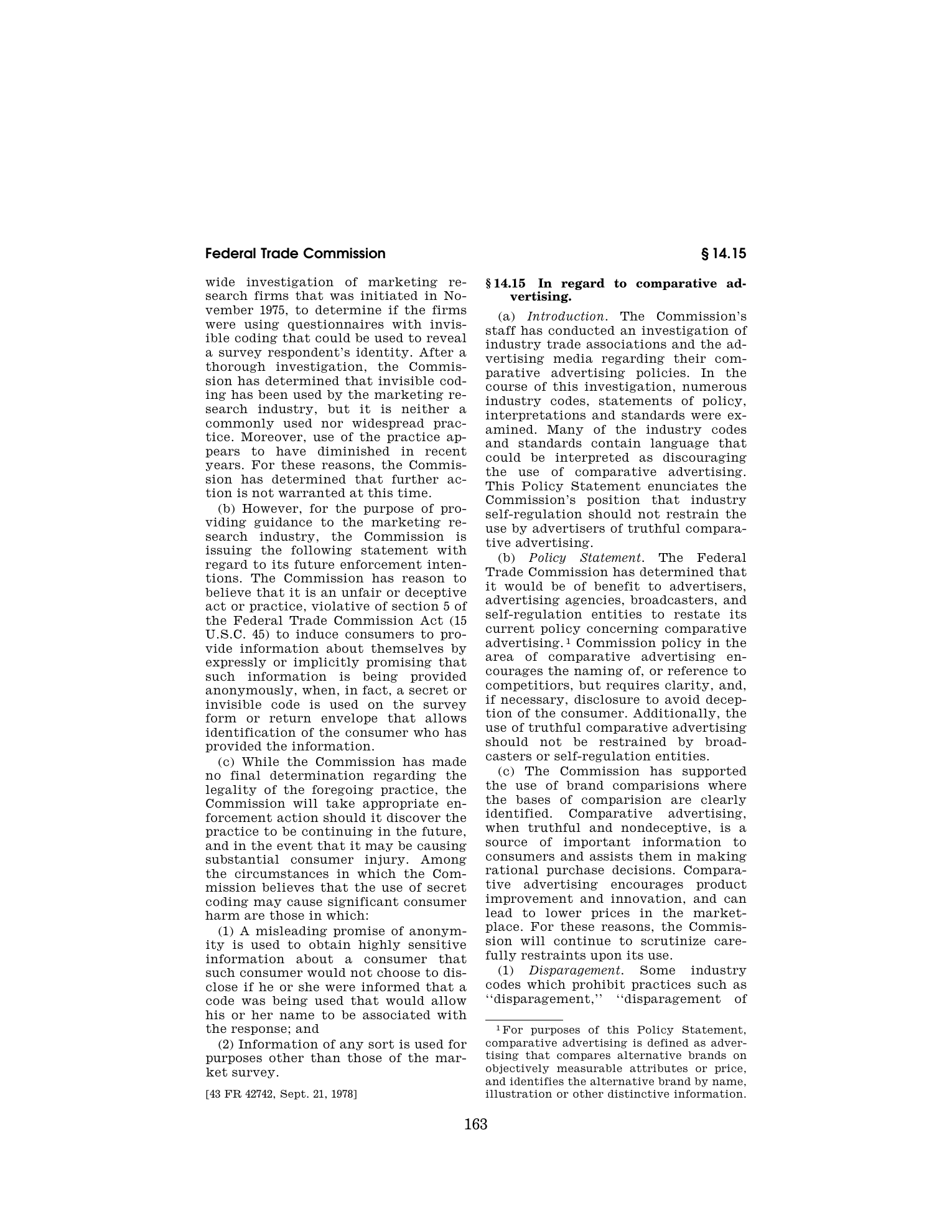
Source: Federal Trade Commission via GovInfo.
The official policy supports brand comparisons when the basis is clearly identified. It also says truthful, nondeceptive comparisons can help consumers make rational purchase decisions. That is a policy rationale, not proof that your page will convert.
What evidence should the page preserve?
The page should preserve the source, date, scope, method, and owner for every claim that can affect the decision.
Google's review guidance gives marketers a useful checklist. It asks reviewers to provide evidence, use quantitative measurements, explain differentiation, cover comparable options, discuss benefits and drawbacks from original research, and identify important decision factors. It also asks for first-hand support when something is called the best for a purpose.
I counted 14 recommendations on the current page. Google says to focus on quality and originality rather than length, so the list is not a word-count formula. It is also not evidence that completing 14 fields improves search performance.

Source: Google Search Central.
For an owned B2B comparison, use a claim record like this:
Field | What to preserve | Hold condition |
|---|---|---|
Buyer and job | Who is choosing and what they need to accomplish | The page tries to cover everyone |
Criterion | The factor used to compare the options | It was chosen after seeing the winner |
Claim | Exact public statement | It is still an adjective or impression |
Source | Product document, test artifact, contract, or approved proof | The trail ends at another marketing page |
Effective date | When the source was checked | The fact can change but has no date |
Method | Documented, tested, observed, or inferred | Inference is written as observed fact |
Scope | Plan, region, account type, use case, or limitation | A narrow fact becomes a universal claim |
Owner | Person accountable for truth and public use | Nobody can approve or correct it |
Review trigger | Release, pricing change, integration change, or set date | The page has no maintenance path |
I downloaded the current 2025 CFR edition and checked both printed pages 163 and 164 of the FTC section.
The continuation matters: the first page states the truth and clarity boundary; the second explains that comparison claims face the same false-or-deceptive question as other advertising.
How should you choose fair comparison criteria?
Choose criteria from the buyer's decision before you evaluate the products, then explain why each criterion belongs.
A good criterion changes the choice. Deployment model may matter to a regulated buyer. Native publishing may matter to a team with one marketer. A logo count, feature tally, or broad AI-powered label usually tells the reader less unless the underlying capability and fit are defined.
Use this sequence:
Collect the repeated buyer questions from calls, support, search language, and product evaluations.
Group them into decision factors such as fit, workflow, evidence, control, cost, or implementation.
Define how each factor will be checked before opening the product pages.
Record a source and date for both sides.
Mark each result as documented, directly tested, observed in an answer, inferred, or unknown.
Let an accountable reviewer approve the public wording.
Google's list makes the same practical move in several ways. It asks publishers to cover comparable things, explain which option fits certain circumstances, and focus on important decision factors. It also asks for quantitative measurements, but a number is useful only when the method and denominator are visible.
Do not turn absence of evidence into a competitor failure. We could not verify this in the public documentation checked on 5 August 2026 is different from the product does not support it.
When should you name the competitor?
Name the competitor when it is a genuine alternative and the page can compare the options clearly without impersonating independent editorial judgment.
An owned Trovance vs. X page is advocacy. Say who wrote it, which sources were used, what was tested, and when the review occurred. Link to the competitor's own documentation for its capabilities instead of citing your summary as proof of their product.
The FTC policy explicitly encourages naming or referring to competitors. It also requires clarity and supports comparisons whose basis is clearly identified. Permission to compare is not permission to invent, omit a material condition, or freeze an old weakness in time.
Do not name a company merely because its brand has search demand. If buyers do not choose between the products, write the category or use-case page instead. If the comparison depends on confidential sales material, an old demo, or a plan you cannot access, hold the claim until you have a source you can defend publicly.
Which comparison-page route fits your situation?
The right action may be a new page, an evidence project, a product clarification, a consolidation, or no publication.
If this describes you | Check this | Take this action |
|---|---|---|
Buyers repeatedly compare two named products | Current first-party facts, shared criteria, and honest fit boundaries | Publish an owned canonical comparison page |
Buyers need the comparison, but several claims are unverified | Product docs, approved proof, direct tests, and source dates | Build the evidence packet first; hold the draft |
The issue is unclear positioning rather than missing comparison evidence | Homepage, category language, sales calls, and AI explanations | Clarify the positioning before creating a versus page |
The competitor is not a real alternative for the buyer or job | Lost deals, evaluation notes, and support questions | Do not force the comparison; answer the real use case |
Several old pages repeat conflicting facts | Canonical source, traffic, links, and product-change history | Consolidate and redirect rather than add another variant |
A regulated, legal, security, or contractual claim is unresolved | Accountable expert review and public-use permission | Hold publication until the claim is approved |
Keep the full answer on your own site. A LinkedIn post, community answer, or short video can distribute one finding, but social engagement should not become the access gate for the criteria, sources, or checklist.
The owned page is the canonical evidence record. Social is distribution only.
What can a comparison page actually prove?
A comparison page can document the evidence and judgment behind a choice. It cannot prove that an AI system will retrieve, cite, rank, or recommend the page, and it cannot prove that any later sale came from the asset.
Keep four states separate:
State | What you can say | What remains outside the page |
|---|---|---|
Observed | A model produced a dated answer or citation under a preserved prompt and run | Why the model produced it |
Documented | A current primary source states a product fact | Whether every account behaves the same way |
Inferred | The available evidence suggests a gap or likely buyer concern | Causality and complete market coverage |
Human judgment | A reviewer decides which option fits a stated buyer and risk profile | A universal recommendation |
Business impact needs external analytics. Track impressions, visits, CTA clicks, product starts, qualified accounts, opportunities, and revenue with separate denominators. A public view count or engagement spike is not acquisition proof without a cohort, attribution method, and observation window.
The FTC source is a policy boundary. Google's source is content guidance. Neither source reports a sample showing that comparison pages create AI citations or revenue. That missing result stays missing.
How can Trovance turn a comparison gap into a credible page?
Trovance can connect an observed comparison problem to the evidence decision and resulting asset without treating every weak answer as a request for more content.
A team begins with the buyer question and observes how AI systems explain, cite, compare, and recommend the company. The result may show a missing capability fact, a stale source, an unfair category match, weak third-party proof, unclear positioning, or legitimate bad fit. A score alone cannot tell the team which one happened.
Trovance helps diagnose that gap, decide whether a comparison page is justified, and carry approved claims and sources into the proof-backed asset that should exist. It can help produce and publish the page while human reviewers retain responsibility for product truth, competitor accuracy, legal risk, taste, and the final publication decision.
That is why a team would use Trovance here: to move from AI keeps comparing us incorrectly to a reviewable decision and maintained evidence record.
Scan your AI visibility, then check whether the gap calls for a comparison page at all.
FAQs
Should every B2B company publish competitor comparison pages?
No. Publish one when qualified buyers really compare the products and the company can maintain current evidence for both sides. If the alternative is not a genuine choice, the page becomes search bait. A category explainer, use-case page, product clarification, or no new content may answer the buyer's actual problem better.
Is it legal to name a competitor on a comparison page?
The FTC policy encourages truthful comparative advertising and the naming of competitors, with clarity and disclosure where needed to avoid deception. That is a general US policy boundary, not legal advice for a specific claim. Trademark, regulated-industry, contractual, and jurisdictional questions still need qualified review before publication.
What sources should support a product comparison?
Prefer current first-party product documentation, pricing pages, release notes, public contracts, approved proof, and direct test artifacts. Record the access date, plan, region, and method. Use third-party analysis for context rather than as a substitute for product truth. If a capability cannot be verified publicly, label it unknown instead of absent.
How often should a competitor comparison page be updated?
Set review triggers from the claims, not a universal calendar. Pricing, packaging, integrations, security, and product availability may need event-based checks. Stable category definitions may change less often. Assign an owner, preserve the last verified date, and reopen the page whenever a source, product release, or buyer criterion changes.
Should a comparison page declare a winner?
Only when the winner is tied to a named buyer, job, criteria, and current evidence. Best for a lean team that needs X is more useful than best overall when the trade-off is real. Google asks reviewers to explain any best label with first-hand support. Unknowns and loss conditions should remain visible.
Can a competitor comparison page improve AI visibility?
It may create clearer public evidence for a comparison question, but the sources here do not prove a visibility effect. AI systems vary by prompt, engine, time, and retrieval path. Measure dated answers and citations separately, then check web and business analytics. Do not turn one before-and-after screenshot into a causal result.
What should we do if the competitor's product facts are unclear?
Link the public source you checked, state the access date, and mark the claim unknown or unverified. Ask the competitor or locate stronger documentation if the fact is material. Do not infer a missing capability from a missing page. If the comparison cannot remain fair without the claim, hold publication.
Related Resources
Turn a comparison gap into a governed evidence decision with Trovance