11 min
Zach Chmael
In This Article
Agent readiness proves that machines can access and use your site. It does not prove AI assistants cite, compare, or recommend your company.
Updated
TL;DR
🌐 Cloudflare scanned 200,000 high-traffic domains for its agent-readiness dataset.
🤖 A robots.txt file appeared on 78% of scanned sites, but presence alone did not establish recommendation visibility.
🧾 Only 4% declared AI-use preferences through Content Signals.
📝 Just 3.9% passed Cloudflare's Markdown content-negotiation check.
🔀 Cloudflare separates 2 questions: can agents use the site, and is the company recommended?
An Agent-Ready Website Can Still Miss the AI Shortlist
Making your website easier for AI agents to access is useful infrastructure work. It does not prove that an assistant cites your pages, understands your offer, compares you fairly, or recommends you.
Cloudflare's own August 2026 launch draws this line. Its Agent Readiness diagnostics check whether machines can discover and use a site. Its separate AEO view checks what selected assistants say about companies in a category. Treat those as two different jobs, with two different success measures.
That distinction keeps a clean technical project from turning into an unsupported growth promise.
What does an agent-ready score actually prove?
An agent-ready score proves that a defined set of machine-access and interaction checks passed at a given time. It does not prove market understanding.
Cloudflare built its April 2026 dataset by taking the 200,000 most visited domains, excluding categories such as redirects, ad servers, and tunneling services, then scanning the remaining businesses, publishers, and platforms. That is a large implementation survey. It is not a study of purchase behavior or recommendation outcomes.
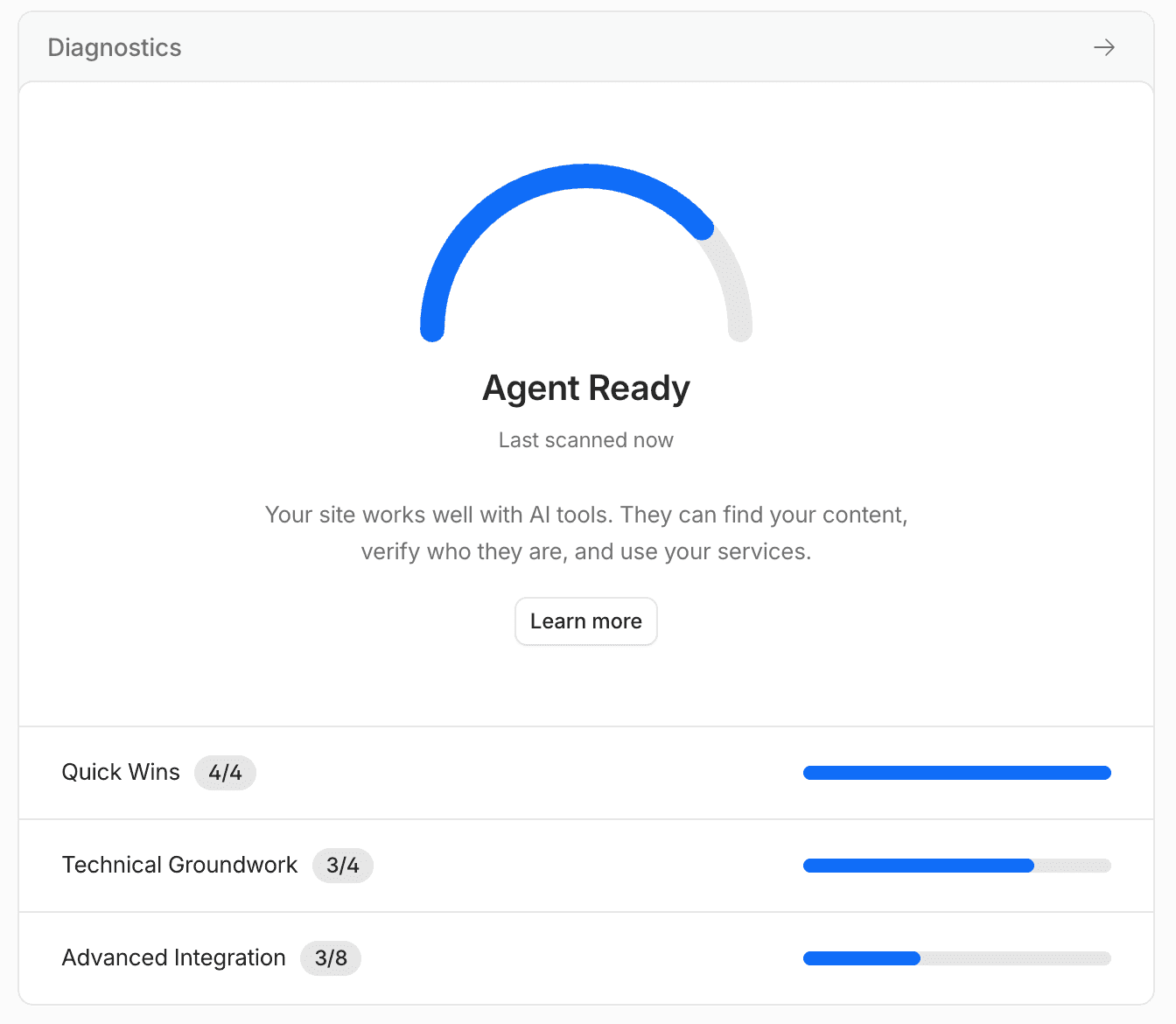
The scan evaluates 4 dimensions: discoverability, content delivery, bot access control, and capabilities. The current dashboard groups checks into 4 effort levels: quick wins, technical groundwork, advanced integration, and commerce. Individual checks return 3 states: pass, fail, or neutral.
Source: Cloudflare.
That screenshot is useful because it shows exactly what the score is: an implementation checklist. A site can have a readable robots.txt, a current sitemap, clean Markdown, and published tool metadata while remaining a poor fit for the buyer's request. It can also have weak proof or muddled positioning.
Cloudflare found robots.txt on 78% of sites, Content Signals on 4%, and Markdown content negotiation on 3.9%. MCP Server Cards and API Catalogs appeared together on fewer than 15 sites. Those figures measure standards adoption inside Cloudflare's filtered scan. They do not show that adopters earned more citations or recommendations.
Why can a technically ready site still miss the shortlist?
A technically ready site can still miss because access, understanding, evidence, comparison, and fit are separate stages.
Think of the path this way:
Stage | Question | Evidence you need | What a pass cannot prove |
|---|---|---|---|
Access | Can the machine request the page? | Request logs, status code, crawler policy | That the answer used the page |
Discovery | Can it find the relevant URL? | Sitemap, links, index observations | That the page matches the buyer's job |
Interpretation | Can it extract the facts correctly? | Preserved answer, quoted claim, cited source | That the facts are persuasive or complete |
Comparison | Can it place the company against alternatives? | Criteria, limitations, current proof | That the company belongs on every shortlist |
Recommendation | Does it name the company for this buyer and constraint set? | Repeated prompts, models, dates, raw answers | That the recommendation caused a purchase |
A 200 response proves access. A citation proves source attribution under the observed conditions. A mention shows that the model named the company. None of those events automatically becomes a shortlist, qualified account, or sale.
Cloudflare's launch makes the same separation operationally. Diagnostics tests whether a machine can use the site. AEO currently probes 2 named assistants, Anthropic's Claude and OpenAI's GPT, with likely category prompts.
The product announcement says those prompts cover 3 jobs: recommendations, product comparisons, and general advice.
The announcement does not publish the number of prompts per category, exact model versions, repeated-run count, category inclusion rule, observation window, or validation set. Without those details, its AEO numbers are product outputs, not public benchmarks for how often brands should appear.
Which agent-readiness fixes should you prioritize?
Prioritize fixes that remove a verified access or interpretation failure for an important buyer question. Do not implement every emerging standard because a score can turn greener.
Use this route table:
If this describes you | Check this | Take this action |
|---|---|---|
Important pages return access errors to a bot you intend to allow | Request logs, robots rules, response status, authentication | Fix the exact policy or delivery failure, then verify the request again |
The right page exists but machines receive noisy or incomplete content | Rendered response, text extraction, headings, source links | Repair the canonical page or its machine-readable representation without replacing the human page with bot copy |
Assistants cite stale facts | Source date, product truth, canonical owner, update path | Update the owned source and preserve the correction date |
Assistants describe you accurately but do not recommend you | Buyer constraints, fit, alternatives, public proof | Decide whether the gap is comparison evidence, reputation, positioning, or legitimate bad fit |
The scan fails an emerging protocol you do not use | Actual buyer workflow and supported agent behavior | Defer it; a failed optional check is not automatically a business problem |
The site passes readiness checks but answers remain wrong | Raw answer, citation trail, unsupported claim | Diagnose the evidence gap before prescribing more infrastructure |
The practical rule is boring and good: fix observed failures from the bottom up. Access comes before interpretation. Interpretation comes before recommendation. Business attribution comes last and needs external analytics.
I read Cloudflare's April methodology and August launch before building this table. The first source reports adoption across a filtered domain scan. The second describes a product workflow. Neither source runs a controlled test showing that a readiness fix increases recommendation rate.
How should you measure AI recommendation visibility?
Measure recommendation visibility with preserved prompts, raw answers, citations, comparison context, dates, and repeated runs. Keep it separate from server access telemetry.
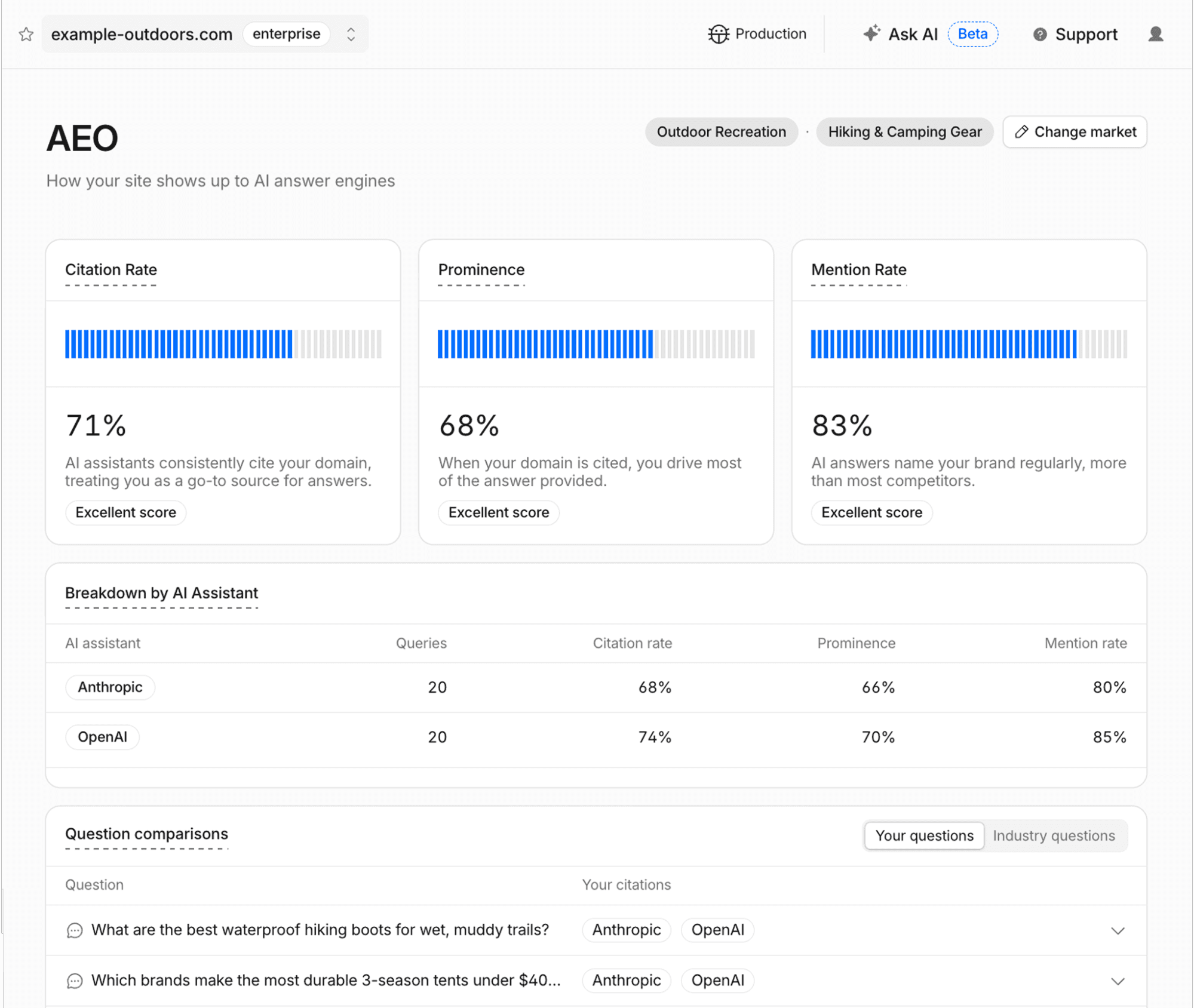
Cloudflare's AEO screenshot reports 3 headline percentages in its example: Citation Rate, Prominence, and Mention Rate. The article also defines Share of Voice as a 4th metric. These are useful measurement classes, but their meaning depends on the prompt panel, competitors, models, category boundary, and scoring method.
Source: Cloudflare.
The example dashboard shows 71% Citation Rate, 68% Prominence, and 83% Mention Rate. Those are interface examples, not published market averages or expected results. Do not use them as a target without the underlying prompt denominator and category definition.
The launch says Cloudflare precomputes 1 panel per category and reuses that baseline across accounts in the category. It combines answer text with cited sources, uses model-assisted judgment where needed, and also applies exact-text analysis. That explains the mechanism at a high level. It does not provide enough public detail to reproduce the score.
For your own measurement, preserve this minimum record:
Field | Why it matters |
|---|---|
Buyer question and constraints | Defines the decision being tested |
Assistant, model or surface, and date | Bounds the observation |
Exact prompt sequence | Keeps single-turn and conversational tests distinct |
Raw answer and cited URLs | Separates mention, citation, and recommendation |
Repeated-run count | Exposes answer variance |
Competitor and fit rule | Prevents share metrics from hiding a bad comparison set |
Human review state | Records whether the interpretation and public claim were approved |
Cloudflare also separates crawl and referral data by operator and calls out 2 error classes, 403 blocks and 404 dead links. That is the right instinct. Crawl, referral, answer presence, and recommendation should remain different measures even when they appear in one dashboard.
What can you claim after making a change?
You can claim the exact technical or answer change you observed, under the conditions you recorded. You cannot claim a ranking, recommendation, acquisition, or revenue effect that your evidence did not measure.
Use a simple evidence ladder:
Observation | Safe claim | Blocked claim |
|---|---|---|
A previously blocked request now returns | The selected client can access this URL under the tested policy | AI assistants will now cite the page |
The scan passes a sitemap or Markdown check | The tested discovery or content-delivery condition passed | The site is now more likely to be recommended |
A repeated prompt set begins citing the corrected page | Citation behavior changed in this observed panel | The page change caused the result without a stronger design |
The company appears more often in category answers | Mention or recommendation presence changed in this prompt set | Buyers saw the answers or entered the pipeline |
Qualified accounts improve in a declared cohort | The business outcome changed for that cohort | The readiness work caused it without attribution controls |
Public view counts, crawl volume, and dashboard percentages are not acquisition proof. A citation is not a recommendation. A recommendation is not a shortlist. A shortlist is not revenue.
I also inspected the original Cloudflare screenshots with their surrounding launch copy. The readiness image is a grouped implementation score. The AEO image is a separate example measurement surface. Keeping them apart is the point of this article, not a minor caveat.

How can Trovance tell whether agent readiness is the real gap?
Trovance helps a team begin with what AI systems actually say, then work backward to the missing evidence or access condition instead of treating every failed check as a content brief.
The platform can observe how AI systems explain, cite, compare, and recommend a company, preserve the answer and source trail, and diagnose whether the gap is access, stale proof, weak comparison language, unclear positioning, outside reputation, or legitimate bad fit. A score alone cannot make that decision.
When the evidence supports a public asset, Trovance helps produce and publish the proof-backed page that should exist. It does not promise that a sitemap, Markdown response, new page, or higher readiness score will cause a citation, recommendation, or sale.
Scan your AI visibility to see whether the next step is a technical fix, stronger evidence, clearer positioning, or no new content at all.
FAQs
What does agent-ready mean for a website?
Agent-ready means a site passes a declared set of checks for machine discovery, access, content delivery, authentication, or interaction. The definition depends on the scoring system. It does not mean an AI assistant understands the company correctly, considers it a good fit, or recommends it for a buyer's request.
Does a higher agent-readiness score improve AI recommendations?
Cloudflare's public sources do not establish that causal link. They document standards adoption, readiness checks, and a separate recommendation-measurement product. A higher score may remove technical friction, but recommendation also depends on the prompt, evidence, category, competitors, model behavior, and whether the company actually fits the request.
Should every website serve Markdown to AI agents?
No universal evidence says every site should. Cloudflare found that 3.9% of its filtered 200,000-domain scan passed Markdown content negotiation, which measures adoption rather than outcome. Use Markdown when a verified client needs a cleaner representation and you can keep it consistent with the canonical human page.
Is a crawl the same as a citation?
A crawl only records that a client requested a resource. A citation shows that an answer attributed information to a source under observed conditions. The system may use another index, cached copy, or different source. You need the raw answer and cited URL before claiming that a crawl became a citation.
What is the difference between a mention and a recommendation?
A mention means the answer named the company. A recommendation places it forward as an option for a stated job or constraint. A company can be widely known and mentioned while remaining a poor fit. Preserve the surrounding language, prompt, alternatives, and limitations rather than counting the brand string alone.
How often should I rerun an AI recommendation test?
Choose a cadence that matches the decision and rate of change, then keep it stable enough to compare. Rerun after a material evidence or access change, but use multiple runs because answers vary. Record the assistant, model or surface, prompt set, date, competitors, and scoring rule each time.
Can AI visibility data prove revenue impact?
Not by itself. Revenue analysis needs a defined cohort, denominator, attribution rule, observation window, product or CRM events, and a defensible link between exposure and the buyer. AI visibility can show observed mentions, citations, comparisons, or recommendations. External business analytics and human judgment must establish what happened afterward.