6 min
Zach Chmael
In This Article
Run a repeatable set of buyer prompts, inspect every claim and citation, then sort errors into evidence, positioning, or fit before editing.
Updated
TL;DR
🔎 Run 10 fixed prompts across identity, fit, and comparison questions.
🗂️ Save 5 fields for every answer: prompt, date, response, citations, and finding.
🔁 Repeat each prompt 2 times before treating a difference as stable.
🧾 Sort each claim into 4 states: supported, unsupported, stale, or judgment.
✅ Use 1 decision table to choose proof, positioning, access, or no action.
The 10-Minute Audit Of What ChatGPT Tells Buyers About You
Open ChatGPT with web search, ask a fixed set of buyer questions, and save the exact answers and citations before you edit anything. In 10 minutes, you can see how it currently describes your company, where the explanation breaks, and whether the next move is better evidence, clearer positioning, or no action.
The point is a dated record, not a victory lap over one flattering answer. Run the same 10 prompts in 2 passes, keep search on, and check every factual claim against the cited page. That gives you something useful enough to inspect without pretending one chat represents every buyer.
What should you do in the next 10 minutes?
Start with a controlled check, not a rewrite. Use a fresh chat, turn on web search, record the date and time, and ask the same questions twice.
Here is the fast version:
Open a new ChatGPT conversation with search enabled.
Run the 10 prompts below without adding hints about the answer you want.
Save the full response and every citation.
Open each cited page and check whether it supports the nearby claim.
Mark the finding before deciding what to change.
For this audit, I opened OpenAI's current web-search documentation and checked the product mechanism directly. OpenAI says its web-search tool can access current internet information and return sourced citations. That supports this workflow, but it does not mean every ordinary ChatGPT answer searched the web or used the same sources.
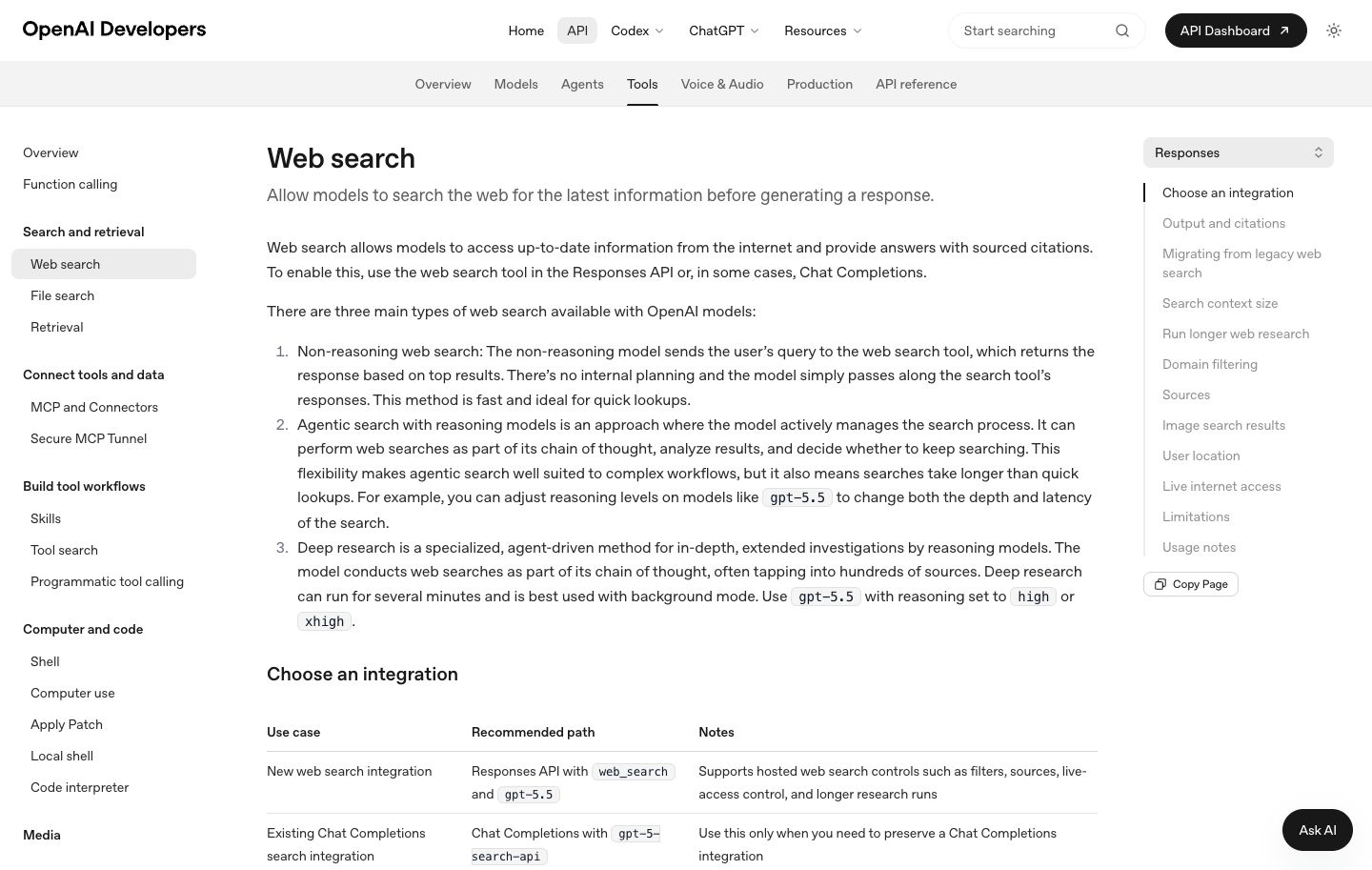
Source: OpenAI Developers.
Preserve the surface you tested. A saved answer should say whether search was on, which product surface you used, the exact prompt, and when you ran it. Without those details, a later comparison becomes guesswork.
Which version of the problem describes you?
Most audits land in one of five recognizable situations. Identify the situation before prescribing a page, because the same ugly answer can come from very different gaps.
What ChatGPT says | What it may mean | What to check next |
|---|---|---|
It cannot explain what your company does | Weak access, identity, or public evidence | Homepage, about page, product pages, indexing, and cited sources |
It states an old product or pricing fact | Stale first-party or third-party evidence | Current product docs, pricing, release notes, and source dates |
It describes you in vague category language | Positioning is hard to distinguish | Category, buyer, use case, proof, and comparison language |
It recommends another company for the job | Missing evidence, stronger competitor proof, or legitimate bad fit | Buyer constraints, cited comparison criteria, and actual product fit |
It gives a fair description you simply dislike | Taste or strategy disagreement | Human review before any content change |
Do not turn all 5 situations into a content brief. An access problem needs a technical fix. A stale fact may need one source updated. A fair bad-fit answer may need nothing at all.
The earlier guide on why a business may not appear in ChatGPT covers crawling, indexing, and missing evidence in more detail.
This audit starts one step later: what did the answer actually say, and what decision follows?
Which 10 prompts should you run?
Use a small prompt set that tests identity, fit, and comparison without coaching ChatGPT toward praise. The goal is to see the current explanation a plausible buyer could receive.
Ask these 10 questions:
What does
[Company]do?Who is
[Company]built for?What problem does
[Company]solve?What products or services does
[Company]offer?What evidence supports
[Company]'s main claims?What are the main limitations of
[Company]?Which companies compete with
[Company]?How does
[Company]compare with[Competitor]for[buyer job]?Is
[Company]a good fit for[buyer type and constraint]?What should a buyer verify before choosing
[Company]?
Run the set once, then repeat it in a fresh chat. If 2 answers disagree, preserve both. The disagreement is an observation about instability under those runs, not proof that one version is normal.
Keep the buyer and job specific where you know them. A generic prompt like What is the best software? mixes companies that may not belong in the same decision. A prompt such as Which option fits a two-person B2B marketing team that needs current product evidence? gives the comparison a real boundary.
How should you record each answer?
Record enough context to rerun the check and audit the sources. A spreadsheet, document, or database is fine if it preserves the same fields.
Use this 5-field worksheet:
Field | What to save | Why it matters |
|---|---|---|
Run context | Date, time, product surface, search mode | Keeps the answer tied to a real observation |
Prompt | Exact wording and buyer constraints | Makes the check repeatable |
Answer | Full response, not a paraphrase | Prevents later interpretation from replacing the record |
Citations | URL, page title, and nearby claim | Lets a reviewer test source support |
Finding | Supported, unsupported, stale, or judgment | Connects observation to the next decision |
I also checked OpenAI's Output and citations section before writing this. It documents 2 main response parts: a search-call item and a message item. The message can carry URL annotations with the source URL, title, and citation location.
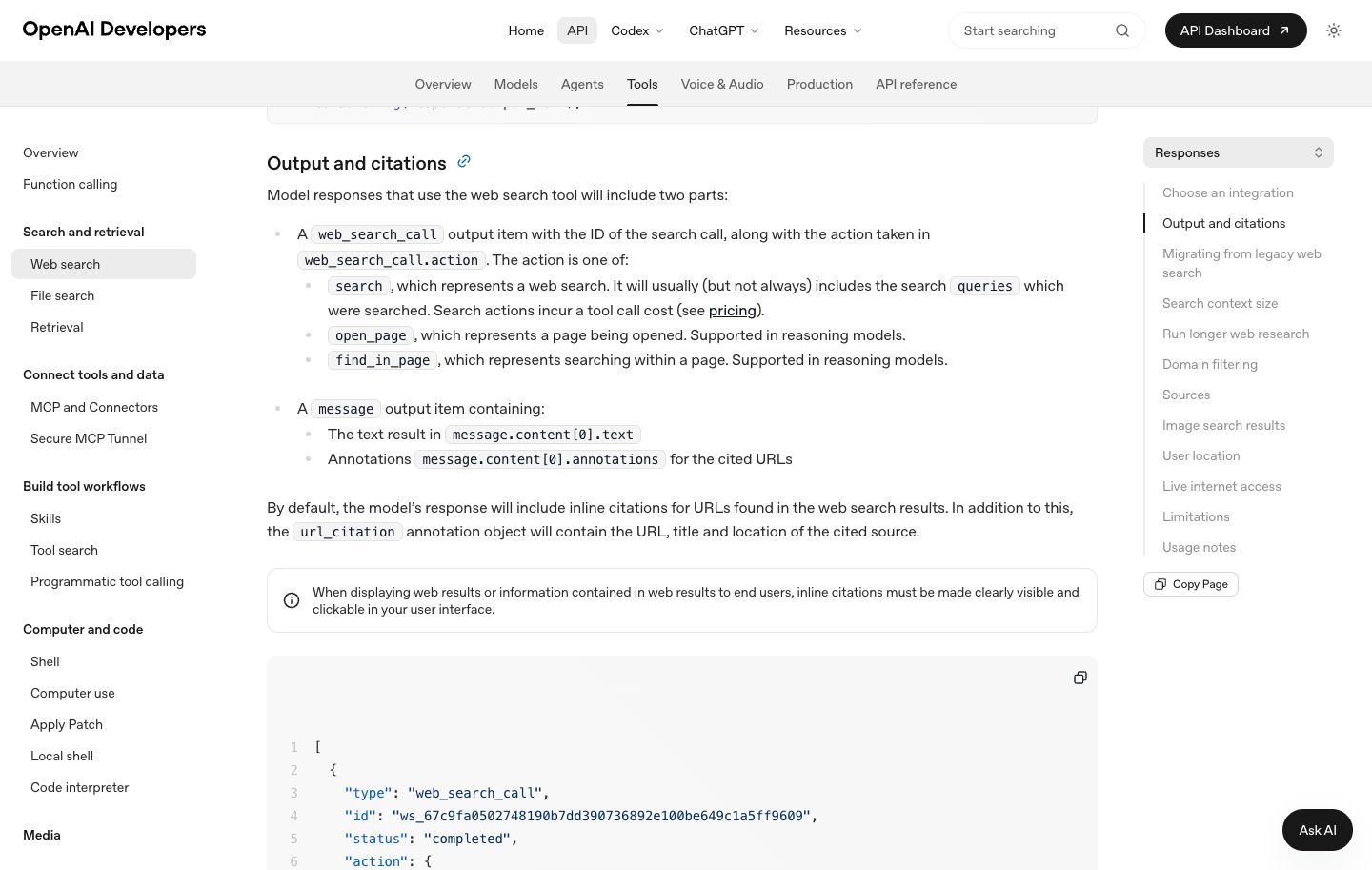
Source: OpenAI Developers.
That technical shape is why saving only a screenshot of the prose is weak. Preserve the links too. A claim may look precise while its citation supports only part of the sentence, points to a stale page, or comes from a source you would never use for a business decision.
What does each finding ask you to do?
The next action depends on the type of gap, not the emotional sting of the answer. Use the smallest action that can make the public evidence clearer.
If this describes you | Check this | Take this action |
|---|---|---|
A factual claim is wrong and the cited source is stale | Current first-party page, release note, and effective date | Correct or refresh the canonical source, then rerun the prompt |
The answer is vague because your own pages are vague | Buyer, use case, category, product facts, and proof | Clarify the owned page that should carry the explanation |
A competitor is favored on a real decision criterion | Current evidence for both companies and the buyer's constraint | Build the missing proof or a fair comparison only if the choice is genuine |
ChatGPT cites a weak third-party source over your site | Accessibility, first-party evidence, and source authority | Strengthen the owned evidence and pursue legitimate third-party validation |
The company is a bad fit for the stated buyer | Product scope and buyer constraint | Accept the result; do not publish a page that argues past the truth |
The finding is subjective or material risk is unclear | Product, legal, sales, and brand owners | Route it to human judgment before changing public copy |
The canonical answer should live on your owned site, where claims, sources, dates, and corrections can be maintained. A LinkedIn post or short video can distribute one finding. Social is distribution only, and comments or email should never gate the 10-prompt asset.
Resist page multiplication. If the right fact already exists on your homepage, product page, documentation, or comparison page, update that source instead of creating another near-duplicate article. The homepage audit is an existing resource to use, not recreate.
What can this audit prove, and what can't it prove?
This audit can prove what ChatGPT returned for a preserved prompt, product surface, search setting, and date. It can also show which citations appeared and whether those pages support the claims you checked.
It cannot expose why the model selected a source, omitted your company, ranked an option, or formed a recommendation. Those are inferences. It also cannot tell you whether the answer caused a visit, lead, opportunity, or sale.
Keep the boundary explicit:
Evidence state | What you can say | What you still need |
|---|---|---|
Observed | ChatGPT produced this dated answer and these citations | Repeated runs and later checks for stability |
Inferred | The pattern suggests an evidence, positioning, access, or fit gap | More source review and competing explanations |
Business outcome | A person visited, started, qualified, or bought | External analytics, CRM data, cohorts, and attribution |
Human judgment | The answer is fair, material, risky, or worth correcting | An accountable reviewer with product and brand context |
A citation is not an endorsement. A recommendation is not a shortlist, and a shortlist is not revenue. Public views, likes, shares, or engagement do not prove acquisition or revenue without a cohort, attribution method, and observation window.

How does Trovance turn a ChatGPT answer into the right next action?
Trovance starts with the current answer instead of asking your team to guess what AI says. It observes how AI systems explain, cite, compare, and recommend your company, then keeps the sources attached so a marketer can see whether the problem is a wrong fact, missing proof, unclear positioning, weak comparison evidence, or legitimate bad fit.
A score alone does not resolve any of those cases. Trovance helps diagnose the evidence gap, decide whether an asset should exist, and carry approved sources into the proof-backed page, comparison, FAQ, or update your team should produce and publish. Humans still own truth, fit, permission, risk, taste, and the publication decision.
See how AI currently describes your company and which evidence may be missing or unclear. Scan my AI visibility, then use the preserved answers to choose the smallest defensible action. The scan does not promise a citation, ranking, recommendation, or business result.
FAQs
Can I just ask ChatGPT what it knows about my company?
Yes, but save more than the answer. Record the exact prompt, date, product surface, search setting, full response, and citations. Run the prompt again in a fresh chat. That turns a casual lookup into a dated observation you can compare later without treating one response as the whole market.
Should I use ChatGPT search for the audit?
Use web search when you want to inspect current public information and visible sources. Record that search was enabled because an ordinary answer may rely on a different information path. OpenAI documents sourced citations for web-search responses, but that does not mean every ChatGPT conversation searches or cites the web.
How many prompts are enough for a first check?
Ten prompts are enough for this short audit because they cover identity, buyer fit, evidence, limits, and comparison without becoming a false visibility score. They are a starting set, not a benchmark. Add questions tied to real sales calls or evaluations, and preserve the same wording when comparing runs.
What should I do when ChatGPT gets a fact wrong?
Open the cited source first. If it is stale, correct the canonical page and record the effective date. If your own current page is clear, preserve the mismatch and check other sources before publishing anything new. A wrong answer can come from stale evidence, retrieval, synthesis, or another public source.
Does a ChatGPT citation mean the model recommends us?
No. A citation says the answer displayed a source near a claim. It does not establish endorsement, ranking, recommendation, buyer attention, or revenue. Check what the cited page supports, then keep mentions, citations, comparisons, recommendations, shortlists, and business outcomes as separate observations with separate denominators.
How often should I repeat the audit?
Repeat it after a material product, pricing, positioning, or evidence change, and on a schedule that matches how often your facts move. Keep the prompt set stable enough to compare. A later answer can show that the public explanation changed, but it cannot prove your edit caused the change.
Should every bad answer become a new article?
No. The right response may be a homepage correction, product-document update, comparison page, third-party proof project, technical access fix, or no action. Check existing assets before adding another URL. Publish only when a missing canonical answer is the actual gap and a human can approve the claims and sources.