
AI search visibility can lead to traffic, leads, and revenue, but a visibility measurement alone cannot prove that it did. You need a preserved answer baseline, identifiable downstream events, a declared attribution rule, and a stronger test before you can move from "these events happened in sequence" to "AI visibility caused the result."
The honest business case is a chain, not one heroic number. Measure the answer, the visit, the buyer action, the qualified account, and the revenue event separately. Join only what your records can support.
Which measurement situation describes your team?
Most teams arrive at this question through one of four situations, each with a different missing link.
You have more AI visibility but no obvious traffic. Tracked prompts show more mentions or citations, yet GA4 appears flat. An answer can satisfy the question without a click, route the buyer through another channel, produce a later branded search, or never reach a qualified buyer. It can also mean the visibility had little commercial value.
You have identifiable AI referrals but few leads. GA4 classifies sessions from assistants, but visitors do not start the intended action. The problem may be buyer fit, landing-page continuity, the offer, measurement setup, or a tiny denominator. A referral proves arrival, not intent.
You have leads with an unclear path. A prospect says "I found you through ChatGPT," while analytics shows direct, organic, or no usable referrer. The self-report is evidence worth preserving. It is still incomplete, especially if several content, social, sales, and search touches preceded the lead.
You have revenue beside a visibility increase. Both lines moved during the same period. That is enough to investigate and perhaps assign model-based credit. It is not enough to claim incrementality when pricing, product, seasonality, sales effort, paid distribution, or brand demand changed too.
Adjacent resources already cover 6 visibility signals and AI referral classification. This page has a narrower job: show where those records join and where the claim must stop.
What should you measure right now?
Start with one high-value buyer question and one downstream business action. Preserve the first answer set, then attach a simple measurement record to every stage you can observe.
| Stage | Mechanical record | Denominator | System of record | Defensible statement |
|---|---|---|---|---|
| AI visibility | Answer appearance, mention, citation, comparison, or recommendation | Repeated runs across the declared prompt and engine set | Answer-observation system | The brand appeared in this measured answer set |
| Owned visit | Landing-page session with available source data | Classified sessions in the selected period | Web analytics | An identifiable visit reached the site |
| Product or sales start | Scan, account, demo, trial, or other defined start | Eligible visitors or CTA actors | Product analytics or CRM | A person began the intended process |
| Activation | First event that demonstrates credible value | Starts in a named cohort and window | Product analytics | A starter reached the defined value event |
| Qualification | Account meets written fit and intent criteria | Started or activated accounts | CRM and sales process | An account met the stated qualification rule |
| Revenue | Paid, closed-won, retained, or expanded value | Named account cohort | CRM and billing | Revenue occurred in the measured cohort |
Do not blend these rows into an "AI revenue score."
Google Search Console itself keeps 4 search measures distinct: clicks, impressions, click-through rate, and average position. Its table supports 6 dimensions, yet none of those fields is a qualified lead or revenue event. AI visibility deserves the same restraint.
For each row, save the numerator, denominator, entry rule, date window, exclusions, and owner. A statement such as "3 qualified accounts from 42 identifiable AI-referred sessions in 90 days" is reviewable. "AI visibility drove pipeline" is not.
How do you connect AI visibility to website traffic?
Connect visibility to traffic only when you have two separate records: the answer observation and a classifiable site visit. Timing, destination URL, source data, campaign tags where available, and buyer self-report can strengthen the connection, but none makes invisible journeys fully observable.
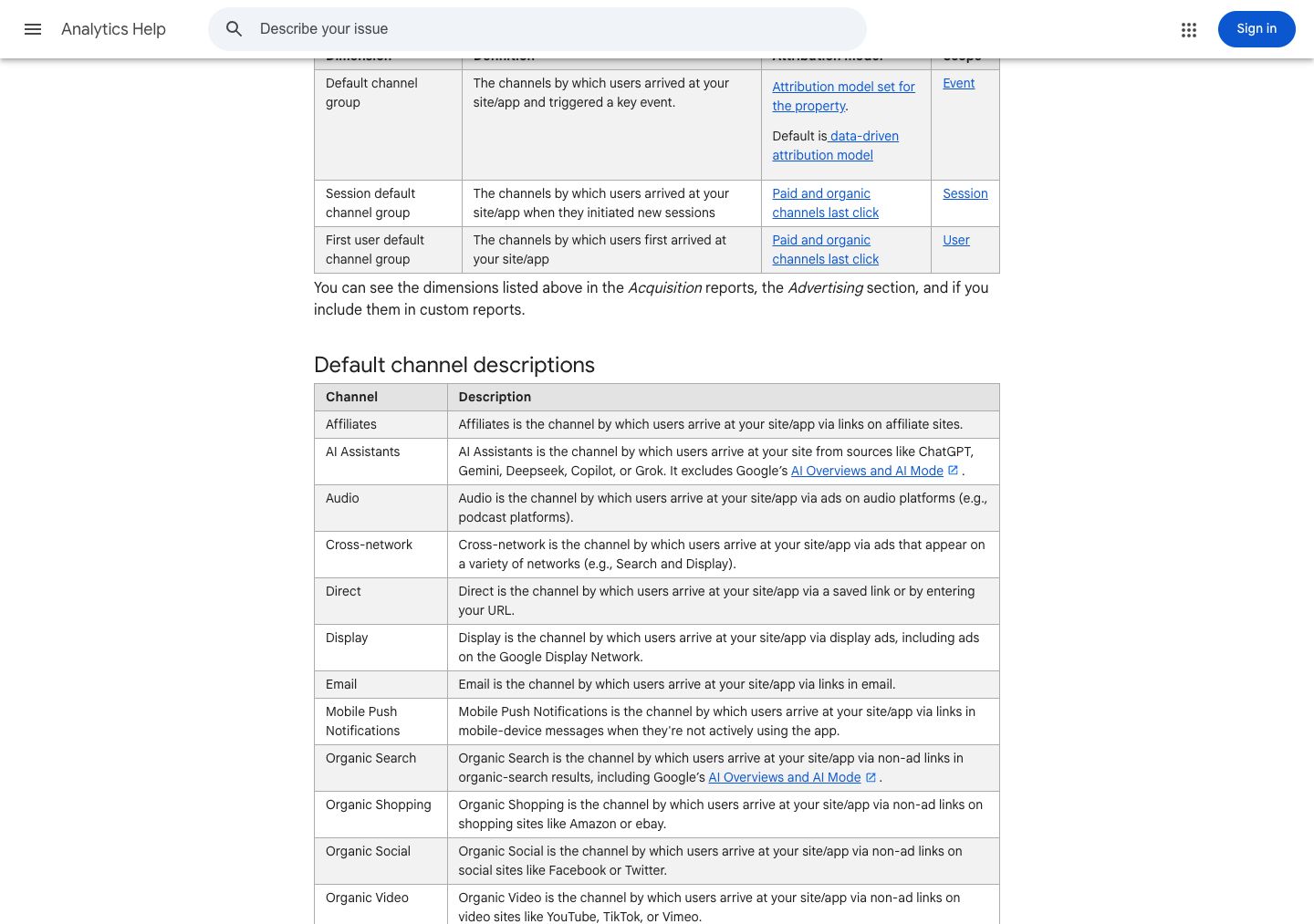
Google Analytics currently defines an AI Assistant channel for arrivals from sources such as ChatGPT, Gemini, Deepseek, Copilot, and Grok. That is 5 named examples, not a census of every AI-shaped visit. The same documentation excludes Google's 2 AI search surfaces, AI Overviews and AI Mode, from that channel and classifies them under Organic Search.
Source: Google Analytics Help.
The screenshot shows why "AI traffic" is already an interpretation. Broader AI visibility also includes no-click answers, citations, comparisons, recommendations, and journeys that continue through another source.
Use Session default channel group or Session source / medium when the question is which channel initiated a session. Google documents 3 related scopes: event, session, and first user. They can disagree without any report being broken because they assign credit to different moments.
A useful traffic statement sounds like this: "GA4 classified 42 sessions in the AI Assistant channel during the selected period." It does not sound like this: "42 buyers discovered us through AI." That version claims identity and discovery history the channel row cannot see.
How do you connect traffic to leads and revenue?
Define the action first, then follow a named cohort through the systems that own each event. A form fill may not be a qualified account. A deal attached to a contact is not automatically revenue caused by the first recorded source.
Use this decision path:
| If this describes you | Check this | Take this action |
|---|---|---|
| Visibility rose, traffic did not | No-click answers, referral loss, branded search, prompt fit, repeated-run variance | Keep visibility as distribution evidence; do not claim acquisition |
| AI referrals rose, starts did not | Landing page, CTA event, buyer fit, sample size, source classification | Fix the page-to-action path or stop targeting that question |
| Starts rose, qualification did not | Activation event, ICP rule, duplicates, spam, sales acceptance | Tighten the event and qualification contract before buying more reach |
| Qualified accounts rose with AI touches | Identity join, time window, touch sequence, attribution model | Report contribution with the model and raw counts attached |
| Revenue rose after a visibility change | Concurrent campaigns, pricing, product, seasonality, sales effort, holdout options | Treat the pattern as a hypothesis; run a bounded test before claiming causation |
GA4 defines an engaged session using 3 alternative conditions: at least 10 seconds, at least one key event, or at least two page or screen views. That threshold is useful for behavior reporting. It does not establish buyer quality.
Its session key-event rate uses 2 counts: sessions with a key event divided by total sessions. The formula is clear, but the event can still be weak. A newsletter signup, account creation, accepted diagnosis, booked meeting, and purchase should not share one vague "conversion" label.
Revenue requires another handoff. Web analytics may record revenue or assign event credit, while CRM and billing systems carry account, opportunity, payment, retention, and expansion records. A lean team needs stable definitions and a record of what remains unknown more than it needs multi-touch software.
Which attribution claim can your evidence support?
Use four states. They prevent a sequence of plausible events from quietly becoming a causal story.
| Claim state | What you have | What you may say | What is still missing |
|---|---|---|---|
| Observed | Preserved answer, citation, session, event, lead, or revenue record | The event occurred under the declared method | A supported connection to another event |
| Attributed | A rule assigns credit across joined records | The touch received credit under this model | Proof that the touch changed the outcome |
| Inferred | Timing, path, and context make a connection plausible | The evidence is consistent with influence | Complete exposure history and a counterfactual |
| Causal | A credible experiment or quasi-experiment estimates incrementality | The treatment changed the measured outcome under these conditions | Generalization beyond the tested cohort and period |
Attribution is bookkeeping with a declared rule. Causation asks what would have happened without the exposure or change. First touch, last touch, linear credit, and data-driven models allocate credit; they do not reveal the counterfactual by themselves.
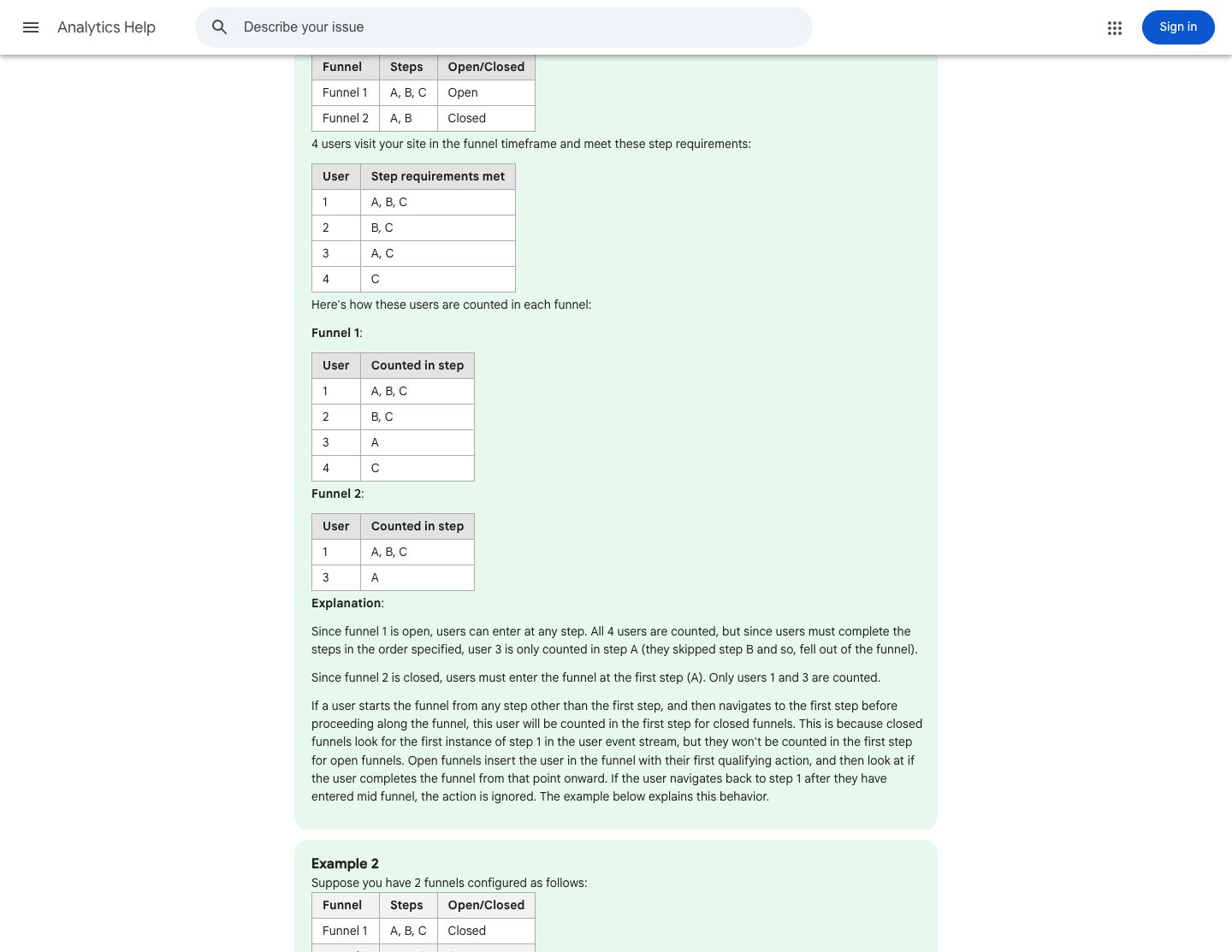
Funnel settings can change even the descriptive story. Google Analytics supports 2 funnel modes: open and closed. In Google's worked example, 4 users meet different step combinations. The open funnel counts all four at their first eligible step, while the closed funnel counts only 2 users who entered through step A.
Source: Google Analytics Help.
Same behavior, different entry contract. GA4 allows up to 10 configured steps and 4 comparison segments, but additional controls do not rescue a bad denominator.
Classification and funnel rules are part of the claim. If the rule is missing from the report, leadership cannot tell whether the number changed or the counting changed.
How do you attribute revenue to content when buyers research inside an AI assistant?
Build the records analytics cannot see: a self-report field, one link convention you control, and two content fields on every deal. The middle of an assistant-led journey stays private, so the fix is collection discipline at the edges. G2 reports that 51% of software buyers now start research with an AI chatbot more often than with Google, and that one in three said an AI chatbot led them to choose a vendor they hadn't considered.
Four records make that middle reportable:
- An open text field asking how the buyer heard about you, on every form, logged beside the contact record. Self-report is the only place a no-click answer or a private share names itself. Log the wording verbatim.
- One naming convention for the links you control, so a single source does not split into three channels.
- Two fields on every deal: first content touchpoint, and content the buyer saw before close.
- A rollup to topic clusters rather than single URLs, because per-URL counts at low deal volume are too thin to read.
These records support an attributed claim under a declared rule. They do not make it causal. Treat a content tactic as the least likely explanation until tested: C-SEO Bench tested conversational-SEO methods across two tasks and six domains and found most of them largely ineffective and often harmful to citation rank, with gains shrinking as more sites adopted them.
What belongs in an AI visibility business-case review?
Bring one page, not a pile of dashboards: the measured chain, the break in it, and the decision that follows.
Use this checklist:
- Name the buyer question, engine set, repeated-run method, baseline date, and observation window.
- Separate answer appearance, mention, citation, comparison, and recommendation.
- Record the landing pages and source classifications used for identifiable visits.
- Define the product or sales start mechanically.
- Define activation as credible received value, not mere setup.
- Write the account-level qualification rule and owner.
- Attach raw counts to every rate.
- State the identity join, lookback window, attribution model, and known missing paths.
- List concurrent changes that could explain the result.
- Label the conclusion observed, attributed, inferred, or causal.
- Decide whether to maintain, fix, test, or stop the work.
Public view and engagement counts belong in the distribution row. They are not acquisition or revenue proof without a cohort, denominator, attribution method, and observation window.
How can Trovance establish the visibility baseline before revenue analysis?
Trovance can establish the observed-answer layer and connect it to the evidence action, while your analytics, product, CRM, and billing systems measure downstream behavior.
Start with a preserved visibility baseline before connecting changes to traffic, leads, or revenue. Trovance observes how AI systems explain, cite, compare, and recommend your company, then helps diagnose whether the gap comes from missing proof, unclear positioning, stale facts, weak comparison language, technical access, outside reputation, or legitimate bad fit.
Observation does not resolve the gap. If a proof-backed asset should exist, Trovance helps produce and publish it. If the right action is a product clarification, third-party validation, measurement repair, or no new content, the diagnosis should say so. A Visibility Gap Is Not a Content Brief remains the deeper decision guide for that boundary.
Trovance does not provide a causal revenue model, expose hidden model reasoning, or guarantee traffic, leads, citations, rankings, or recommendations. Its cookieless first-party pixel records identifiable AI referrals and the conversions you define, and the Stripe revenue webhook, once set up, adds payments; nothing is modeled. Your product and CRM records still supply activation and qualification. Human judgment still owns fit, truth, claim strength, and whether the evidence justifies more investment.
To put the observed-answer layer in place first, start a free Trovance trial.
Measuring AI visibility
Six Signals That Beat a Single AI Visibility Score - the signals worth tracking
There Is No Such Thing as an AI Visibility Score - why one score misleads
AI Crawler Traffic Does Not Prove Buyer Visibility - crawler hits are not buyers
How buyers actually search
AI Visibility Tests Miss How Buyers Actually Prompt - prompt sets shape every count
The Front Page of the Internet Is Now an Answer - why answers absorb clicks
How Cross-Platform AI Agents Build Product Shortlists - how shortlists form early