
Generative engine optimization improves the evidence path between your company and an AI-generated answer.
The useful version is a four-gate diagnosis: can the system access your source, retrieve it for the buyer's question, use its evidence accurately, and recommend the company when the fit is real?
Do not start by rewriting every page. Start with one important buyer question, preserve the answer and cited sources, find the first gate that failed, and fix that failure.
A crawl problem needs a technical repair. A weak comparison needs proof. A bad-fit recommendation may need no content at all.
What is generative engine optimization?
Generative engine optimization is the work of making accurate, relevant evidence easier for AI systems to find, interpret, cite, compare, and use in generated answers.
The term came from Aggarwal and Murahari's co-first-authored KDD 2024 paper with Rajpurohit, Kalyan, Narasimhan, and Deshpande. Their framework treats a generative engine as a black box: a source goes in, an answer comes out, and the publisher tests how changes affect the source's representation in that answer.
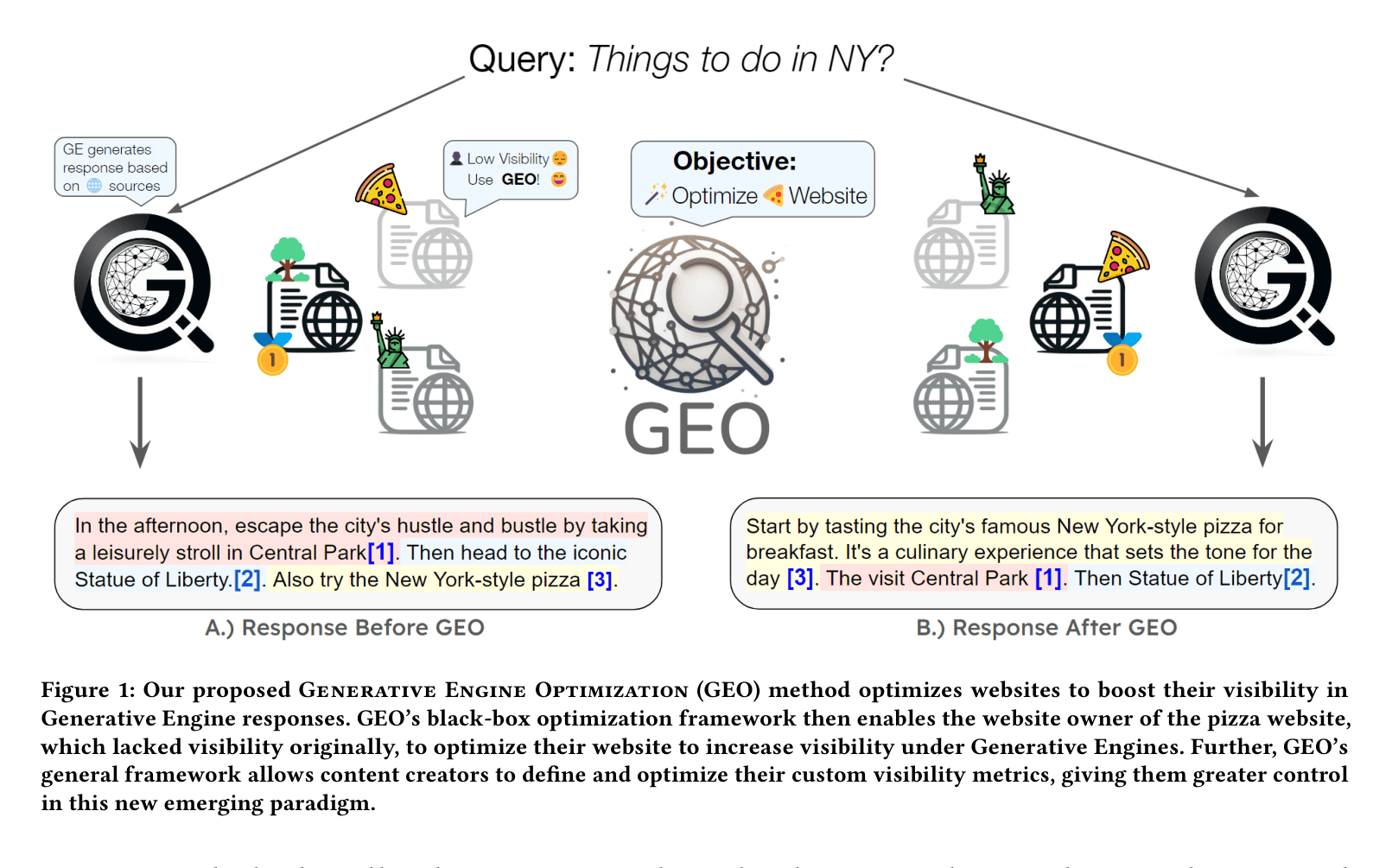
Source: Aggarwal et al., GEO.
The figure is a conceptual model, not a promise that moving a pizza paragraph will reliably move a citation. The paper's main experiment used Google's top 5 sources as context for GPT-3.5-turbo, then evaluated 9 content transformations against an unchanged source.
The authors measured Position-Adjusted Word Count and Subjective Impression. Those outcomes ask how much a source appeared, where it appeared, and how a model-based evaluator judged its influence. They do not measure whether a buyer trusted the answer, clicked, became qualified, or purchased.
That difference matters. GEO is a useful discipline when it keeps the whole evidence path visible. It becomes theater when a dashboard compresses access, retrieval, citation, recommendation, and revenue into one green number.
Where can AI visibility break?
AI visibility can break at four different gates, and each failure calls for different evidence and work.
Gate | Question to answer | Evidence to inspect | Possible action |
|---|---|---|---|
Access | Can the system reach and parse the source? | Request status, crawler policy, rendered text, authentication | Repair the exact delivery or policy failure |
Retrieval | Does the source enter the evidence set for this buyer question? | Retrieved URLs, query fit, source competition, date | Improve relevance or the owned canonical answer |
Evidence use | Does the answer preserve the claim, scope, and citation? | Raw answer, quoted passage, cited URL, conflicting sources | Clarify, refresh, or strengthen the proof |
Recommendation | Does the company fit the buyer's constraints for supportable reasons? | Comparison criteria, limitations, outside proof, repeated answers | Publish better comparison evidence, improve the offer, or accept bad fit |
A fifth question sits outside the GEO measurement itself: did any of this affect acquisition or revenue? That needs a declared cohort, attribution method, observation window, CRM or product events, and human judgment. Public views, mentions, and citations do not answer it.
The gates are sequential without being perfectly linear. A model may rely on an index or cached source rather than a fresh server request. It may retrieve a relevant page but cite a competing source. It may cite your page accurately and still recommend another company because that company better fits the prompt.
A mention therefore is not a citation. A citation is not a recommendation. A recommendation is not a shortlist. A shortlist is not revenue.
Keeping those states separate is less exciting than a single score. It is also how you avoid funding the wrong fix.
What should you do first?
Start with one buyer question that could change a real marketing or product decision, then preserve enough evidence to locate the first failed gate.
Use this route:
If this describes you | Check this | Take this action |
|---|---|---|
The relevant page cannot be fetched or parsed | Status code, robots policy, rendered response | Fix access, then verify the same request again |
The page is accessible but absent from the answer's sources | Question-to-page fit, competing sources, freshness | Improve the canonical answer or choose a source that better matches the job |
The page is cited but the answer drops the decisive fact | Exact claim, scope, date, proof, conflicting wording | Repair the evidence-bearing passage and its source trail |
The company is described correctly but not recommended | Buyer constraints, comparison criteria, product fit, outside reputation | Strengthen real proof or accept that the prompt describes a bad fit |
Mentions increased but pipeline did not | Exposure denominator, cohort, attribution, CRM events | Treat visibility as an observation and investigate the business path separately |
For a lean team, one clean question is enough to expose the operating problem. Record the assistant or surface, date, exact prompt sequence, raw answer, cited URLs, competitors, and repeated-run count. Then label what was observed, what you inferred, and what still needs external analytics.
I used that same sequence for this article. I checked the current sitemap and CMS inventory before choosing the topic, then read the two primary papers rather than inheriting the category's usual tactic list. The first step prevented duplication. The second changed the article from "add citations and statistics" into a much more cautious diagnosis.
Why are common GEO tactics unreliable?
Common GEO tactics are unreliable because their effect changes with the model, domain, competing sources, adoption rate, metric, and whether the source was retrieved in the first place.
The KDD paper reported real gains in its controlled setup. In the appendix table with standard deviations, Quotation Addition scored 27.1 versus a 19.8 baseline on Position-Adjusted Word Count. Statistics Addition scored 25.5, and Cite Sources scored 25.3.
But even that paper contains the warning label. Keyword stuffing scored 19.8 against the same 19.8 baseline on the appendix metric. That supports no measurable benefit in that condition. It does not support the popular claim that keyword stuffing universally harms AI visibility.
The paper's Perplexity check was narrower than "tested in the wild" suggests. Researchers supplied source text as uploaded files because they could not specify URLs, and they used a 200-sample subset. Cite Sources improved the word-count metric to 26.8 from 24.1 while its subjective score fell to 19.0 from 24.7. One method moved two metrics in opposite directions.
C-SEO Bench supplied the later corrective. The NeurIPS 2025 study covered 2 tasks, 6 domains, more than 1,900 queries, and over 16,000 documents. It tested 10 transformations across 4 answer models and measured citation-rank change.
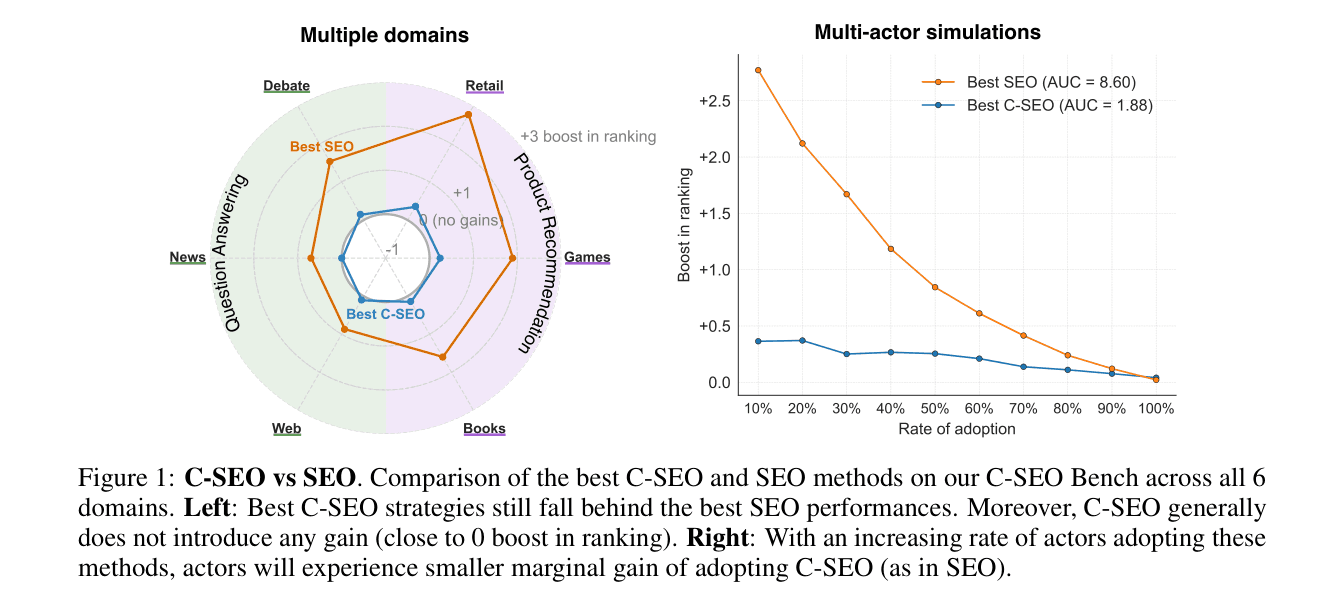
Source: Puerto et al., C-SEO Bench.
The figure shows two bounded findings. The best retrieval-order condition beat the best tested rewrite in all 6 domains. As adoption rose from 10% to 100%, gains shrank toward zero because competitors cannot all move ahead of one another.
I checked the original figure and its caption before cropping it. It supports retrieval order as the larger effect inside this benchmark. It does not tell a marketer which live SEO action will earn that position, and it does not prove that useful quotations or statistics should be removed.
The practical rule is simple: add evidence because the claim needs proof, not because a tactic list promises a citation.
What can GEO measurement actually prove?
GEO measurement can prove only the conditions you observed: which question was asked, which system answered, which sources appeared, how the company was described, and whether a defined change coincided with a later answer change.
Observation | Safe claim | Claim that remains blocked |
|---|---|---|
A bot now receives a complete | The tested client can access the page under that policy | AI assistants will cite it |
A source appears in a preserved answer | The answer used or cited the source under recorded conditions | The source caused a recommendation |
The company appears more often across repeated prompts | Presence changed in that prompt panel and period | More buyers discovered the company |
The answer now preserves a corrected product fact | The observed explanation became more accurate | The page edit alone caused the change |
Qualified accounts improved in a declared cohort | The business outcome changed for that cohort | GEO caused the outcome without attribution controls |
Run-to-run variance is another reason to preserve raw answers rather than reporting one screenshot. The original GEO experiment generated 5 responses per query and repeated method evaluation across 5 seeds. A production audit should also use repeated observations, even though no universal run count guarantees stability.
Owned canonical pages should hold the complete, current answer. Social posts can distribute the idea, but engagement on a rented platform is not proof that the underlying page improved acquisition. Keep the source, claim, update date, and business measurement attached to the asset you control.
How can Trovance turn a GEO gap into an evidence action?
Trovance can begin with the observed answer, identify which gate failed, and keep the evidence attached as the team decides what should happen next.
The platform observes how AI systems explain, cite, compare, and recommend a company. It then diagnoses whether the gap is access, retrieval, stale proof, unclear positioning, weak comparison evidence, outside reputation, or legitimate bad fit. A visibility score alone cannot make that distinction.
When the diagnosis supports a public asset, Trovance helps produce and publish the proof-backed page that should exist. That could be a refreshed product page, a comparison with explicit tradeoffs, a source-backed FAQ, a proof page, or no new content. Trovance does not promise a citation, ranking, recommendation, or sale.
Start your free trial to find the first failed gate before funding the fix.