
Keep changing product facts and screenshots consistent by maintaining one record for every consequential claim: its approved value, canonical source, owner, volatility, review trigger, and affected assets. A page can have yesterday's update date while still carrying last year's pricing, integration list, screenshot, benchmark, or product language.
Ubicloud engineer Jeremy Evans describes the maintenance problem in his own team: when an application changes, related documentation screenshots need updating too. His account explains how Ubicloud tackles that problem. It establishes a concrete company example, not market prevalence or search volume. Extending the same discipline to product facts across a content library is our recommendation.
FreshQA gives teams a more useful model. Its 600 questions were split into never-changing, slow-changing, fast-changing, and false-premise classes. The test set held 125 questions in each class, and the researchers excluded facts expected to change more often than once per week. They also assigned each question an expected next review date.
That does not prove how often a company should refresh a page. Our editorial recommendation is to give every consequential fact an owner, a source date, an expected rate of change, and a review decision. For this workflow, our recommendation is to manage that record at the claim level, and we would not schedule blanket rewrites when the source remains valid.
Which content facts are most likely to go stale?
Facts are most likely to go stale when their truth depends on a changing product, person, market, policy, or period.
A company founding date may be stable. Current pricing is not. A case study's measured result can remain historically true while the surrounding product description becomes obsolete.
"Supports Salesforce" can change faster than a category definition. "Most recent" begins decaying the moment it is published.
FreshQA sorted answers into four classes: never-changing, slow-changing, fast-changing, and false-premise.
Its 500-question test set was balanced across those classes. Another 100 questions were reserved for development.
Evidence at readable size. Swipe or scroll horizontally to read all columns; keyboard users can focus the image and use arrow keys.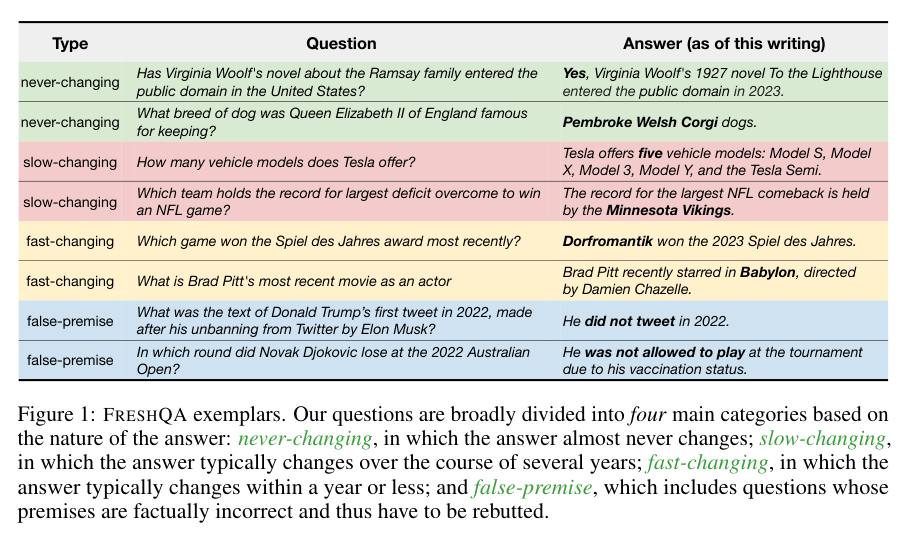 Source: Vu et al., FreshLLMs Figure 1.
Open the full-size freshness-category figure.
The figure is useful partly because several answers now look dated. It labels a 2023 award winner as "most recent" and lists a then-current Tesla lineup. The paper is not wrong about its 2023 test condition. The artifact simply demonstrates why answer date and review state belong beside the claim.
For a B2B content system, start with classes tied to actual change patterns:
| Fact type | Typical risk | Review trigger | Possible action |
|---|---|---|---|
| Company history | Low | Acquisition or correction | Verify unchanged |
| Positioning and category | Medium | Strategy change | Revise connected pages |
| Product capability | Medium to high | Release or deprecation | Update source and claims |
| Pricing and packaging | High | Plan change | Replace across all assets |
| Customer result | Mixed | Method or approval change | Preserve period and scope |
| "Latest" or "current" claim | Immediate | New event or source | Date, replace, or remove |
What did FreshQA actually measure?
FreshQA measured question-answer factuality under a historical model setup, not whether fresher marketing pages earn citations.
The researchers manually reviewed examples, checked answers and supporting URLs, and attached an expected next review date.
The study evaluated answers under two procedures intended to measure correctness and hallucination. Those benchmark procedures are not a ready-made company audit standard.
The study generated more than 50,000 judgments. Its model comparisons are historical results from 2023.
Current models, search indexes, and answer engines have changed, so the scores should not be sold as current performance benchmarks.
The durable lesson is the evaluation split. A page can contain the right primary answer while extra details are stale. That page passes a loose editorial glance and fails a strict fact audit.
How should a content freshness registry work?
A content freshness registry should track the smallest consequential claim that can change, then connect it to every asset that repeats it.
Use a record like this:
| Field | What to store |
|---|---|
| Claim | Exact public statement |
| Current value | Approved wording or structured fact |
| Canonical source | First-party or primary proof |
| Source date | When the evidence became valid |
| Volatility | Stable, periodic, event-driven, or continuous |
| Next review | Date or event that reopens the claim |
| Supersedes | Prior value and change date |
| Affected assets | Pages, FAQs, decks, and comparisons |
| Owner | Person accountable for truth |
| Decision | Keep, update, consolidate, remove, or hold |
FreshQA's maintainers put this principle into practice. The official repository says the dataset is updated weekly or on request and preserves dated snapshots in its version history.
A declared cadence can become stale too. The system needs evidence that a review occurred, not a sentence promising that reviews happen. The repository's version archive is more useful than a generic "last updated" badge because it preserves what changed and when.
What should each source record preserve?
Each source record should preserve enough context to judge truth, recency, and scope without reconstructing the research later.
FreshPrompt stored source webpage, publication date, title, text snippet, and highlighted terms. It also tested how evidence order affected answers in that benchmark.
Evidence at readable size. Swipe or scroll horizontally to read all columns; keyboard users can focus the image and use arrow keys.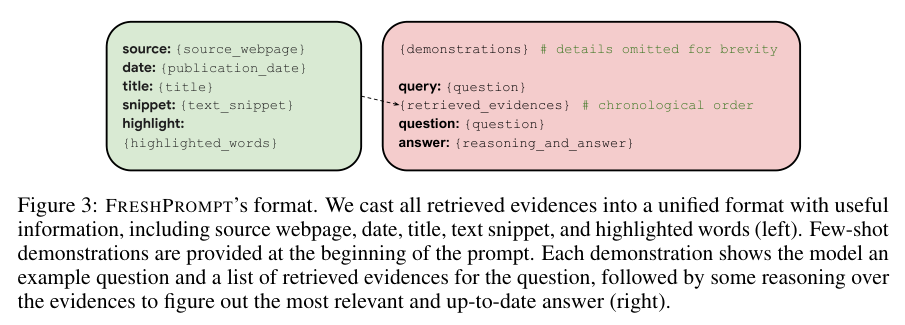 Source: Vu et al., FreshLLMs Figure 3.
Open the full-size evidence-record figure.
The paper's analysis says both the amount and order of retrieved evidence affected answer correctness in this setup.
Do not turn those results into page-order tactics. This was evidence inside a model prompt, not a web-ranking experiment. The operational takeaway is simpler: dates and source context can affect which evidence a system treats as current, so stripping them during production makes later review harder.
The paper's strongest reusable artifact is not an accuracy lift. It is the explicit evidence record.
When should a team refresh, consolidate, or not publish?
A team should act only after the review identifies what changed and where the contradiction lives.
Refresh when the public claim is still needed and better evidence now exists. Consolidate when several pages repeat different versions of the same fact. Correct when the old statement was wrong even at publication time. Add a date when the fact remains historically valid but should not read as current.
Do not publish when the gap is not a content gap. A missing answer may reflect unclear positioning, a product limitation, absent customer proof, inaccessible documentation, weak third-party reputation, or legitimate bad fit. Updating the article timestamp cannot repair those conditions.
That does not mean more sources always help. Conflicting or weak sources can create a different failure, and the benchmark does not measure editorial maintenance.
A review queue should therefore end with a decision, not a rewrite quota.
How can Trovance help a team keep AI-facing facts current?
Trovance can connect a stale AI answer to the exact evidence and asset that need review, without treating every old fact as a request for another article.
A team can use Trovance to observe how AI systems explain, cite, compare, and recommend the company for a defined buyer question. The answer trail exposes where an outdated capability, comparison, price, or proof point appears. Diagnosis then separates a stale source from a retrieval issue, product gap, positioning problem, or legitimate bad fit.
A visibility score alone cannot make that distinction. Trovance helps the team decide which proof-backed asset should exist, then helps produce and publish the correction, product page, comparison, FAQ, or source-backed article. Human review keeps responsibility for the current fact, evidence, permissions, and final publication.
That is why a team would use Trovance here: to turn "the answer looks stale" into an inspectable maintenance decision tied to a real source and affected asset. Text Trovance to inspect the question, evidence, and next action with a human in the loop.