
To get your business to show up in ChatGPT, first find out which outcome is missing: a mention, a citation, a comparison, or a recommendation. Then fix the public evidence for that specific gap and rerun the same buyer questions; no copy trick gives you control over the answer.
That distinction saves a lot of pointless publishing. A company can clear 1 stage and fail the next 3 stages. Work on the first broken stage instead of chasing a vague idea of "visibility."
What should you do first to show up in ChatGPT?
Start by recording the answer you have, not drafting the answer you want. Ask a real buyer question with web search on, save the exact wording, date, response, and citations, then repeat it in a fresh chat.
OpenAI's current documentation says web search can access up-to-date internet information and return answers with sourced citations. It describes 3 search modes: non-reasoning search, agentic search, and deep research. That product documentation supports inspecting visible sources. It does not mean every ChatGPT conversation searches the web or reveals why a source was chosen.
For this article, we opened that documentation in a public browser and checked the wording in context.
The useful move is boring on purpose: preserve what happened before you interpret it.
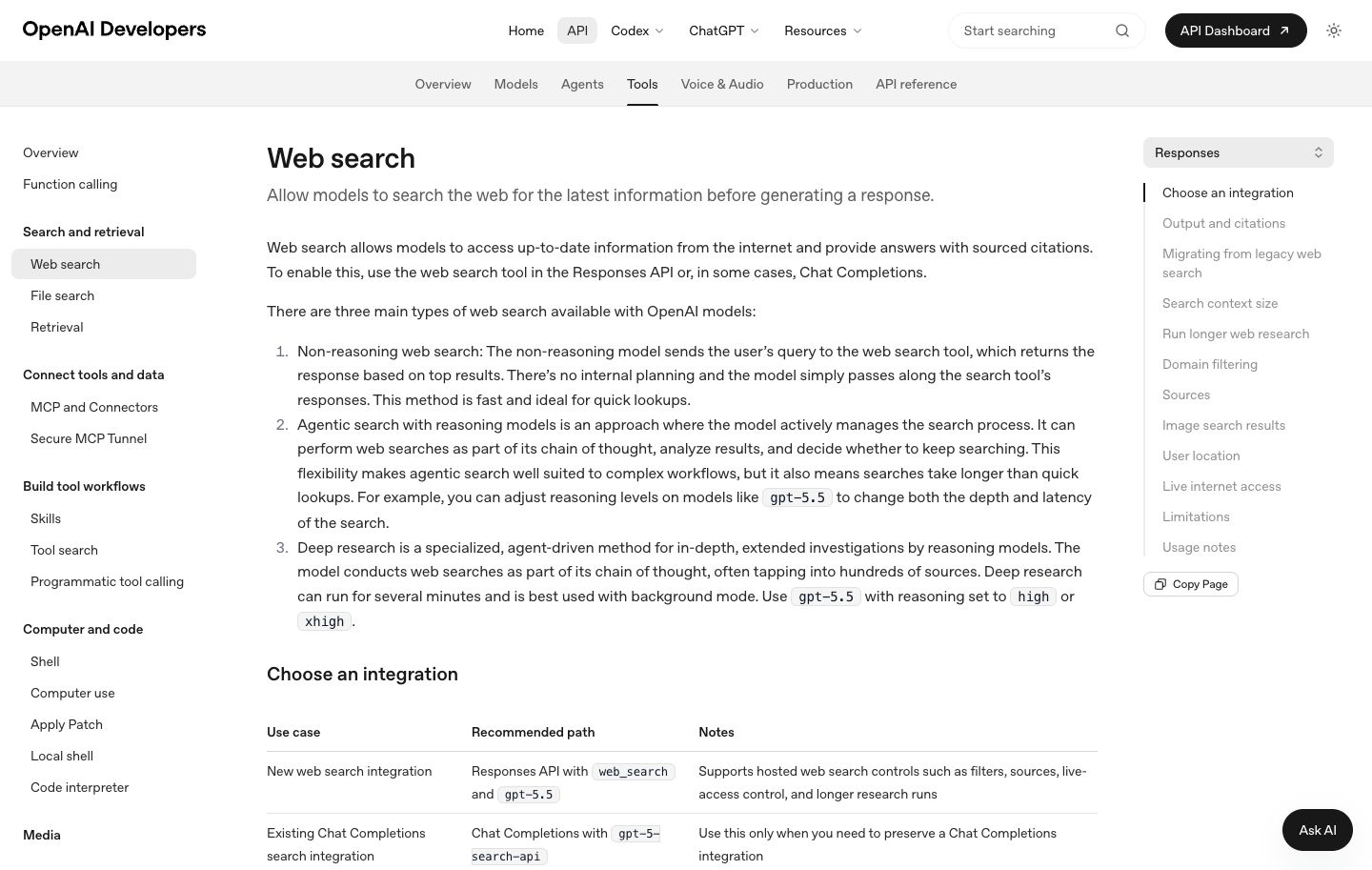
Source: OpenAI Developers.
Use the same question in 2 fresh chats, but do not call that a benchmark. Two runs can expose a disagreement. They cannot estimate the full range of answers a buyer might see.
Which ChatGPT outcome are you actually missing?
Name the missing outcome before you prescribe work. These 4 states look similar in a dashboard and ask for different evidence.
Outcome | What you can observe | What it does not establish |
|---|---|---|
Mention | Your company is named in the answer | That your site was used or the description is accurate |
Citation | A visible source is attached to a claim | Endorsement, recommendation, or buyer attention |
Comparison | Your company is evaluated against another option or criterion | Fair criteria, stable rank, or good fit |
Recommendation | The answer favors your company for a stated buyer job | A durable shortlist, visit, lead, or sale |
If ChatGPT names you but cites someone else, the issue may be source authority, freshness, or missing first-party proof. If it cites you accurately but recommends another company, the issue may be comparison evidence, product fit, third-party trust, or a fair conclusion you should accept.
A recommendation without the buyer's job and constraints is nearly useless. "Best CRM" and "best CRM for a 2-person services team migrating from spreadsheets" are different decisions. Keep the prompt attached to the result.
What does the path from mention to recommendation require?
The path requires increasingly decision-ready evidence, not increasingly clever prose. Treat each stage as a separate question.
Stage | Question to ask | Evidence that may help |
|---|---|---|
Mention | Can the system identify us and explain what we do? | Clear identity, category, buyer, product facts, and current pages |
Citation | Is there a source that directly supports the claim? | Dated documentation, methods, specifications, quotes, and original data |
Comparison | Can a buyer test us against a real criterion? | Fair comparison pages, limitations, pricing scope, integration facts, and proof |
Recommendation | Are we a good fit for this buyer's stated job and constraints? | Product fit, credible outcomes, third-party validation, and honest trade-offs |
This is a diagnostic sequence, not a funnel with a guaranteed finish. A company can deserve a mention and still be the wrong recommendation. Accurate exclusion is better than a flattering answer built on missing constraints.
The canonical answer should live on your owned site, where the claim, evidence, date, and correction can be maintained. A LinkedIn post can carry one finding to the market. Social is distribution only, and the worksheet above should never be gated behind comments, email, or engagement.
The existing article Does GEO Replace SEO? What The Evidence Says covers the retrieval foundation in detail. Use it as the next layer rather than creating another page that fights for the same query.
Which situation describes you, and what should you do next?
Match the visible failure to the smallest defensible action. This is the working version of if this describes you -> check this -> take this action.
If this describes you | Check this | Take this action |
|---|---|---|
You are absent from identity questions | Crawl access, index presence, homepage identity, and current third-party profiles | Fix access or clarify the canonical identity page, then rerun the same prompt |
You are mentioned with no useful source | Which pages support the exact claim and whether the answer cites a stale intermediary | Strengthen or update the source that should carry the fact |
You are cited but described vaguely | Buyer, use case, product scope, limitations, and proof on the cited page | Make the existing source more specific before adding a new URL |
You appear in comparisons but lose on a real criterion | The buyer constraint, current competitor evidence, and your actual product fit | Publish fair proof or improve the product; do not write around a true disadvantage |
You are recommended for the wrong reason | The claim, source, date, and risk of the mismatch | Correct the canonical fact and make the limitation explicit |
The recommendation is fair and the buyer is a bad fit | Product scope and buyer constraints | Accept the result and spend the publishing time elsewhere |
Do not convert all 6 routes into articles. The right action may be a product-document update, a comparison refresh, a technical fix, a customer-proof project, or no content at all.
Why don't common ChatGPT visibility hacks solve this problem?
Common hacks fail because they collapse retrieval, citation, and recommendation into one assumed ranking lever. The strongest recent corrective tested content-side tactics across more than 1,900 queries and 16,000 documents, then measured changes in citation rank.
C-SEO Bench, published at NeurIPS 2025, covered 2 tasks: question answering and product recommendation. Those tasks spanned 6 domains, and the product-recommendation setup asked a model to choose 5 products from 10 retrieved documents.
The paper tested 8 inherited content transformations, including added statistics, citations, quotes, fluency edits, and technical terms. In this benchmark, the best content-side methods generally produced close to 0 boost in citation ranking, while improvements to retrieval rank were much stronger. As adoption rose from 10% to 100%, marginal gains shrank.
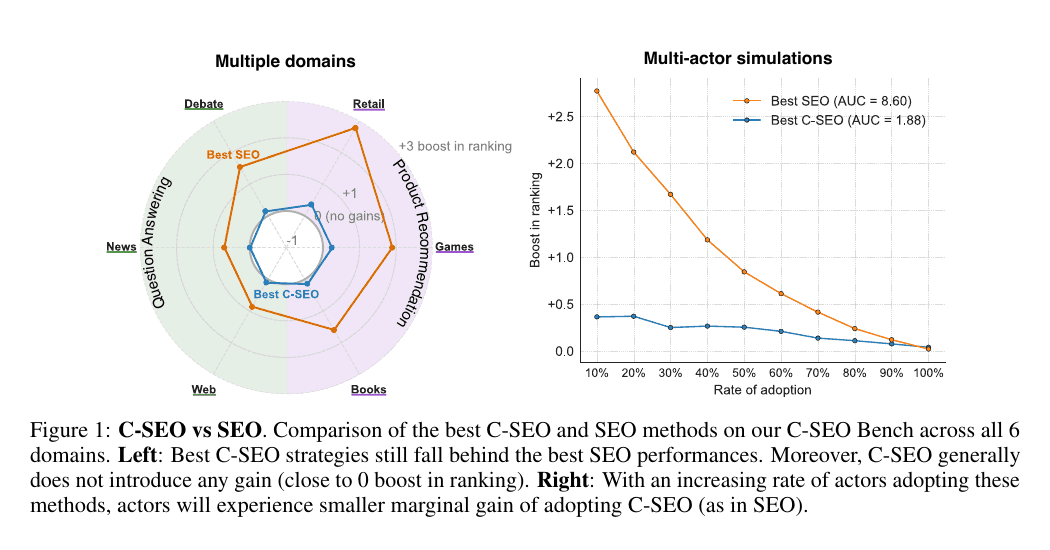
Source: C-SEO Bench, NeurIPS 2025.
We reread the paper and its methods before using that chart. It is a benchmark, not a forecast for your company. Its metric is citation-rank change under specified models, datasets, prompts, and adoption conditions. It does not measure buyer trust, pipeline, or revenue.
The earlier KDD 2024 GEO paper tested a different setup with 10,000 queries, 9 datasets and 25 domains. It found some content treatments improved its visibility metrics, but the later benchmark shows why a tactic should not become a universal recipe. The safer principle is simpler: make true, relevant evidence easy to retrieve and verify, then test the actual answer.
What can you observe, infer, and prove?
You can observe a dated answer, its visible citations, and whether your company was mentioned, compared, or recommended for that exact prompt. You cannot inspect a hidden reason for the source choice or prove that a page edit caused a later answer to change.
Evidence state | What you can say | What you still need |
|---|---|---|
Observed | This prompt produced this answer and these visible sources on this date | Repeated checks to see whether the pattern persists |
Inferred | The pattern may reflect an access, evidence, positioning, reputation, or fit gap | Competing explanations and more source review |
Business outcome | A person visited, started, qualified, bought, or retained | External analytics, CRM records, cohorts, and attribution |
Human judgment | The answer is fair, material, risky, useful, or worth correcting | An accountable reviewer with product and market context |
A public view count is not acquisition proof. Likes, shares, and engagement are not revenue evidence without a cohort, an attribution method, and an observation window. Keep the denominator attached to every claim.
Human judgment matters most at the recommendation stage. A model can assemble evidence and state a preference. It cannot own your definition of fit, approve a risky claim, decide whether a comparison is fair, or take responsibility for publication.
How does Trovance find the gap between a mention and a recommendation?
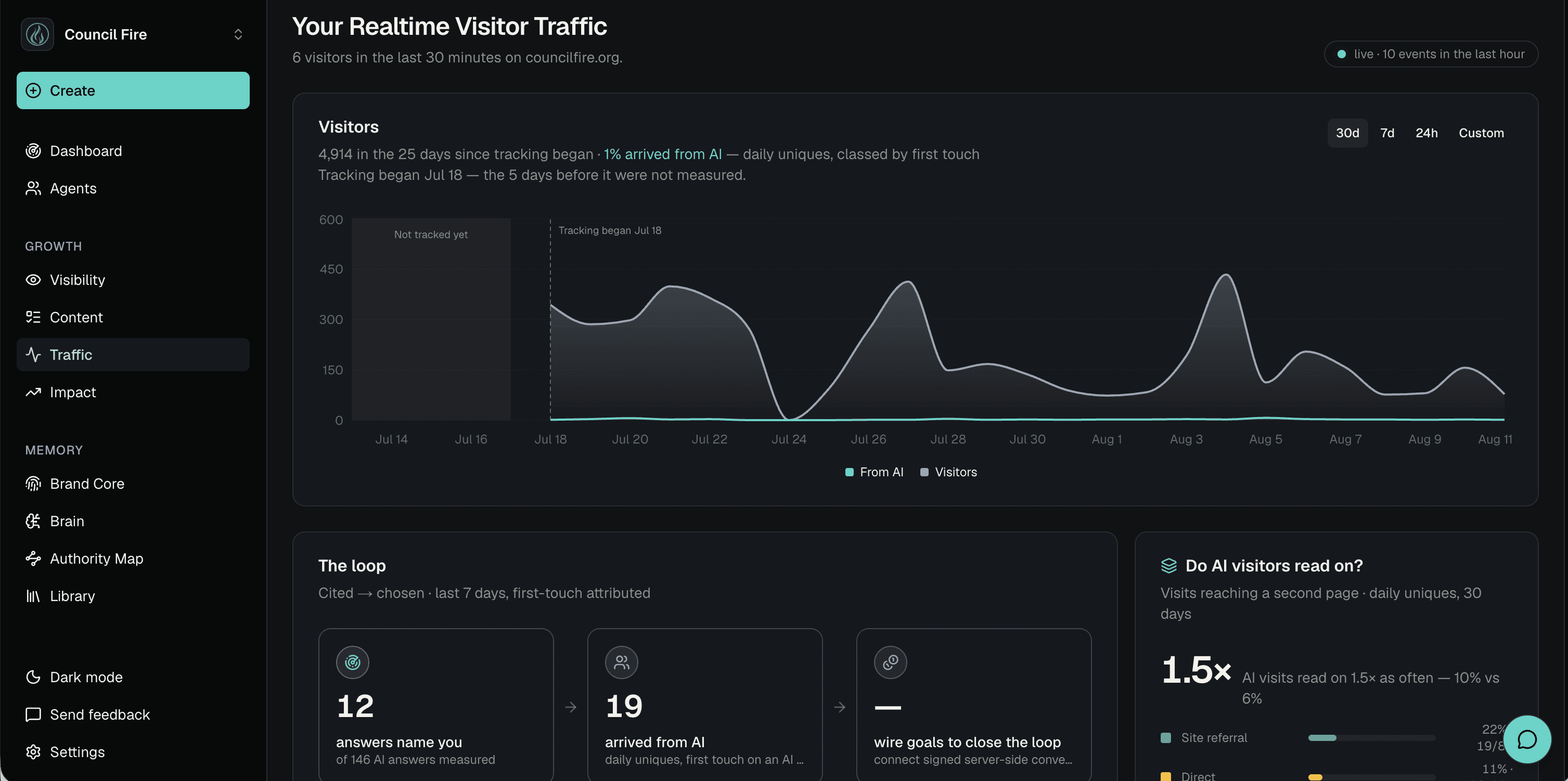
Trovance observes how AI systems explain, cite, compare, and recommend your company across the buyer questions you choose. It keeps the answer and sources attached, so the team can see whether the first break is identity, citation support, comparison evidence, product fit, or a legitimate reason not to be recommended.
A score alone cannot tell you which of those actions is justified. Trovance helps diagnose the evidence gap, decide whether an asset should exist, and carry approved sources into the proof-backed page, comparison, FAQ, or update the team should produce and publish. People still own truth, risk, fit, taste, and the publish decision.
Before changing your site, establish where your company appears today and what the answers rely on. Start your free trial, then use the first broken stage to choose the smallest honest action.
The trial does not promise a citation, ranking, comparison, recommendation, or business result. It gives your team a preserved answer and a clearer question: what evidence should exist here, if any?