
Before you prepare a product feed for AI discovery, give every consequential product fact one accountable owner. Then make the visible page, structured data, feed, and checkout agree with that source. A polished feed cannot rescue a wrong inventory value, and another article cannot fix a stale price hiding in a downstream record.
That is the verdict. Feed readiness is an operating contract before it is a formatting exercise.
In March 2026, a practitioner who works with merchants asked the OpenAI Community what matters most before formal onboarding and which common gaps to avoid. That public question supplies useful wording, not evidence of demand volume or merchant outcomes. The useful answer is not "complete every field." It is: choose the facts that can change a buying decision, establish who owns them, synchronize every public output, and test the handoff.
What should merchants get right before submitting a product feed?
Merchants should get identity, price, availability, seller context, and update ownership right before worrying about feed polish. OpenAI's current product-feed documentation says structured catalog data helps ChatGPT surface products with accurate pricing, availability, and seller context, and tells merchants to keep price and inventory updates fresh.
That wording makes freshness part of the feed contract. It does not tell you that a valid feed will be included in every answer, outrank another seller, complete checkout, or create revenue. Those outcomes sit downstream of the record you control.
Start with facts that can change a buyer's decision or make a transaction fail:
- the stable product and variant identifier;
- current title and unambiguous product identity;
- price, currency, and sale window;
- availability by variant and market;
- seller and fulfillment context;
- shipping constraints and delivery promise;
- compatibility or feature claims;
- the URL and image that represent the exact item.
For each field, name the accountable business system and human owner. "The feed" is not an owner. It is an output. Inventory may belong to an order-management system.
Approved product language may belong to a product-information system. Shipping may belong to a fulfillment ruleset. The feed should carry those decisions without silently becoming a second source of truth.
This is the same distinction behind pricing pages that AI agents can actually read: clarity on the page matters, but the underlying offer still needs a reliable owner and a consistent machine-readable expression.
What is product data drift?
Product data drift is a disagreement between records that are supposed to describe the same product at the same time. The page may show a new price while its JSON-LD carries the old one. A feed may mark an item available after the inventory system has sold the last unit. Every record can look valid alone while the set is wrong.
Drift is easy to miss because teams inspect surfaces, not the chain. Marketing checks the page. Engineering validates markup. Commerce operations reviews the feed.
A platform accepts the upload. Checkout calculates its own total. Each team gets a green light, but nobody compares one attribute across all five places.
Google documents this failure directly. When it combines website and Merchant Center feed data, update lag can create inconsistencies, including conflicts in price and stock availability. That is a Google-specific example, not a universal rule for ChatGPT. It still gives merchants a concrete operating lesson: parallel records drift when their owners, clocks, and update paths differ.
Evidence at readable size. Swipe or scroll horizontally to read all columns; keyboard users can focus the image and use arrow keys.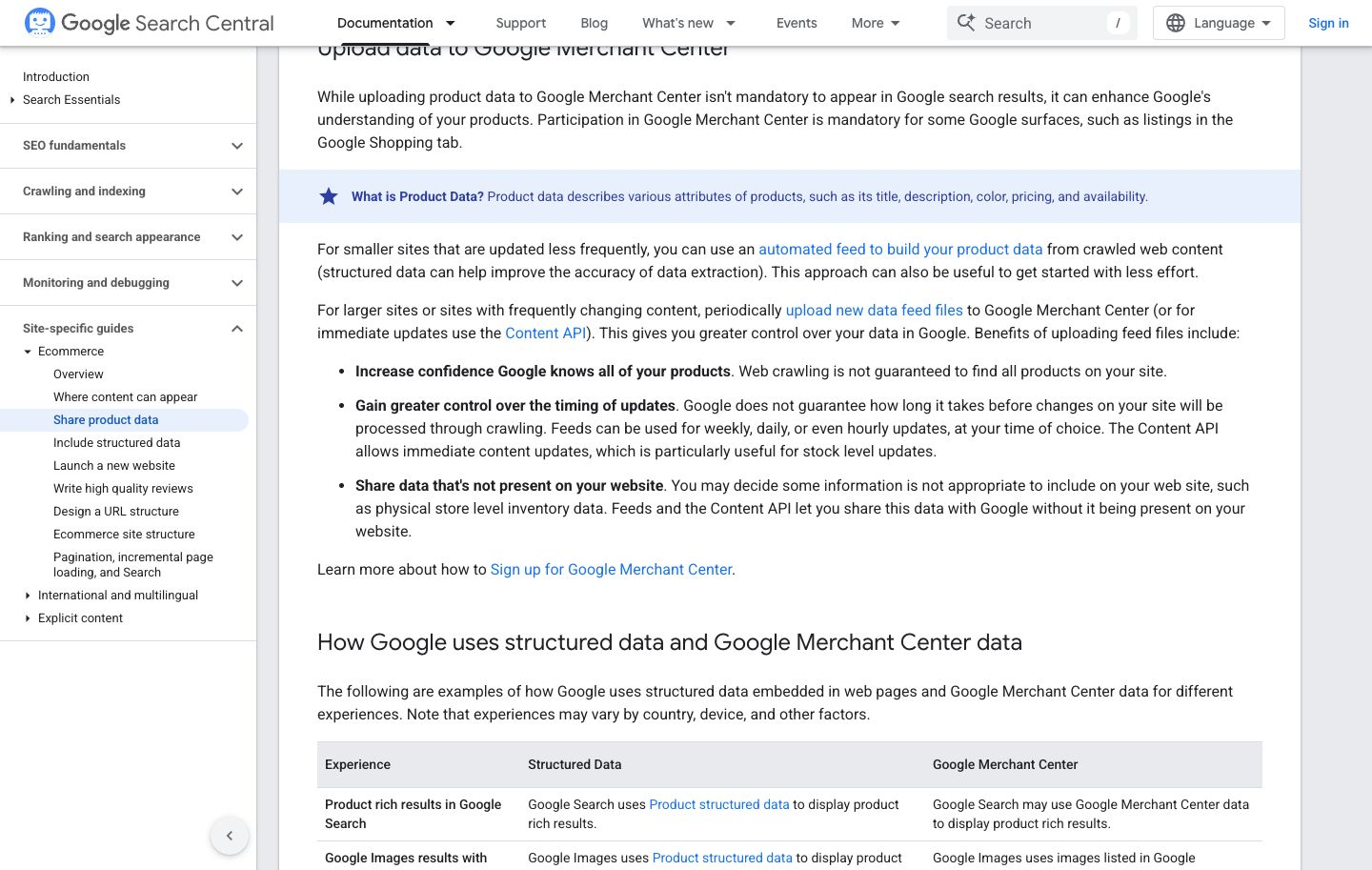 Source: Google Search Central.
The figure compares documented feed paths; it does not establish AI placement or sales outcomes.
Which record should be the source of truth?
The source of truth should be the accountable business system that can verify the disputed fact, its scope, and its effective time. The page, structured data, feed, and checkout should be synchronized outputs. There is no honest universal rule that the feed always wins or the page always wins.
Use this decision table before changing copy:
| Disputed fact | Accountable source | Outputs to reconcile | Human decision |
|---|---|---|---|
| Price or sale price | Commerce or pricing system | Page, JSON-LD, feed, checkout | Which price is legally and commercially current? |
| Availability | Inventory or order system | Page state, markup, feed, checkout | What does "in stock" mean for this market and variant? |
| Product title | Product-information owner | H1, metadata, markup, feed | Which name is current and unambiguous? |
| Shipping | Fulfillment rules | Product page, policy, markup, feed, checkout | Which geography and service level apply? |
| Compatibility | Product and documentation owner | Specs, comparison, feed description | Is the claim shipped, scoped, and supportable? |
The table is an editorial governance recommendation, not an OpenAI or Google prescription. Its purpose is to stop a common handoff failure: changing the easiest record instead of correcting the record that owns the fact.
A stale availability field does not need thought leadership. An unshipped integration does not need stronger copy. If the underlying product does not meet the buyer's condition, accept the gap. A relevant page can still miss the evidence AI needs, but evidence cannot make an unavailable product available.
How do you audit a page, markup, and feed mismatch?
Audit one disputed attribute from its accountable source through every downstream record. Capture each value and timestamp before changing anything, correct the owner first, regenerate dependent outputs, and verify each destination separately. Do not use a channel-wide rewrite to hide a single broken field.
Use this sequence:
- 1 — Name the exact item and attribute. Include product ID, variant, market, currency, and the fact in dispute.
- 2 — Preserve the current chain. Save the source-system value, visible page, rendered structured data, feed record, platform display, and checkout result with timestamps.
- 3 — Choose the accountable owner. Record who can verify the value, its scope, and its effective date.
- 4 — Correct upstream first. Change the owned system, then regenerate the page, markup, and feed instead of patching each copy by hand.
- 5 — Validate outputs. Inspect the rendered page and machine-readable record. Confirm the feed submission contains the intended value.
- 6 — Observe destinations later. Recheck the platform after its documented processing window and preserve what changed.
- 7 — Rerun the buyer question separately. If an AI answer was wrong, repeat the same declared test without claiming the feed caused any change.
Evidence at readable size. Swipe or scroll horizontally to read all columns; keyboard users can focus the image and use arrow keys.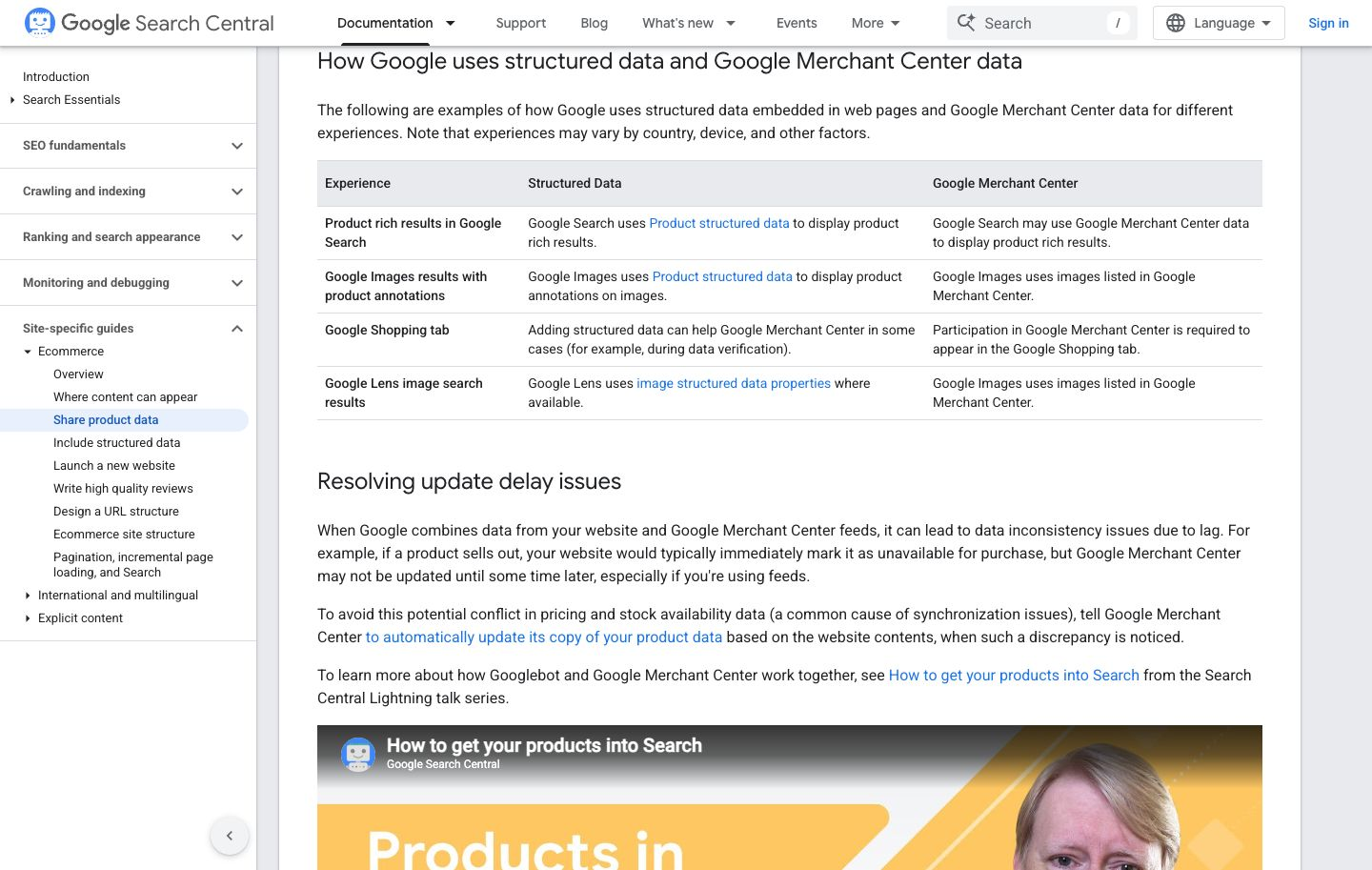 Source: Google Search Central.
The full context shows that input roles differ by surface and that accepted records can still drift.
The most useful audit artifact is not a score. It is a row-by-row comparison that a product, commerce, and marketing owner can sign off on. This example is illustrative, not a preserved merchant audit:
| Checkpoint | Observed value | Timestamp | Owner | Pass condition |
|---|---|---|---|---|
| Accountable source | $180, USD | Example timestamp | Pricing | Approved current value |
| Visible page | $180, USD | Example timestamp | Web | Matches source |
| Product markup | $200, USD | Example timestamp | Web platform | Must be regenerated |
| Merchant feed | $180, USD | Example timestamp | Commerce ops | Matches source |
| Checkout | $180, USD | Example timestamp | Commerce | Matches source and terms |
That table converts "AI has the wrong price" into a bounded correction. It can also reveal that the owned records are already consistent, which means the team should investigate another evidence source, an old third-party copy, platform processing, model variance, or buyer fit instead of rewriting the page.
What does a successful feed submission actually prove?
A successful feed submission proves that a destination accepted a record under its submission contract. It does not prove that the destination displayed the value, that an AI system retrieved it, that a buyer saw it, or that a transaction occurred. Keep those evidence states separate so the team does not turn one receipt into a funnel.
Use four layers:
| Evidence layer | What you can say | What remains unknown |
|---|---|---|
| Company record | The page, markup, or feed contains the approved fact | Whether an external system processed it |
| Platform display | A named destination displayed the fact at a recorded time | Which input controlled the result or how long it will persist |
| AI answer | A named system returned the fact for a dated question | Whether it generalizes across users, models, or future runs |
| Business result | Analytics recorded a visit, action, or sale under a declared method | Incremental causality without a stronger design |
A changed answer after a feed correction is worth recording. It is not enough to say the correction caused the change. Index refreshes, other sources, model updates, prompt context, geography, and ordinary run variance may have moved too.
This is why one AI visibility score is not enough. The operational question is not whether one number rose. It is which record changed, which surface processed it, which buyer question moved, and what decision follows.
How does Trovance route the right action after a product-data mismatch?
Trovance starts with the buyer question and the observed answer, then works backward to the evidence or product condition that explains the gap. It preserves what an AI system said, the sources it exposed, and the company records available for inspection. The diagnosis can be stale data, missing proof, unclear positioning, retrieval access, product fit, or no actionable gap at all.
Once the gap has a name, Trovance routes the smallest action that should exist. A stale price belongs in the accountable commerce system and its downstream records. A true feature with no public support may need documentation or a product clarification.
A misleading comparison may need a sourced page update. A product that does not satisfy the buyer's constraint may require a product decision, not content. Recommended work still crosses a human approval gate before execution.
After an approved correction ships, the question can be rerun and the new answer compared with the preserved baseline. That closes the loop without pretending a changed answer proves causality. The useful next state is a verified correction and a clearer decision trail—not another dashboard asking the team to guess what a score means.
If your page, markup, and feed disagree, Text Trovance with the exact product, attribute, and observed answer so the diagnosis starts from the record instead of a score.