
Choose the platform that begins where your team's work currently breaks. Evaluate Trovance first when the missing step is deciding what evidence-backed action should follow an AI answer; AirOps when the priority is repeatable SEO/AEO content workflows; and Jasper when a larger marketing organization needs shared context and governance across many workflows.
That is not a universal ranking. These 3 products now overlap across monitoring, context, production, review, and measurement, so the useful decision is which operating model solves your first broken handoff with the least unsupported inference.
Which workflow should your team evaluate first?
Evaluate the workflow closest to your current bottleneck before comparing breadth. A lean team that cannot explain why a competitor appears in AI answers has a different problem from an enterprise team trying to keep hundreds of assets aligned to one brand system.
Use this quick diagnosis:
| If this describes your team | Check this first | Take this action |
|---|---|---|
| You can see mentions and citations but cannot decide what should change | Inspect whether the system preserves answers, sources, uncertainty, and a no-action path | Evaluate the evidence-decision workflow first |
| Your strategy is clear, but research, refresh, review, and publishing are inconsistent | Inspect workflow building, data connections, review checkpoints, and CMS fit | Evaluate AirOps first |
| Many teams need one governed context layer across campaigns, SEO, personalization, and other marketing jobs | Inspect context setup, permissions, conflicts, agents, and pipelines | Evaluate Jasper first |
| You need monitoring plus production but do not know which operating model fits | Use the same real question and source set in every trial | Run the 6-part test below before buying |
The decision can change as the bottleneck moves. A team may solve workflow execution and then discover weak evidence diagnosis, or establish strong market evidence and later need broader campaign production. Buy for the next consequential handoff, not a permanent category identity.
What does each platform sell today?
Each platform sells an operating loop, but the loop begins from a different center of gravity. Public pages can establish that intended contract; they cannot prove performance inside your team.
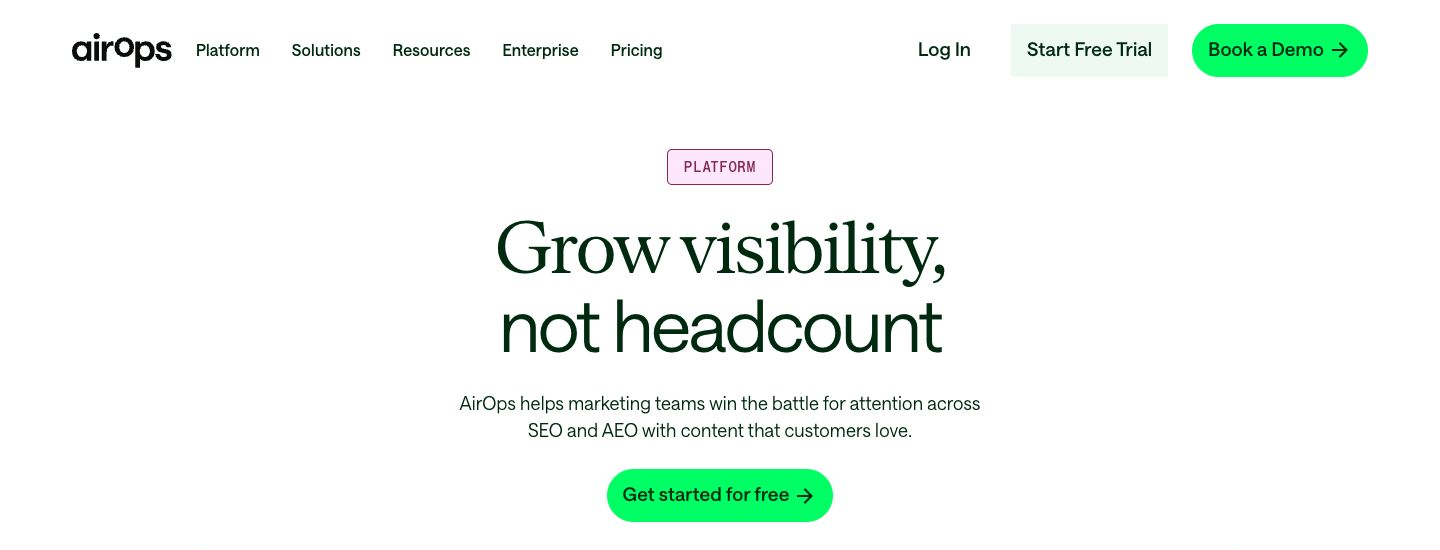
AirOps describes a content-operations platform built around Workflow Studio, AI Copilot, Power Agents, brand knowledge, human review, and publishing connections. Its AI-search visibility page adds recurring prompt tracking, page-level mentions and citations, prioritized actions, content refreshes, and post-update observation. That makes AirOps more than a writing tool: its public contract joins content automation to SEO and AEO signals.
Source: AirOps.
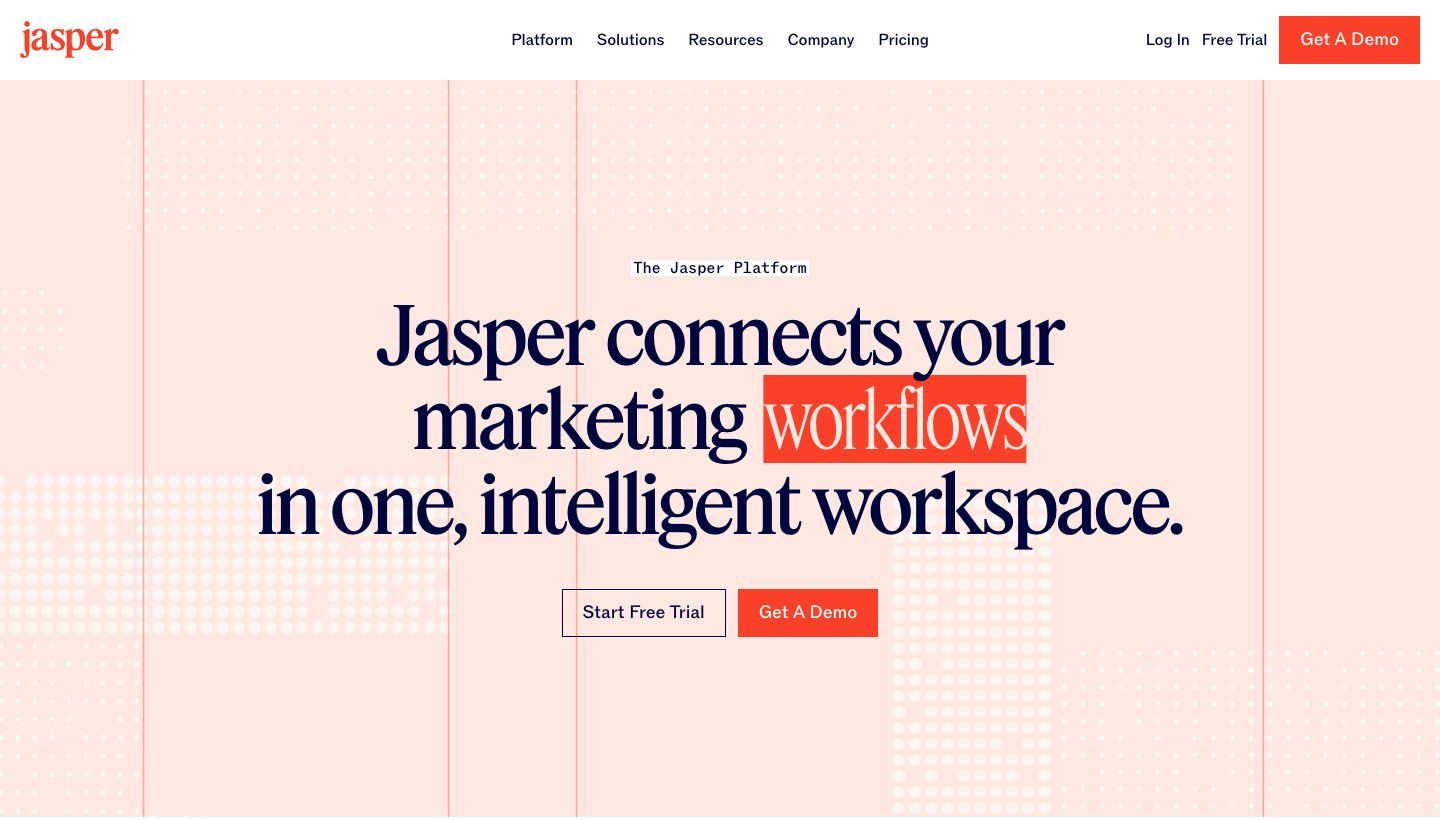
Jasper describes a broad AI marketing platform. Its architecture centers shared intelligence, agents, Content Pipelines, and Canvas, while Jasper IQ carries brand, marketing, product, audience, and company context. Its GEO page now adds AI-search monitoring, action prioritization, governed production, and measurement.
Source: Jasper.
Trovance starts from the observed buyer answer and the evidence decision behind it. Its public contract runs through observation, diagnosis, decision, production or routing, approval, execution, verification, re-observation, and learning. The narrower starting question is not simply "How do we make more content?" It is "What does the answer show, what evidence is missing, and what justified action should follow?"
These descriptions are vendor-published contracts, not independent outcome studies. They support what each company says the product is designed to do, not which product is faster, more accurate, easier to adopt, or more valuable.
How do the 3 operating models differ?
The clearest difference is the object each system tries to govern. AirOps foregrounds repeatable content workflows, Jasper foregrounds enterprise marketing context and execution, and Trovance foregrounds the answer-to-evidence-to-action record.
| Decision axis | AirOps public contract | Jasper public contract | Trovance public contract |
|---|---|---|---|
| Starting object | Content strategy, page, refresh, or workflow | Shared marketing context, campaign, agent, or pipeline | Buyer question, observed answer, source, and evidence gap |
| Primary operating promise | Systematize expert content work across SEO and AEO | Govern many marketing workflows in one enterprise platform | Turn an observed answer into a bounded decision and approved action |
| Human control | Review checkpoints and last-mile editing | Governed output and approval processes | Explicit gates for truth, fit, permission, taste, spend, and publication |
| Measurement boundary to test | Whether a content update and later visibility observation are kept separate from causality | Whether GEO scores and recommendations expose methods and uncertainty | Whether observation, inference, external analytics, and human judgment remain distinct |
| Best first fit to validate | Content and SEO teams scaling repeatable production | Larger marketing organizations aligning context across use cases | Teams stuck between visibility findings and defensible action |
The overlap matters. All 3 products now talk about context, workflow, review, and AI-search action. A buyer should therefore test quality at the seams: what enters the system, what gets inferred, which source survives, how exceptions work, who approves, and what receipt remains.
Do not let "end to end" erase those seams. One platform may span more steps while requiring more setup. Another may begin with a narrower job and produce a more inspectable decision. Neither condition proves better business results.
What setup burden should you expect?
Expect setup burden wherever the platform needs to understand your brand, data, workflow, or measurement rules. The question is not whether setup exists; it is whether each required input improves a real decision enough to justify maintenance.
For AirOps, test the work required to encode a workflow, connect sources, define brand rules, add review checkpoints, and publish into the existing stack. A flexible builder can fit many use cases, but every branch, exception, integration, and owner becomes part of the operating system your team must maintain.
For Jasper, test context governance first. Shared brand, marketing, product, audience, and company knowledge can reduce repeated prompting, but conflicts, stale records, permissions, and cross-team ownership become central. The buying team should see what happens when 2 sources disagree or 1 business unit needs an exception.
For Trovance, test the quality of the initial company, buyer-question, source, and approval setup. A smaller loop still fails if the wrong question is tracked, a source is stale, an inference is treated as fact, or every observation becomes a content request.
Ask each vendor to disclose 5 practical costs:
- Required input: Data and context before the first credible result.
- Configuration: Human time to build the first live workflow.
- Maintenance: Ongoing review, exception, and ownership work.
- Handoffs: Integration limits and manual transfers.
- Failure receipt: The record available when the system is wrong.
A polished demo can hide all 5. A buyer-owned test exposes them.
How should you run 1 fair trial?
Run one commercially important buyer question through all 3 systems and evaluate the complete path from input to approved action. Do not use 3 different demo problems or accept a blended score as the final artifact.
Preserve the model or engine, date, region, persona, prompt, raw answer, visible citations, source pages, and repeated runs. Then use this 6-part trial:
| Trial step | Pass condition | Failure signal |
|---|---|---|
| 1. Observe | Raw answer, prompt context, sources, and date remain inspectable | Only a score or summary survives |
| 2. Diagnose | Observation and inference are visibly separate | An absence automatically becomes a content gap |
| 3. Decide | The proposed action follows from evidence and allows no action | Every route ends in creating more content |
| 4. Produce | Claims remain attached to sources, brand context, and owner | Fluent copy loses provenance or conditions |
| 5. Approve | A named person controls consequential changes | Review is implied, optional, or difficult to audit |
| 6. Measure | Answer observations remain separate from traffic, activation, pipeline, and revenue | A score change becomes an attribution claim |
Add one adversarial case. Make the competitor legitimately better for the prompt, provide a stale source, or create a conflict between brand language and public product documentation. The useful system should surface the conflict rather than smoothing it into confident copy.
Score the operating reality only after the trial: time to first credible result, review burden, exception handling, source visibility, integration work, and quality of the final receipt. Do not convert that trial into a universal product ranking; it is evidence about your workflow under declared conditions.
What can this comparison not prove?
This comparison cannot prove output quality, return on investment, attribution, reliability, or adoption because it did not run credentialed production tests inside the 3 platforms. It inspected current first-party product contracts and visible page evidence.
AirOps' pages include performance and attribution claims. Jasper's pages include claims about governed execution, review cycles, citations, and measurement. Trovance's site includes category and product-loop claims. Those statements may guide a trial, but they should not be inherited as buyer benchmarks without a cohort, denominator, observation window, causal design, and complete failure accounting.
Keep 4 evidence classes separate:
| Evidence class | What it supports | What it does not support alone |
|---|---|---|
| Public product contract | Intended capabilities, module names, and positioning | Accuracy, reliability, adoption, or outcomes |
| Visible interface | What the page or demo exposes | Hidden scoring, backend behavior, or complete permissions |
| Controlled trial | Performance on your declared inputs and workflow | Universal superiority or long-term business impact |
| Business analytics | Visits, activation, qualification, pipeline, and revenue events | Causality without an attribution design |
Pricing and packaging can change the decision, but public prices are not normalized across usage, services, onboarding, seats, regions, and enterprise terms. Compare total operating cost only after each vendor scopes the same workflow.
When should your team choose Trovance?
Choose Trovance when your expensive gap sits between observing what AI says and deciding what evidence-backed action should follow. The product is designed to preserve the answer and visible sources, diagnose whether the break is evidence, positioning, retrieval, product, or fit, then produce or route an action through human approval and verification.
Source: Trovance.
That starting point matters when a visibility finding keeps becoming an unsupported article request. A responsible result may be a source correction, product clarification, comparison page, third-party validation, refresh, no action, or work owned by another team. Trovance can help observe, cite, compare, recommend, preserve evidence, produce a draft, and prepare a publish action. It cannot control model answers, guarantee recommendations, prove revenue causality, or replace analytics and human judgment.
Run Trovance on your own company so you can compare the workflow using a real visibility and evidence result. Start your free trial, preserve the answer and sources, and use that same evidence package in every vendor trial.