
AI can remove hours from production without removing a single hard marketing decision. The brief can become a page, campaign, or workflow in one sitting. Someone still has to decide whether the audience matters, the claim is true, the evidence is sufficient, the work sounds like the brand, and the result deserves to ship.
Vibe marketing is an AI-assisted operating model in which a marketer describes the desired outcome, audience, constraints, and creative direction in plain language, then uses models, agents, and no-code tools to execute bounded parts of the work. The marketer steers through feedback rather than completing every production step by hand. Its promise is speed. Its real test is whether the team learns faster without weakening truth, taste, or accountability.
TL;DR
⚙️ AI already represented 17.2% of marketing efforts in The CMO Survey's 2025 sample of 281 U.S. marketing leaders.
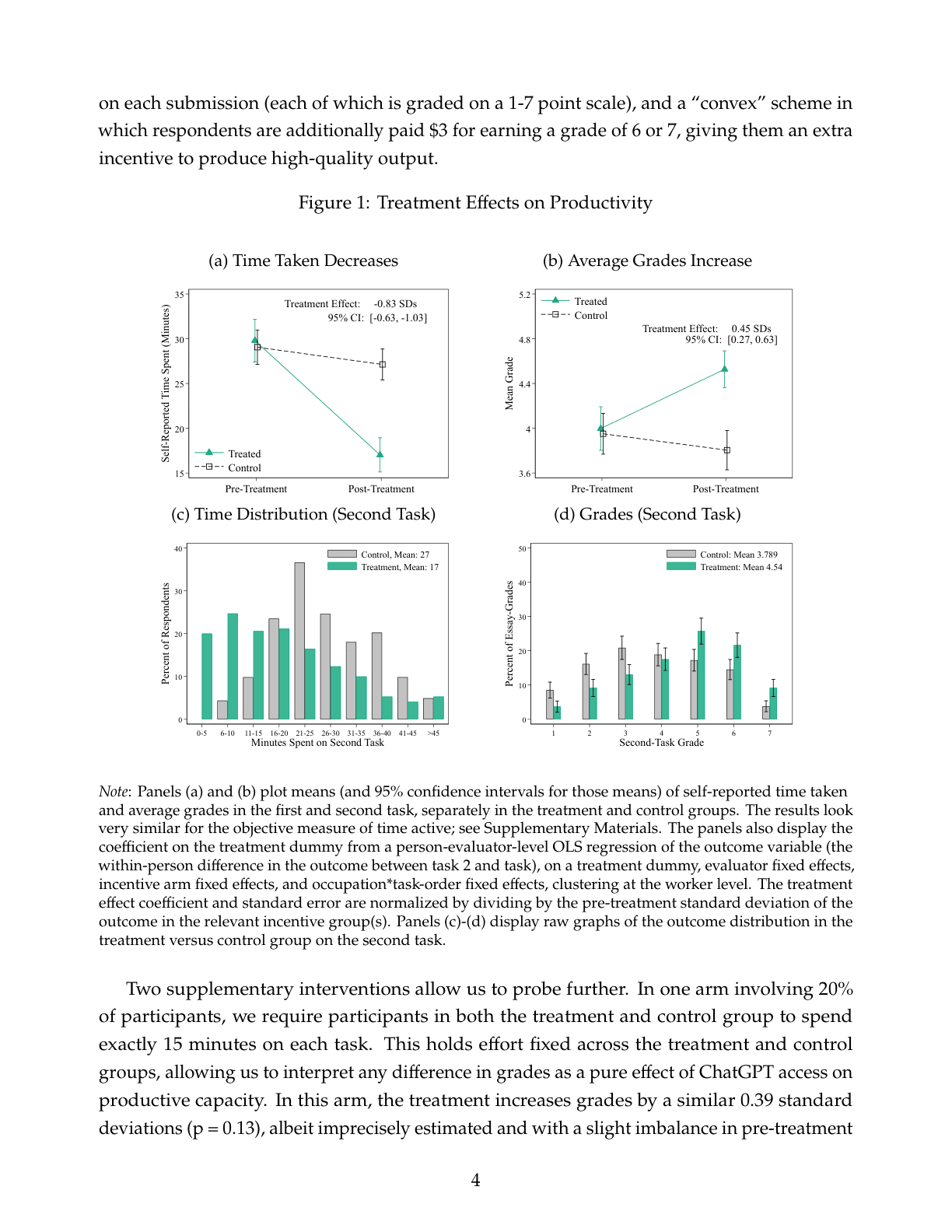
✍️ In a randomized experiment with 453 professionals, ChatGPT cut writing time by 40% and raised evaluated quality by 18% on contained professional-writing tasks.
📈 Organizational AI use rose from 55% to 78% in one year, while generative-AI use in at least one function rose from 33% to 71%.
🧭 A useful vibe-marketing loop has 6 stages: direction, evidence, execution, review, launch, and learning.
🔎 Trovance connects 1 observed market answer to the evidence-backed action a team can approve, publish, and verify.
What is vibe marketing?
Vibe marketing is a way to direct AI-assisted marketing through intent and feedback instead of manually producing every component.
You tell the system what the work should accomplish, who it should reach, what it must preserve, and what it must avoid. The system researches, drafts, builds, analyzes, or routes the work. You inspect the result, correct the direction, and repeat until the artifact is ready for a defined next step.
The phrase covers more than AI copywriting. A vibe-marketing workflow might turn a product insight into a landing page, build a small campaign app from a description, draft an email sequence from approved claims, create ad variants, summarize performance, or route replies for review. The common thread is that natural-language direction replaces part of the manual interface work.
That does not make vibe marketing a formal discipline with one accepted framework. It is an emerging industry label. A 2026 MarTech practitioner article uses it for plain-English campaign building across tools such as Bolt, Lovable, and Make.
Other writers use the same phrase for emotional brand direction, trend response, or autonomous agents. The stable idea underneath the label is simpler: people set direction and boundaries; AI accelerates execution; feedback shapes the next pass.
Where did vibe marketing come from?
Vibe marketing borrowed its name and posture from vibe coding, then translated the idea from software production to marketing work.
In Andrej Karpathy's original February 2025 post, vibe coding meant giving in to AI-assisted flow, describing changes conversationally, accepting generated code, and paying less attention to the underlying implementation. The phrase was funny because it admitted the bargain: speed and access rise while direct inspection falls.
Marketing adopted the same bargain quickly. A marketer can now describe a launch page, upload a screenshot, connect a form, generate copy, and produce a working prototype without waiting for a traditional chain of specialist handoffs. The ability is real even if the surrounding mythology is not.
The marketing version needs a stricter boundary than the original joke. Undetected software defects can break a product. Undetected marketing defects can create false claims, expose customer data, damage trust, waste spend, or teach AI systems and buyers the wrong thing about a company. The easier production becomes, the less defensible it is to skip the evidence and approval steps.
How is vibe marketing different from AI marketing, automation, and agile marketing?
Vibe marketing differs mainly in the interface and operating posture: direction is conversational, execution is assembled quickly, and the marketer steers by inspecting outputs.
Approach | Starting point | Machine's role | Human's role | Main failure mode |
|---|---|---|---|---|
Traditional campaign production | Approved plan and specialist handoffs | Executes narrow software functions | Creates and coordinates most work | Slow cycles and diluted intent |
Marketing automation | Defined triggers, fields, rules, and sequences | Repeats known actions | Designs logic and handles exceptions | Automating stale assumptions |
Agile marketing | Prioritized backlog and short work cycles | Optional support | Runs tests and retrospectives | Activity without strategic learning |
AI-assisted marketing | A task given to a model or tool | Generates or analyzes an output | Prompts, edits, and applies it | Isolated output with weak context |
Vibe marketing | Outcome, constraints, examples, and feedback | Builds connected parts of the activation | Directs, judges, approves, and learns | Speed without evidence or control |
These approaches can coexist. A team might use vibe marketing to prototype a campaign, agile practices to prioritize tests, automation to run approved sequences, and traditional review for legal or brand-sensitive claims.
The term becomes useless when it means any marketing work that touches AI. The meaningful shift is from operating a fixed interface to describing an intended state. Instead of filling 12 fields across 4 tools, the marketer can say what should happen and let a system translate that direction into actions. That compression is valuable only when the translation remains inspectable.
What should a vibe-marketing workflow include?
A working vibe-marketing system needs six stages: direction, evidence, execution, review, launch, and learning.
Direction: define the buyer, business job, desired outcome, brand posture, constraints, and definition of done. "Make it punchy" is taste guidance. It is not a strategy.
Evidence: attach the product truth, customer language, approved claims, sources, examples, current performance, and known limits the system may use. Missing evidence should block or qualify the output rather than invite invention.
Execution: assign bounded work to the appropriate tool. A model may synthesize research, an agent may assemble a page, and automation may move approved data between systems. Each action should have a visible input and artifact.
Review: check claim accuracy, source support, audience fit, voice, privacy, accessibility, design, links, and technical behavior. The reviewer needs authority to reject the work, not just clean up wording.
Launch: publish or activate through a controlled destination. Record the version, owner, approval, date, audience, spend, and rollback path.
Learning: compare the result against the original job. Record reach, response, activation, pipeline, or another business event with its denominator and window. Feed supported lessons back into the next brief.
This loop resembles the lifecycle view in NIST's voluntary AI Risk Management Framework: risk management spans design, development, use, and evaluation. Marketing teams do not need a governance department for every social post. They do need an explicit boundary between reversible experimentation and consequential public claims.
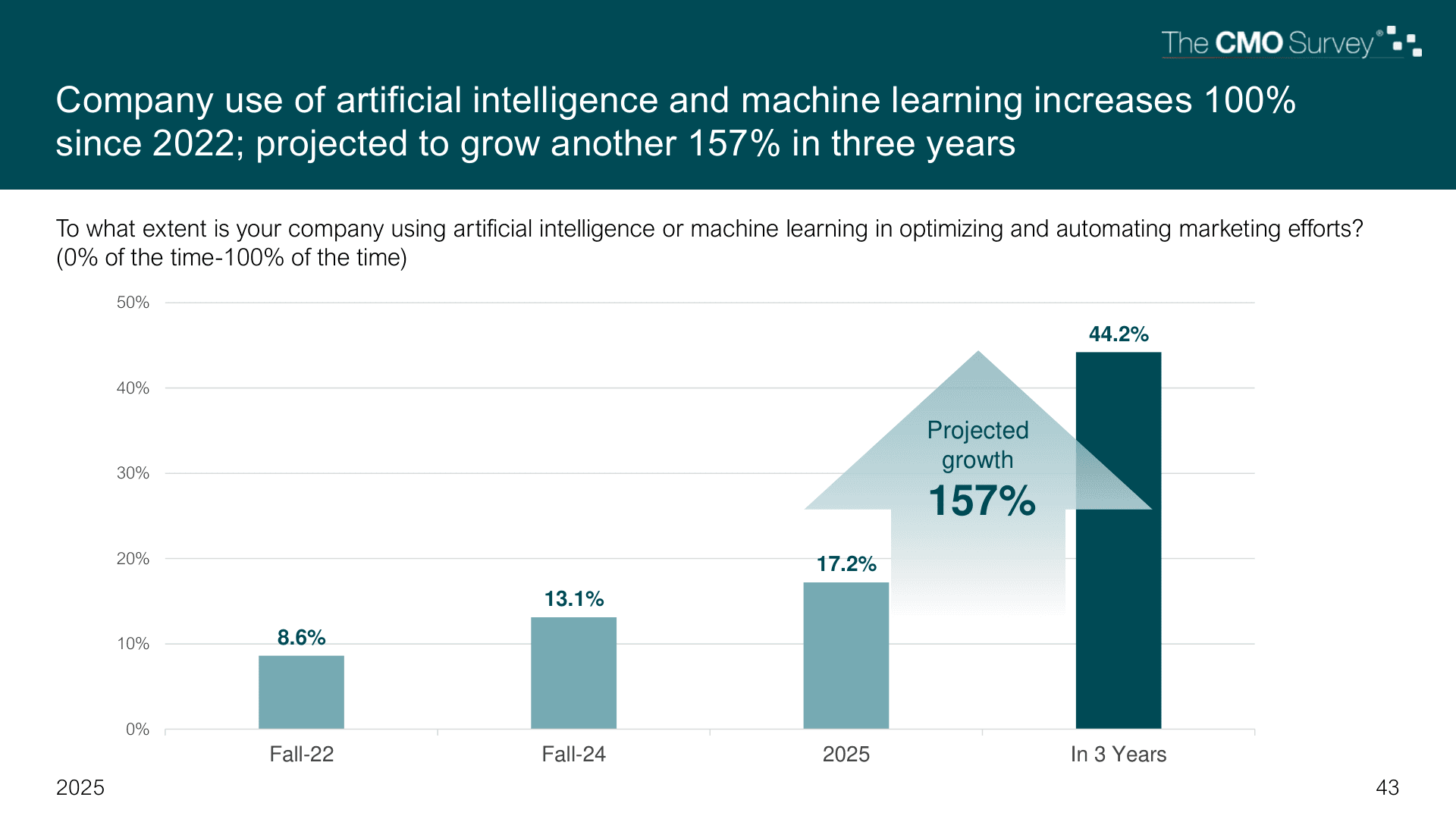
Source: The CMO Survey 2025 Highlights and Insights Report, page 43.
What work should AI handle, and what should people keep?
AI should handle repeatable transformation and inspection work; people should retain truth, permission, taste, prioritization, and consequential decisions.
Delegate first | Keep human-owned | Why |
|---|---|---|
Source collection and formatting | Which sources are credible enough to use | Retrieval is mechanical; authority is contextual |
Draft variants and layout prototypes | The claim and emotional territory | Variation is cheap; brand meaning is scarce |
Data cleanup and recurring summaries | Metric definitions and causal conclusions | Calculation can automate; interpretation can mislead |
Workflow routing and reminders | External sends, spend, and publication approval | Routing is reversible; public action carries risk |
Link, metadata, and consistency checks | Whether the work deserves to exist | Compliance with a template is not editorial judgment |
A useful rule is to delegate work that is bounded, observable, reversible, and easy to verify. Require approval when a task changes public truth, spends money, contacts someone, exposes sensitive data, changes a canonical metric, or is expensive to reverse.
The legal baseline does not disappear because a model drafted the sentence. The FTC's advertising guidance says claims must be truthful, non-deceptive, non-unfair, and evidence-based. AI can help locate support and flag contradictions. It cannot decide that an unsupported claim became acceptable because a deadline arrived.
The control gap is visible in the IAB State of Data 2025 report. Among 529 experts at agencies, brands, and publishers, 40% reported using or planning defined KPIs for AI solutions, 33% mandatory human oversight, and 21% an AI governance board or point person. Because the survey combines implemented and planned controls, those figures describe intent as well as current practice.
In my own content systems, faster drafting changed the work I spent time on. The blank page stopped being the bottleneck. Source selection, claim boundaries, preservation of buyer language, and the decision to publish became the work worth protecting.
What can vibe marketing improve?
Vibe marketing can improve the speed and accessibility of contained work, but the strongest evidence does not prove a universal campaign or revenue effect.
The cleanest causal evidence comes from narrower tasks. Noy and Zhang ran a preregistered randomized experiment with 453 college-educated professionals completing incentivized professional-writing assignments. ChatGPT access reduced average completion time by 40% and increased evaluated output quality by 18%.
Those results support AI-assisted drafting under the experiment's conditions. They do not establish that a model chose the right audience, positioned a product correctly, created an original strategy, or caused revenue growth. The researchers studied contained writing assignments, not a connected marketing program with customer data, brand history, channel effects, and delayed outcomes.
The task itself also changed. In the working-paper analysis, treatment participants spent less time rough-drafting and more time editing. That is a useful description of the vibe-marketing shift: production compresses, selection and correction expand.
A second preregistered experiment with 758 BCG consultants found a jagged performance frontier. Within the tested boundary, AI users completed 12.2% more tasks, worked 25.1% faster, and produced more than 40% higher-quality results. Outside that frontier, AI users were 19 percentage points less likely to reach the correct answer.
The lesson is not that AI works or fails. It is that the operator must know which kind of task sits in front of the system.
Where does vibe marketing fail?
Vibe marketing fails when a team mistakes fluent execution for a correct decision.
The most common failure modes are predictable:
Prompt-first strategy: the team begins with a tool before defining the buyer problem or business event.
Evidence-free claims: models fill missing proof with plausible language, and review focuses on style rather than truth.
Context drift: each tool receives a slightly different audience, offer, metric, or brand rule.
Approval theater: a person clicks approve after the system has already scheduled, sent, or published the consequential action.
Variant inflation: the team produces 50 options without enough traffic or review capacity to learn from them.
Metric collapse: impressions, engagement, clicks, leads, pipeline, and revenue are treated as one story.
Maintenance debt: pages, sequences, and automations keep running after the source facts, offer, or market condition changes.
Broad adoption does not remove these problems. Stanford's 2025 AI Index reports that organizational AI use rose from 55% in 2023 to 78% in 2024, while generative-AI use in at least one business function rose from 33% to 71%. Adoption is an input, not an outcome.
The same report says 71% of respondents using AI in marketing and sales reported revenue gains, but the most common increase was below 5%. That finding is encouraging and bounded. It does not tell us which tool, workflow, baseline, or confounder produced the gain.
How should you measure vibe marketing?
Measure vibe marketing as a funnel from production efficiency to verified business effect, not as an output counter.
Use at least four layers:
Layer | Example metric | Required denominator | What it can support |
|---|---|---|---|
Production | Median brief-to-approved-asset time | Eligible assets started | Whether the workflow got faster |
Quality | First-pass acceptance or repair rate | Assets reviewed | Whether speed preserved standards |
Activation | Qualified visits, sign-ups, replies, or meetings | People exposed or eligible | Whether the work changed behavior |
Business | Pipeline or revenue associated with the cohort | Accounts or opportunities in scope | Contribution under a stated method |
The CMO Survey gives a useful benchmark for adoption, with important limits. Its 2025 report covered 281 U.S. marketing leaders, 99% at VP level or above.
Respondents said generative AI was used in 15.1% of marketing activities, up from 7.0% a year earlier. They reported 8.6% better sales productivity, 8.5% higher customer satisfaction, and 10.8% lower marketing overhead.
Those are executive self-reports, not randomized estimates. Use them to understand the direction and reported magnitude of adoption. Do not paste the percentages into an ROI model and call the result a forecast.
For your own program, define the cohort before launch. Preserve the baseline, date, audience, channel, spend, model and workflow version, excluded failures, and observation window. A campaign that shipped in 2 days instead of 10 may still be a bad trade if review doubled, the evidence weakened, or qualified response fell.
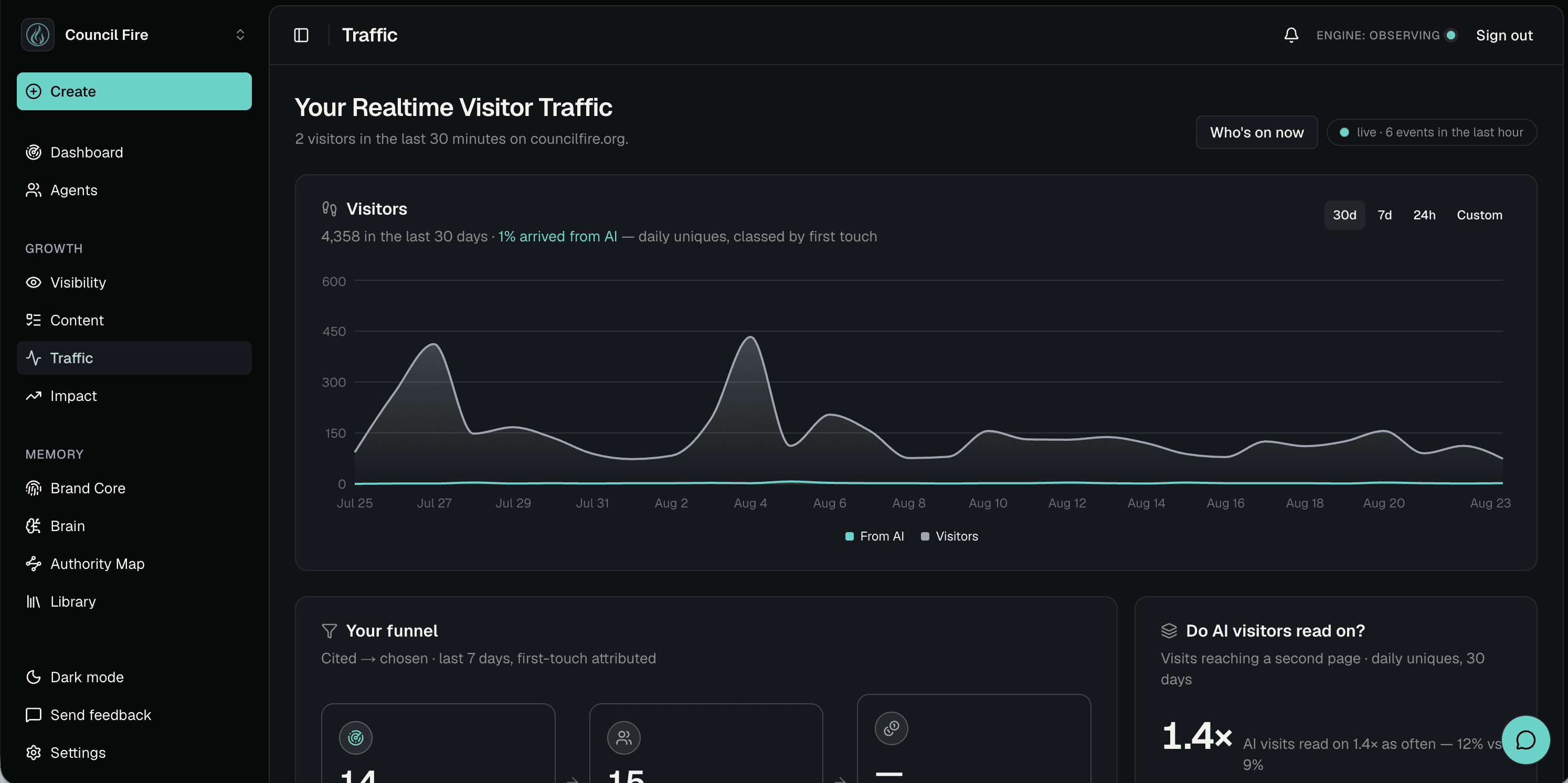
How does Trovance turn vibe marketing into an evidence loop?
Trovance connects fast AI-assisted production to an observed market question, a diagnosed evidence gap, an approved claim, and a verified follow-up.
A generic vibe-marketing workflow can start with an idea and end with a published asset. Trovance starts one step earlier by observing how AI systems answer, cite, compare, and recommend a company. It preserves the answer and sources, helps diagnose whether the real issue is missing evidence, unclear positioning, stale facts, weak third-party proof, technical access, or legitimate bad fit, then moves the justified action into production.
That action may be a page, comparison, FAQ, article, product clarification, proof request, or no content at all. Trovance can help produce the asset and preserve its sources. A person still decides what is true, what can be public, what fits the brand, and what gets published.
The result is vibe marketing with a receipt: observed answer to evidence decision to approved asset to published URL to comparable rerun. Trovance does not guarantee a citation or prove that one content change caused revenue. It makes the work inspectable enough to learn without pretending correlation is causation.