An outline tells a writer what to cover. It does not tell an AI drafting system what the evidence permits it to say.
That gap is where careful source notes become polished nonsense. A brief may contain the right topic, link to the right paper, and still lose the condition that made the source claim true. The safer handoff is a claim contract: the exact assertion, supporting passage, scope, unresolved ambiguity, and public-use decision exposed before prose begins.
A peer-reviewed ACL 2025 study of 396 long-form answers offers a useful mechanism for this control. Its researchers labeled 6,490 sentences with three annotators, compared six methods, and evaluated extracted claims on entailment, coverage, and retained context. It did not study marketing briefs.
For editorial review, our proposed claim contract adapts that research; it is not a framework tested by the paper. If the source cannot resolve an interpretation, the drafting system should not quietly choose one.
What fails when a brief starts with topics instead of claims?
A topic-first brief can organize an article while leaving its consequential assertions underspecified. A topic does not identify the exact source passage, applicable product plan, date, or condition that a writer must preserve. Before drafting, turn each material assertion into a checkable claim so an editor can approve, narrow, or reject it.
"Write about enterprise security" is a topic. "The product supports SSO for accounts on Plan X as of 1 August 2026" is a claim. The second statement can be checked against documentation, scoped to a plan, dated, assigned to an owner, and rejected if the source does not support it.
The ACL paper makes a similar distinction inside fact-checking. It evaluates whether an extracted claim is entailed by the source, whether it covers the source's verifiable elements, and whether it retains enough context to preserve the verdict. Those are different tests. A sentence can be broadly on topic and still fail one of them.
The experiment began with 73,681 generated claims across four extraction methods. After duplicate removal, 73,229 claims remained. That scale is useful, but the sharper lesson comes from the errors: a claim can sound cleaner than its source while omitting who said it, when it applied, or which product and condition it described.
Research note: An AI research agent retrieved the complete ACL paper and compared its main tables with the human-review appendices for this draft. That work is not firsthand research by the named author. The paper describes errors an editor would recognize: an entity inferred from outside knowledge, a relationship assembled from separate claims, or a source viewpoint rewritten as a general fact.
What does a claim contract need to preserve?
A claim contract should preserve the exact assertion, its supporting passage, required factual elements, scope, unresolved ambiguity, evidence location, and human decision. A reviewer needs enough information to reconstruct why a line is allowed into the draft, including the conditions that would require a correction or stop publication.
The first five fields adapt the paper's claim-quality framework. The last two come from editorial governance. Together, they make the handoff inspectable:
| Contract field | Review question | Stop condition |
|---|---|---|
| Exact claim | What will the public draft assert? | The line is still a theme, instruction, or adjective |
| Source passage | Which passage entails the claim? | The source only discusses an adjacent idea |
| Verifiable elements | Which names, numbers, dates, and relationships must survive? | One required element disappears in the rewrite |
| Scope and context | For which product, segment, period, or condition is it true? | Added context would change the meaning or verdict |
| Ambiguity state | Can the source resolve every reference and interpretation? | Two plausible readings remain |
| Evidence URL | Can a reviewer open the primary artifact? | The link ends at a summary or inaccessible chain |
| Owner and decision | Who confirms truth, sensitivity, and public use? | Nobody is accountable for approval |
The researchers define three evaluation dimensions: entailment, coverage, and decontextualization. They deliberately avoid treating atomicity as the finish line because a claim can always be split further. For an editorial brief, that is a relief.
The job is not to atomize language forever. It is to isolate enough meaning that a person can test what the draft is allowed to say.
Evidence at readable size. Swipe or scroll horizontally to read all columns; keyboard users can focus the image and use arrow keys.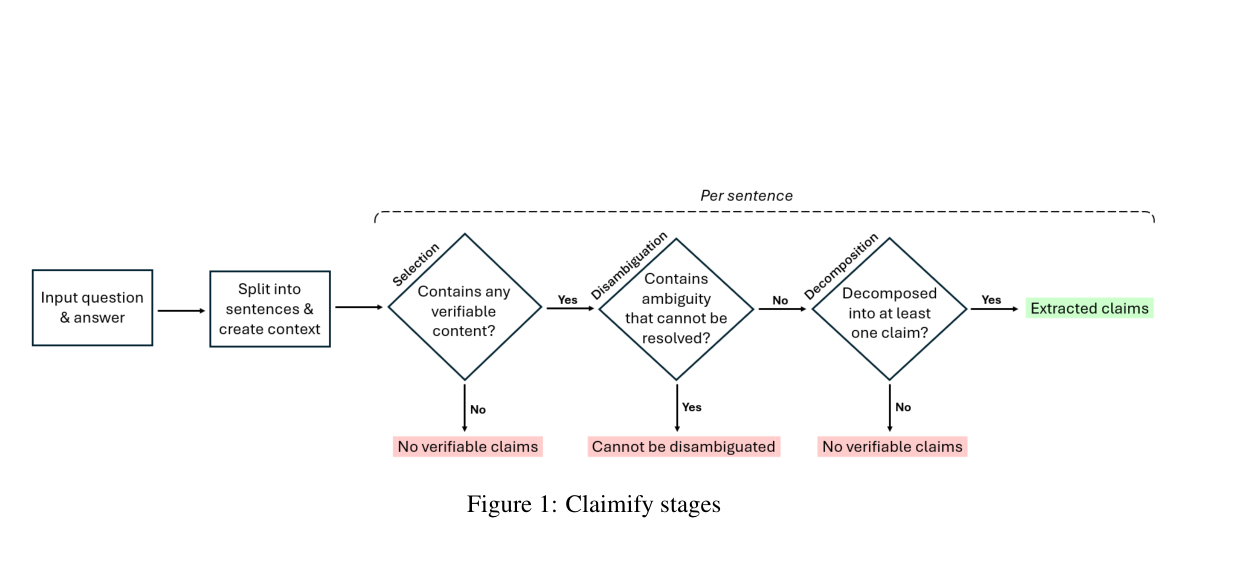 Source: Metropolitansky and Larson, ACL 2025.
Figure 1 shows the paper's sequence: split the answer into sentences and context, select verifiable content, stop when ambiguity cannot be resolved, then decompose the remaining material into claims. A content workflow does not need to copy Claimify to borrow that order. Selection should happen before drafting, and unresolved interpretation should remain unresolved.
Why should ambiguity stop an AI draft?
Ambiguity should stop the affected claim because fluent prose can hide that a source supports more than one reading. The editor should resolve the reference from the source, obtain clarification, narrow the assertion, or remove it. Other supported claims can proceed; the uncertain line must not acquire a meaning merely because the model can supply one.
Consider a product note that says, "It will be available next quarter." Without a stable entity, date, and document context, an AI system can turn "it" into the feature named in the heading and "next quarter" into a calendar date. The sentence becomes easier to read and harder to defend.
Claimify looks for referential ambiguity and structural ambiguity before decomposition. Under the paper's three-model comparison, the share of sentences it marked "Cannot be disambiguated" was 5.4% with Mistral Large 2411, 3.2% with GPT-4o, and 2.4% with DeepSeek-V3. Those are method outputs, not universal ambiguity rates. They show that the stop state was used rather than left as decorative policy.
A serious content system needs the same refusal. Return the claim for clarification. Narrow it to what the source actually says.
Find a stronger primary artifact, or remove the claim. A blank cell in a claim contract is more honest than a paragraph that picked the convenient interpretation.
How should teams measure claim coverage?
Teams should check whether every verifiable element required by the assertion survived the rewrite, including names, numbers, dates, and relationships. Compare the draft with the source passage element by element. Record omissions separately from additions: a sentence can lose a limiting condition and introduce an unsupported interpretation while still sounding factual.
The paper's example is disarmingly simple: "The iconic American flag has 50 stars and 13 stripes." A weak extraction can keep the unverifiable adjective "iconic" and replace the two numbers with "numerous." At the sentence level, it still looks like a factual claim. At the element level, it preserved the wrong thing.
That is common in marketing drafts. A source says an experiment used one model, a defined sample, and a limited task. The draft keeps the positive result and drops the model, sample, and task.
The source link remains. The claim contract has failed.
Evidence at readable size. Swipe or scroll horizontally to read all columns; keyboard users can focus the image and use arrow keys.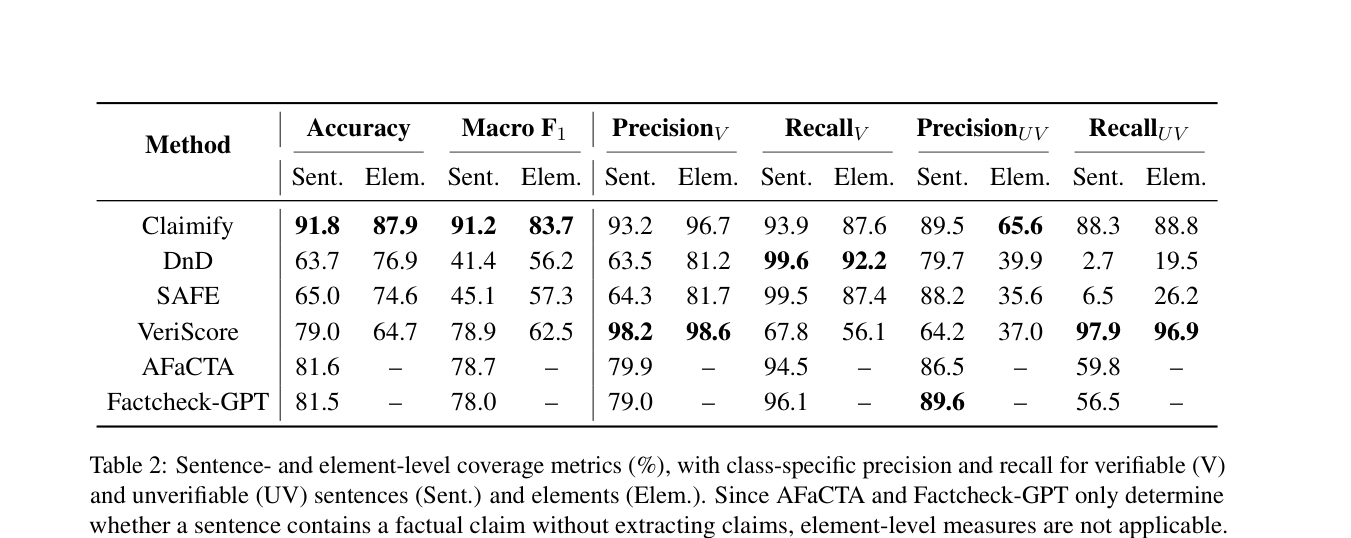 Source: Metropolitansky and Larson, ACL 2025.
In Table 2, Claimify reached 91.8% sentence-level accuracy and 87.9% element-level accuracy under the study's main condition. Its macro F1 values were 91.2% and 83.7%. The element-level evaluation used the 81% of sentences whose element-based verifiability labels matched the sentence annotations, not the entire dataset. These scores measure different tasks on different evaluation sets; they are not a like-for-like estimate of how much accuracy an editorial workflow would lose.
The validation remains bounded. Reviewers manually checked 80 sentences; 76 of 80, or 95%, met all element-quality criteria. Across 806 coverage labels, reviewers disagreed with 25, or 3%.
In 24 of those 25 disagreements, the evaluator incorrectly called an element covered. Even the coverage check tended to be too generous.
What can this study not prove about marketing content?
This study cannot prove that claim contracts improve AI citations, rankings, recommendations, traffic, pipeline, or revenue. It tests extraction of factual claims from generated answers, not the proposed editorial workflow. Its results support investigating selection and ambiguity checks; a content team would still need its own comparison to establish whether those checks reduce unsupported published claims.
It evaluates claim extraction on one dataset of long-form Copilot answers. The 63% of sentences labeled verifiable describe that dataset, not a healthy ratio for a product page. The 99.0% entailment result across 12,406 Claimify claims means the evaluator found those claims supported by the combined source sentence, context, and question. It does not establish that the underlying source was true.
The automated evaluator also needed human scrutiny. In an 80-claim manual sample, its entailment labels conflicted with reviewers in five cases. The paper uses one primary model condition at temperature 0, then reports cross-model tests. Its authors name single-dataset scope as a limitation.
The paper's ablation table helps separate a useful mechanism from a universal workflow claim. Removing the Selection stage reduced element macro F1 from 83.7% to 54.4%, with a reported p<0.001. But decontextualization differences among the full system and variants were not significant at p>0.05.
For a first pilot, we recommend testing selection before drafting because this experiment supplies a specific mechanism to investigate. That recommendation remains an editorial adaptation, not a reported marketing result or proof of a business outcome.
How can a team use claim contracts with Trovance?
A team can use the proposed claim contract as its review checklist when turning a Trovance evidence-gap diagnosis into content. Trovance's role is to connect observed buyer questions and AI answers with governed production work. The contract described here is an editorial recommendation, not a claim that Trovance ships a dedicated claim-contract feature.
A team starts with one buyer question and observes how AI systems explain, cite, compare, and recommend the company. That answer may reveal a missing product fact, an unsupported comparison, stale scope, or legitimate bad fit. A visibility score alone cannot decide which one occurred, and it cannot approve the wording that should become public.
The claim contract gives the diagnosis a production boundary. Trovance connects evidence-gap diagnosis with production work; the team uses the contract to specify which source, scope, and approval must accompany the proposed asset. If the source is ambiguous, the system should return the claim for human judgment instead of smoothing it into prose. If no public claim is justified, the right output may be a product clarification, outside validation, or no new content.
That is why a team would use Trovance here: the brief remains attached to the market question and the evidence decision rather than becoming an isolated writing prompt. Explore Text Trovance for the available next step. The entry page offers the available messaging or web route; you choose whether to send a message.