
Do not publish one page for every buyer-intent query variation. Start with the decision the buyer is trying to make, group the phrasings that require the same answer, and build one resource complete enough to move that decision forward. Split a supporting page only when the buyer needs a different answer, evidence object, or next action.
That verdict creates a practical content model. The canonical resource owns the shared buyer job. Supporting pages handle distinct subproblems.
Contextual internal links connect the path. A technical canonical tag is reserved for duplicate or very similar URLs; it is not a shortcut for deciding which ideas belong together.
What buyer decision should the resource own?
A query list shows language, not automatic page boundaries. Define the actor, situation, decision, required evidence, and next action first. If those elements stay stable across several phrasings, one resource can usually serve them. If the proof or next action changes, preserve the difference rather than forcing a false cluster.
Ten phrases can express one decision, while two nearly identical phrases can require different evidence. I start by writing the decision in one sentence before selecting a title, format, or URL.
For example, "best AI visibility tools," "AI visibility software comparison," and "how to choose a GEO platform" may all support one evaluation resource if the reader needs the same criteria, alternatives, and selection logic. "How to measure AI visibility" is adjacent, but it may require a measurement framework rather than a buying comparison. Similar vocabulary does not make the job identical.
Use five fields to define the shared intent:
Actor: who is making the decision?
Situation: what triggered the search?
Decision: what must they choose, understand, or fix?
Evidence: what would let them trust the answer?
Next action: what should become possible after reading?
If those fields remain stable across several phrasings, you probably have one resource. If the evidence or next action changes, preserve the difference. This keeps the cluster centered on usefulness rather than forcing every phrase into either a separate URL or a giant catch-all page.
Which query variants belong on the same page?
Put queries on one page when their direct answer, required proof, and reader action substantially overlap. Run every candidate through that three-part same-answer test. The language can vary, but the decision contract should stay coherent. When one query needs different evidence or sends the reader toward different work, split it into a connected supporting resource.
I use a short worksheet to make that judgment visible:
A useful worksheet looks like this:
| Query | Direct answer | Required proof | Next action | Page decision |
|---|---|---|---|---|
| best GEO tools | Compare by buyer job and workflow | current product evidence, criteria | shortlist | canonical resource |
| AI visibility platform comparison | Compare by buyer job and workflow | current product evidence, criteria | shortlist | canonical resource |
| how to audit AI visibility | inspect answers, sources, and failure stage | observation method, examples | run an audit | supporting resource |
| fix a wrong AI brand answer | trace the unsupported claim and repair its source | answer capture, source evidence | repair | supporting resource |
The test avoids two common errors. The first is query-fragmentation: producing thin pages whose headings, examples, and conclusions repeat one another. The second is topic sprawl: combining every related phrase into a page that no longer gives any reader a clear answer.
Do not use a similarity percentage as an invented rule. This is a judgment about whether one coherent page can satisfy the same decision. Check the current search results, customer language, product data, and existing inventory when available, but keep the final boundary tied to the reader's job.
What makes a canonical resource decision-complete?
A decision-complete resource gives the verdict, boundaries, decision model, supporting evidence, usable action, and matched next step for one buyer job. Google's people-first guidance asks whether content serves an intended audience, provides a substantial account, and leaves someone able to achieve a goal. That is a quality boundary, not a disclosed ranking formula.
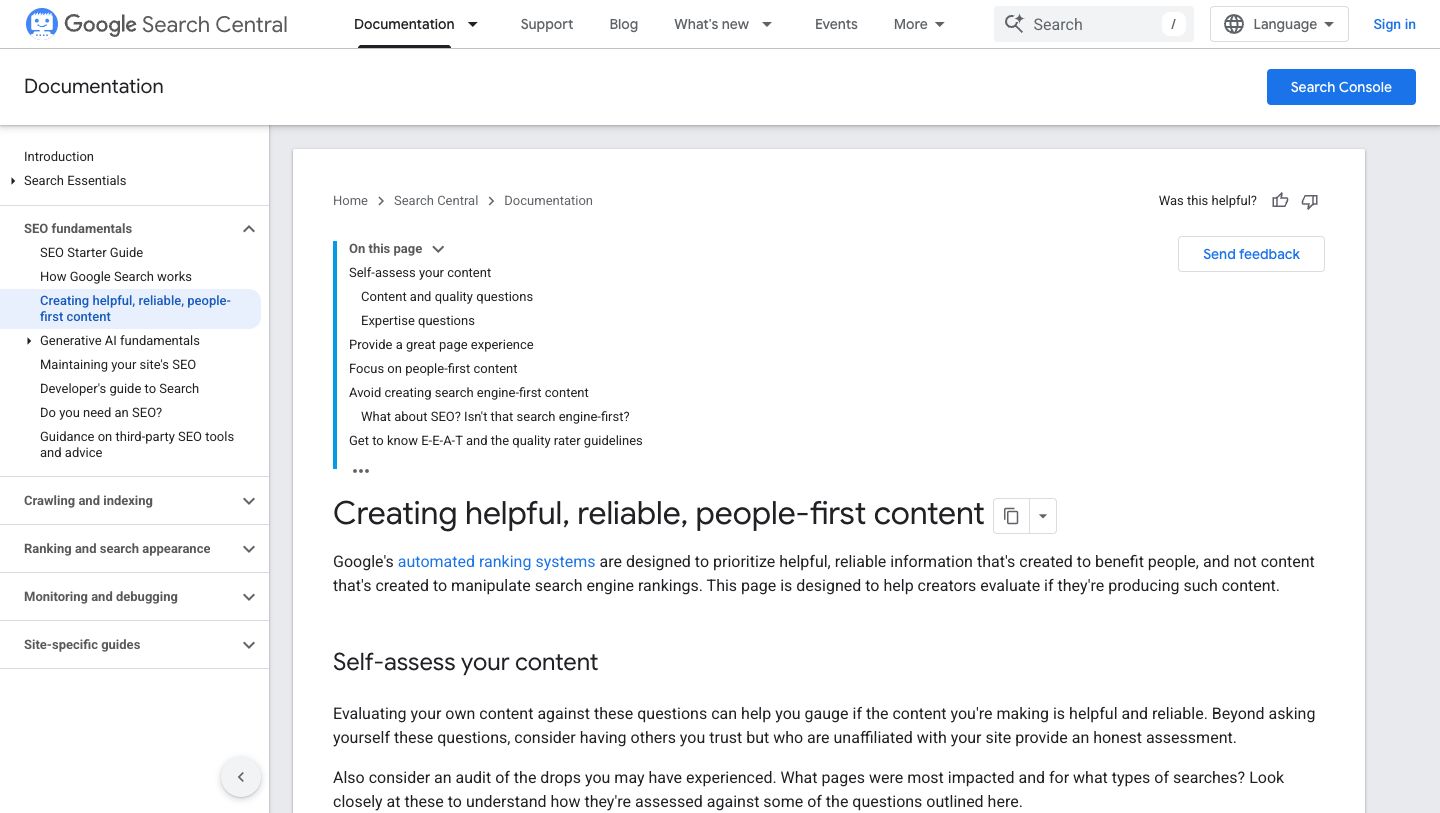
Source: Google Search Central, "Creating helpful, reliable, people-first content". Browser screenshot of the original first-party documentation, accessed September 8, 2026.
A decision-complete resource usually needs six parts:
An early verdict. Tell the reader what to do or how to think about the choice.
A boundary. Explain what the page covers and which adjacent jobs it does not.
A decision model. Give the criteria, stages, or mechanism that organizes the answer.
Evidence near claims. Put definitions, product facts, examples, or research beside the point they support.
A usable action. Include a worksheet, checklist, comparison record, or next-step sequence.
A matched conversion bridge. Connect the solved problem to the product mechanism only when it advances the same job.
Complete does not mean maximal. A page becomes less useful when every adjacent topic gets a long detour. Complete the decision you promised, then route readers to distinct resources for the work before or after it. For example, a buying guide can link to an AI visibility audit without embedding the full audit method inside the comparison.
When does a supporting page deserve its own URL?
A supporting page deserves its own URL when it answers different work: another decision stage, evidence object, format, or next action. It should add a clear contract rather than restate the canonical resource. If the proposed page cannot name its distinct answer, proof, action, and contextual route back, improve the existing resource instead.
A definitions page and a product comparison may share terms but not intent. A benchmark audit needs methods, denominators, and limitations; a how-to guide needs ordered execution. A remediation workflow needs source tracing and ownership. Keeping those jobs distinct makes each page easier to evaluate, maintain, and link at the moment it becomes useful.
Before creating a new URL, answer four questions:
- What direct answer would be different from the canonical resource?
- What new proof must this page carry?
- What reader action does it enable?
- Where will a contextual internal link connect it to the existing journey?
If the answers are vague, update the canonical resource instead. If the new page repeats the same answer and proof, consolidate rather than multiplying inventory. If it serves a genuine adjacent need, publish it with a clear role and link it to the shared decision path.
This is also where a create, refresh, or consolidate decision becomes more useful than an editorial calendar. The unit of planning is not "another article." It is the missing evidence or action in the buyer's journey.
How should internal links connect the resource cluster?
Use internal links as decision routes between distinct jobs. Name the answer or action at the destination, place the link where that next step becomes relevant, and make sure every important page receives a route from another page. Google's guidance supports contextual anchors and explicitly rejects a magical ideal link count.
Use links as decision routes, not decorations. The anchor should tell the reader what they will get next: "audit the source chain," "compare tools by workflow," or "repair a wrong brand answer." A vague "learn more" anchor hides the relationship. A footer containing dozens of unrelated links creates inventory without guidance.
The canonical resource should link outward when a distinct subproblem becomes relevant. Supporting pages should link back with language that names the broader decision. Other established resources should link into the canonical page where their readers naturally graduate to that job. Use ordinary crawlable anchor elements with href attributes; Google notes that script-event pseudo-links are not reliably extracted.
Review the link graph whenever you publish, refresh, merge, or retire a page. A consolidation is incomplete if old internal links keep sending readers toward removed or weaker URLs. A new page is isolated if no relevant resource points to it. Treat links as maintained editorial infrastructure.
When should technical canonicalization enter the workflow?
Technical canonicalization enters after you decide what one page should answer and identify duplicate or very similar URLs. Editorial consolidation sets the content boundary; URL treatment identifies the preferred destination. Keep those decisions separate so a tag does not hide unresolved overlap between distinct buyer needs or substitute for moving useful evidence into the stronger page.
Google says canonicalization can consolidate signals from similar or duplicate URLs into a preferred URL, simplify tracking metrics, and reduce crawling spent on duplicates. That is useful for URL variants, parameters, syndication, and overlapping pages. It does not make two different intents equivalent.
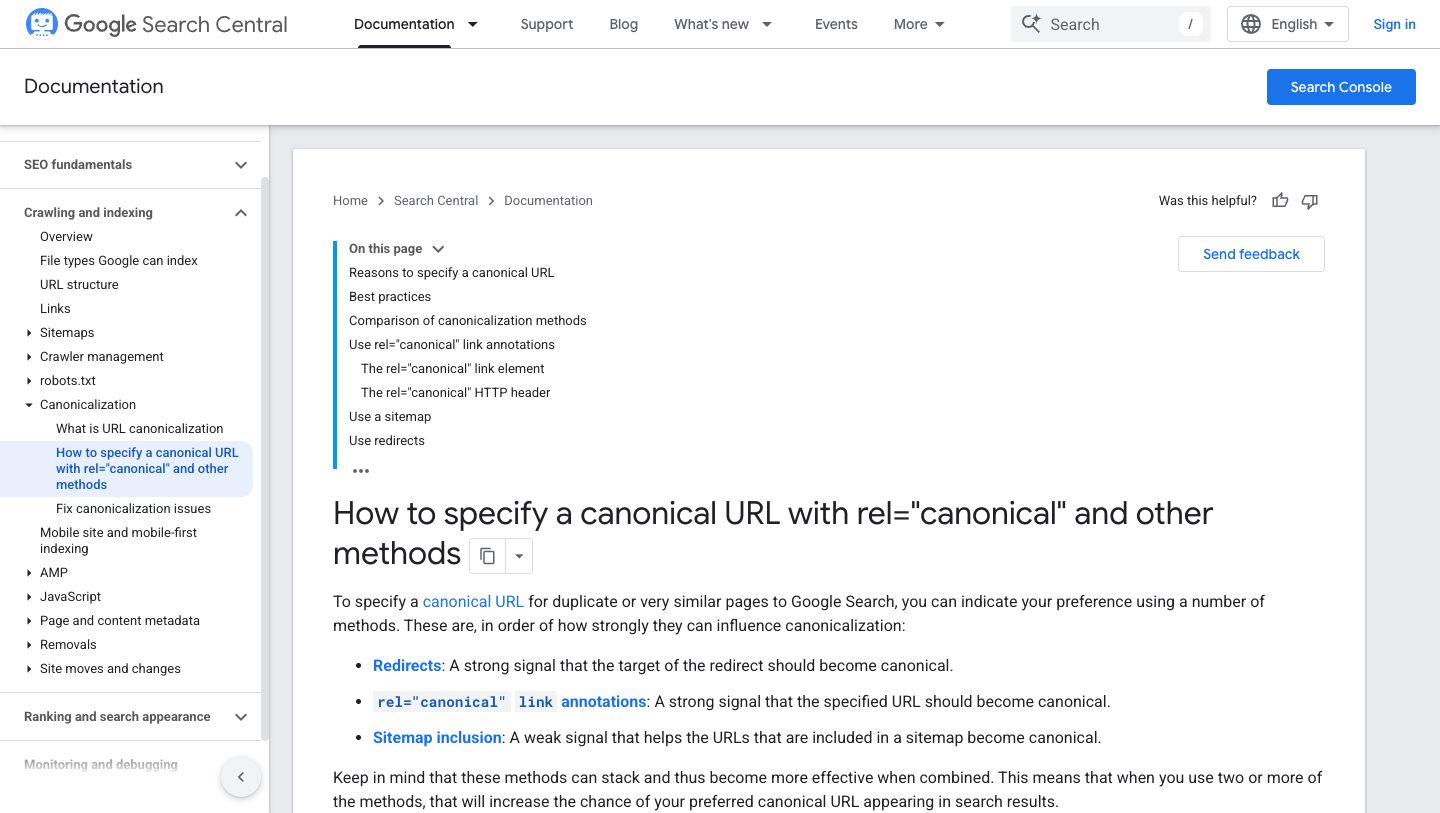
Source: Google Search Central, "How to specify a canonical URL". Browser screenshot of the original first-party documentation, accessed September 8, 2026.
If two pages repeat the same answer, choose the strongest destination, move any unique value into it, redirect where appropriate, update internal links, and keep the technical signals consistent. If two pages answer different jobs, retain both and connect them contextually. Pointing one distinct page at another with rel="canonical" can hide the real editorial problem instead of resolving it.
The practical order is: decide the content boundary, choose the destination, preserve valuable evidence, update the link graph, then implement the correct URL treatment. Strategy first; tags second.
How should you measure a canonical resource?
Measure the resource against the buyer job it owns. Keep discovery, engagement with the decision model, movement to supporting resources, and activation of the matched next step as separate stages. That structure shows where the path breaks; one blended content score cannot tell you whether the issue is reach, evidence, navigation, or conversion.
Track whether the intended query set reaches the page, whether readers use the decision model, whether they continue to relevant supporting resources, and whether the matched CTA activates the next step.
For maintenance, preserve the query cluster, decision statement, claim sources, internal-link map, conversion action, and last verification date. When performance changes, inspect the specific layer.
The query language may have shifted. The evidence may be stale. A supporting page may now deserve consolidation.
An important link may have disappeared. The page may still attract attention while failing to advance the decision.
This record also limits unnecessary publishing. A new phrase can be mapped to an existing resource when its answer contract already fits. A materially new buyer need can earn a supporting page. The content system grows by decision coverage, not by raw URL count.
How does Trovance turn buyer questions into canonical work?
Trovance starts with the buyer questions shaping discovery and preserves the answers, cited sources, comparisons, and recommendations around them. Your team can see which phrasings share one missing answer, which need distinct proof, and whether the next move is to create, refresh, consolidate, strengthen authority, or hold. The result is reviewable work tied to observed evidence.
Instead of handing a writer a keyword list, the workflow keeps the question, observed answer, source evidence, claim boundary, proposed action, and review state connected. A canonical-resource recommendation can therefore specify the buyer decision to own, the evidence the page must carry, the supporting resources it should link, and the baseline your team will inspect later.
That makes content planning more concrete. You can move from "we found 40 related prompts" to "these prompts share one evaluation job, two require separate diagnostic pages, and this existing resource should become the preferred destination." Human review stays at the decision points, while the system carries the provenance and work forward.
Start your free trial to inspect a real buyer question and turn the clearest evidence gap into a reviewable canonical-resource action.