
Yes, people use ChatGPT to research products and services. In one new 7.5 million-conversation sample, the share classified as commercial rose from 13.9% to 19.2% over a year.
That is a useful signal, not a buyer count. The sample does not show whether the person had a budget, visited a site, joined a shortlist, bought anything, or generated revenue. Treat it as a reason to inspect important commercial questions, not as proof that 19.2% of ChatGPT activity is addressable demand.
I read the vendor analysis and checked it against the NBER working paper built from internal ChatGPT data. The direction is believable. The giant extrapolated number is much shakier.
Are people really using ChatGPT to research purchases?
Yes. Both sources show that product and decision research is part of normal ChatGPT use, although neither source measures completed purchases.
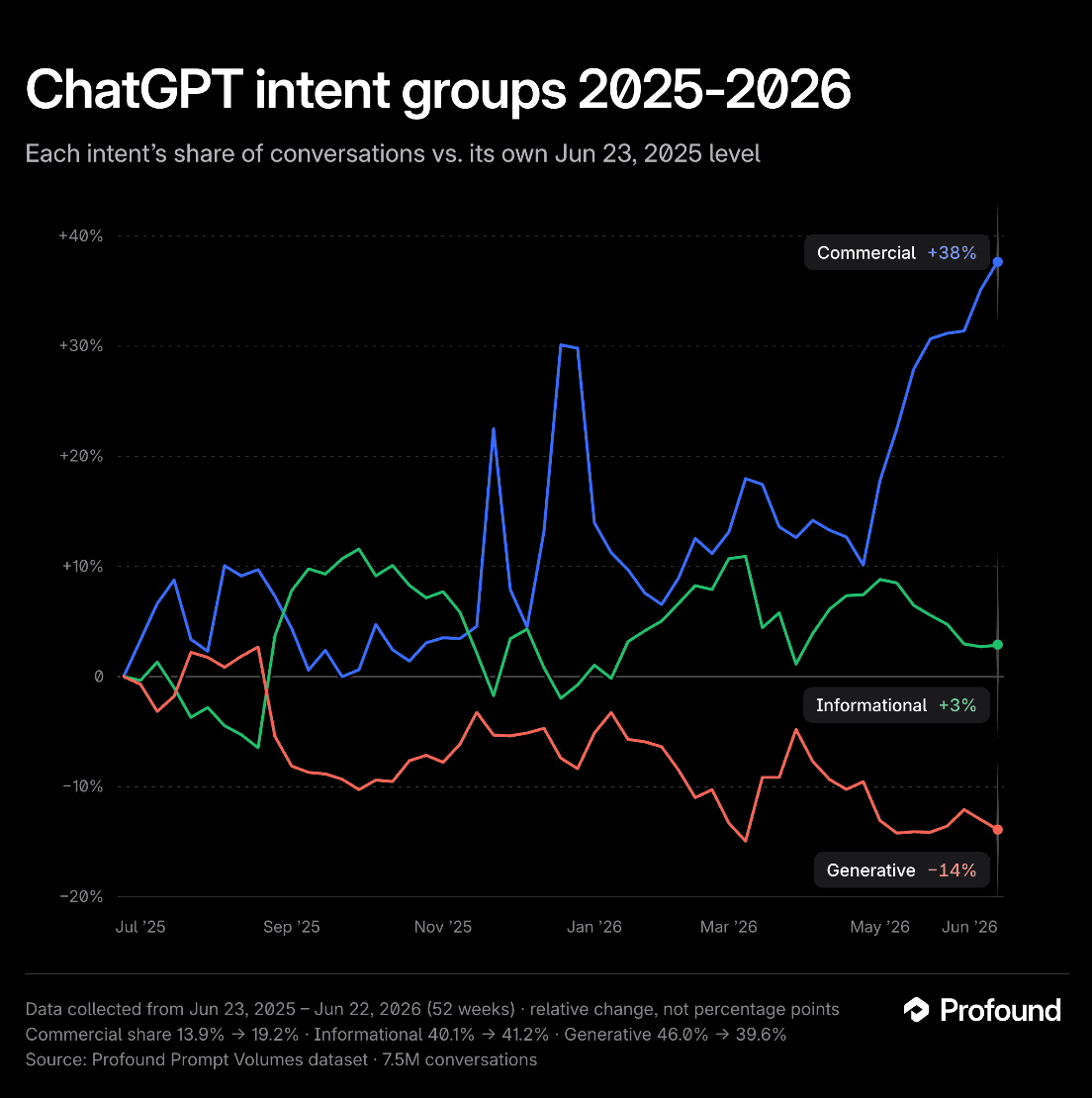
Profound classified conversations into three buckets: commercial, informational, and generative. Between 23 June 2025 and 22 June 2026, the commercial share in its database moved from 13.9% to 19.2%. Commercial conversations per active user rose from 0.384 to 0.541 per week, which the company reports as a 41% increase.
The shape of the trend matters more than the launch headline. Commercial share stayed near 14% to 15% for much of late 2025, spiked around Black Friday and Christmas, then climbed from April 2026. That seasonality looks consistent with shopping activity, but consistency is not proof of what caused the movement.
Source: Profound.
Read the chart's fine print. It shows relative change against each intent's own starting level. The blue +38% label is not a 38-percentage-point gain. The underlying commercial share increased by 5.3 points, from 13.9% to 19.2%.
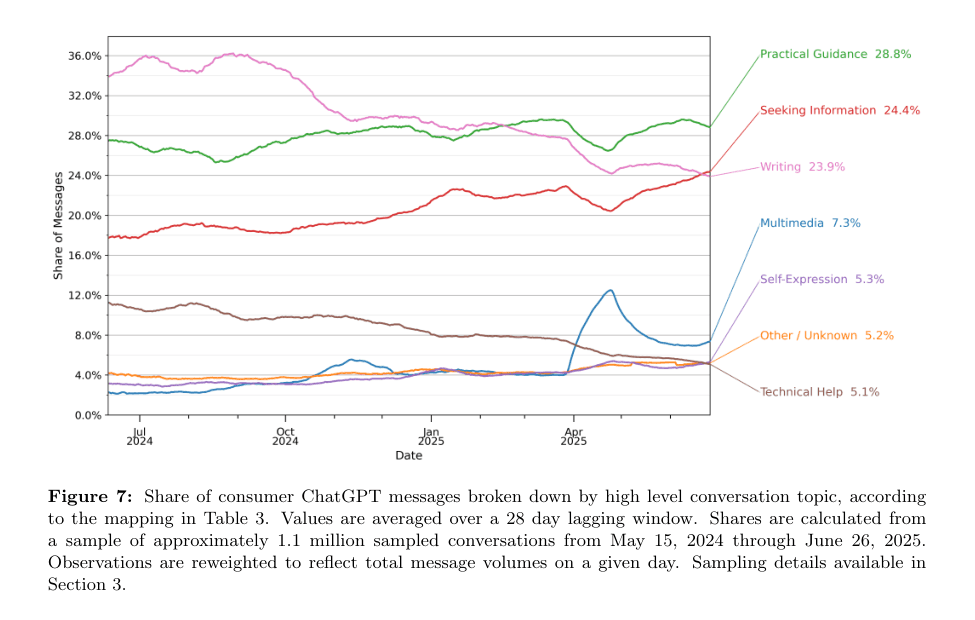
The NBER working paper offers a separate, broader signal. In approximately 1.1 million sampled conversations, Seeking Information rose from about 14% of consumer messages in July 2024 to about 24% one year later. Its published taxonomy puts Purchasable Products inside that topic, alongside specific information and cooking.
Source: NBER, How People Use ChatGPT.
The NBER figure ends with Seeking Information at 24.4%, Practical Guidance at 28.8%, and Writing at 23.9%. It supports a shift toward asking ChatGPT for information and decision support. It does not isolate product research well enough to reproduce Profound's commercial trend.
What did the commercial-intent study actually measure?
It measured how an automated classifier labeled conversations in Profound's proprietary database, then tracked those labels over time.
The sample covers 53 weekly aggregates and 7.5 million conversations. Each conversation receives one mutually exclusive intent label. That gives the analysis a clear unit and period.
Several parts of the measurement contract remain private. The public article does not explain how conversations entered the Prompt Volumes database, publish the exact commercial-intent rubric, report classifier precision or recall, show a confusion matrix, or establish that the sample represents all consumer ChatGPT use. It is also limited to en-US conversations.
That leaves four distinct evidence states:
State | What the study shows | What it cannot establish |
|---|---|---|
Conversation classified as commercial | The text resembled the vendor's commercial-intent definition | The person was a verified buyer |
Commercial share increased | The label became more common in this sample | The same change occurred across all ChatGPT use |
Conversation had multiple turns | The exchange continued beyond one prompt | Stronger purchase intent or better fit |
Estimated platform volume increased | A sample rate multiplied by a weekly-user estimate produced a larger total | Observed purchases, acquisition, or revenue |
Profound reports that commercial conversations ended the period at 2.43 average turns, compared with 2.18 for informational conversations. It also reports a 53% single-turn share for commercial conversations versus 63% for informational ones.
A longer exchange may contain comparison and refinement. It may also contain confusion, correction, or a dead end. Without an outcome event, turn count is depth, not quality.
I checked the methodology section for the missing bridge. It is not there. The analysis never observes a click, account, purchase, CRM record, or payment. That makes commercial conversation the endpoint of the study, not a synonym for demand.
Why is the 28 billion figure an estimate rather than an observed total?
Profound estimated annual volume by multiplying its sample's per-user commercial rate by a modeled ChatGPT weekly active user series.
The article anchors that series to public user milestones, interpolates between them, and uses 985 million estimated weekly active users for the June 2026 endpoint. Combined with 0.541 commercial conversations per active user per week, the model produces 533 million per week and 28 billion per year.
The article is unusually clear that the mid-2026 user count is estimated. Its sensitivity check moves the user base plus or minus 10%, which produces 490 million to 570 million commercial conversations per week.
That sensitivity test checks one input: user count. It does not test whether the Prompt Volumes sample represents ChatGPT, whether the intent classifier makes systematic errors, whether heavy users are overrepresented, or whether a conversation count can stand in for a person or purchase.
Use the 28 billion figure only as a source-reported scale model. Do not turn it into 28 billion buying decisions, 28 billion buyers, or 28 billion revenue opportunities. The source did not measure any of those things.
Which marketing decision fits the evidence you have?
The right action depends on whether you have a broad trend, an observed answer about your company, or a business outcome connected to the journey.
Use this decision path before opening a content ticket:
If this describes you | Check this | Take this action |
|---|---|---|
You only have a market-level commercial-intent trend | Whether your category and buyer questions appear in the source sample | Treat it as research context, then define a small question set |
ChatGPT mentions your category but not your company | Raw answers, cited sources, fit, and existing proof | Diagnose identity, relevance, evidence, reputation, or legitimate bad fit |
Your company appears with stale or wrong facts | The claim, source URL, current product truth, and page owner | Correct the canonical source and preserve the change date |
Your company is cited but not recommended | Comparison criteria, limitations, proof, and buyer constraints | Decide whether a comparison or proof asset should exist |
AI referrals reach the site | Landing page, source, campaign fields, and qualified action | Measure the referral cohort without assuming every visit came from research |
Qualified accounts or sales changed | CRM events, cohort, baseline, observation window, and confounders | Use business analytics and human review before claiming influence |
This is the boring part that keeps a trend from becoming a content factory. A missing mention can be a positioning problem, while a missing recommendation can be legitimate bad fit. A growing category can still be irrelevant to your near-term buyer.
The maintained answer should live on your owned site. Social posts can distribute the finding, but comments, likes, public views, and reposts do not turn the argument into acquisition evidence. The canonical resource is where the method, caveats, corrections, and product truth can stay current.
How should you measure the path from conversation to revenue?
Measure each event separately, because the evidence gets thinner when the stages are collapsed.
Stage | Mechanical event | Denominator | Safe interpretation |
|---|---|---|---|
Classified intent | A conversation receives a commercial label | Classified conversations in the declared sample | Composition of that sample |
Observed answer | A defined prompt produces a preserved response | Runs across prompts, engines, dates, and personas | Answer behavior under observed conditions |
Brand treatment | The response mentions, cites, compares, or recommends the company | Eligible observed answers | Visibility and treatment, not buyer exposure |
Referral | Analytics records a visit from an identifiable AI source | Sessions in the declared window | Referred traffic, with source limits |
Qualified action | A visitor completes a defined activation or qualification event | Referred users or accounts | Downstream behavior in that cohort |
Revenue | A governed attribution method connects a sale to the cohort | Qualified accounts, opportunities, or customers | Business outcome under the stated attribution rule |
Set the question set before looking at the answer. Preserve the exact prompt, date, surface, model context where available, cited URLs, competitors, and repeated runs. A single flattering screenshot is not a baseline.
Then define the business event. For a self-serve product, that might be a verified account that completes activation. For a sales-led company, it might be a qualified meeting or accepted opportunity. Traffic is too broad, and engagement is usually worse.
Public view counts are not acquisition proof. Neither are model mentions. A defensible business claim needs a cohort, denominator, observation window, attribution rule, and confounder log. Even then, the safest wording may be associated with rather than caused.
How can Trovance turn commercial ChatGPT activity into an evidence decision?
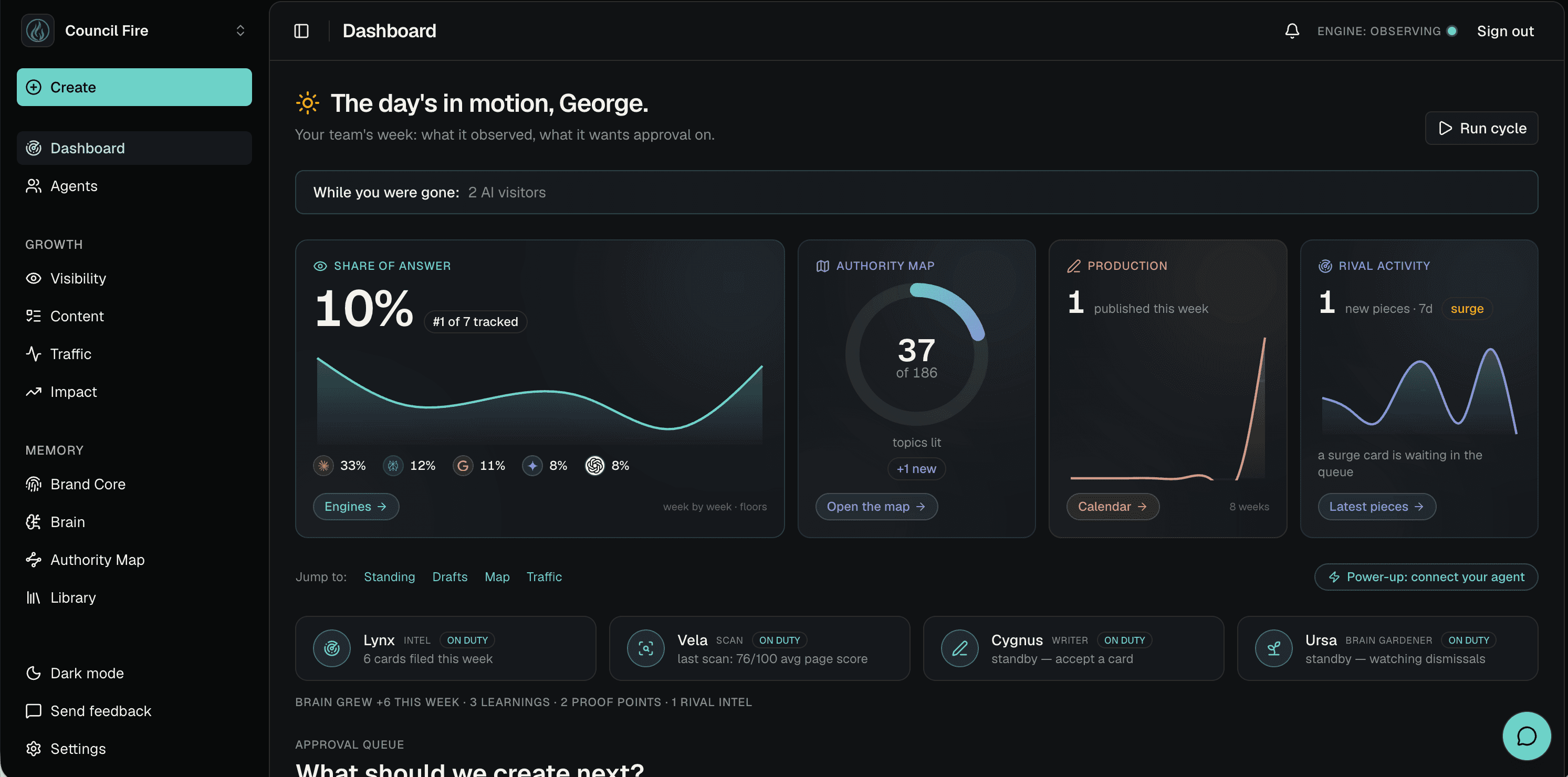
Trovance can show how AI systems explain, cite, compare, and recommend your company for the commercial questions that matter, then help diagnose the evidence gap behind the answer.
That is narrower than observing private conversations or identifying hidden buyers. Trovance does not know who typed a prompt merely because an answer exists, and it does not turn a mention into revenue attribution. External analytics and accountable human judgment still own exposure, qualification, purchase, and causal claims.
The useful bridge is from a broad trend to a specific action. Preserve the question, answer, and cited sources. Check whether the gap is positioning, current product truth, comparison evidence, outside reputation, access, or legitimate bad fit. When public evidence is the constraint, Trovance helps produce and publish the proof-backed asset that should exist.
Start your free trial to inspect the commercial questions, answer patterns, and evidence gaps worth acting on. The trial does not promise a citation, recommendation, ranking, qualified account, or sale.