
When an AI answer gets your company wrong, do not begin by publishing more content. Preserve the answer, check whether the mistake repeats, trace the sources behind it, and fix the smallest accountable record before running the same test again.
That sequence keeps one bad response from becoming a month of speculative work. It also separates an observable error from what your team can only infer about retrieval, model behavior, and business impact.
What does one wrong AI answer actually prove?
One wrong answer proves that a defined system returned a defined response at a particular time. It does not prove the mistake is stable, widespread, caused by your website, or seen by a buyer.
Save the exact prompt, full answer, visible citations, model or product, date, account context, and any browsing mode. Then mark the sentence that is wrong and write the correct version beside it. I use this two-column step because teams otherwise argue about the model's tone while the disputed fact keeps changing.
The error may concern presence, position, description, or recommendation. IAB's August 2026 framework names 4 classes: Presence, Prominence, Portrayal, and Persuasion. If the company appears but the answer states the wrong integration, pricing model, audience, or capability, the primary issue is portrayal.
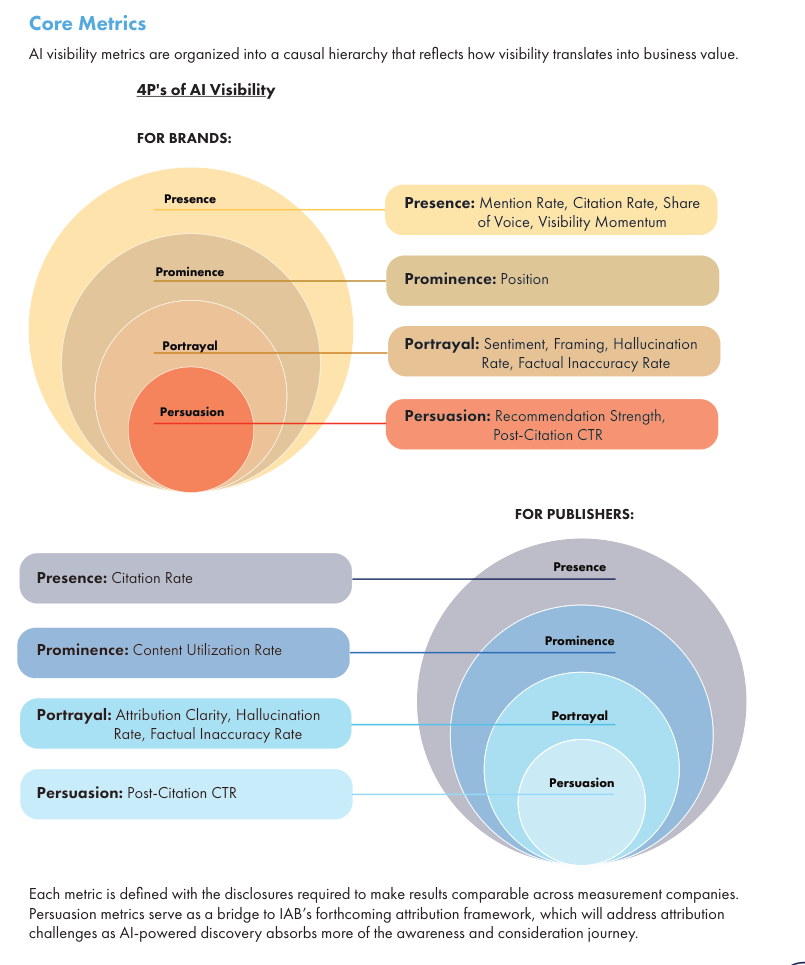
Source: IAB, Measuring Visibility in the AI Era, page 4.
The distinction matters because a presence campaign can increase mentions while leaving the false claim untouched. Name the failure before choosing the work.
How do you tell a repeatable error from answer variance?
Repeat the same question under a recorded protocol before calling the mistake durable. Keep the prompt, model, browsing state, region, and test window as constant as the product allows.
A provider-affiliated 2026 preprint tested 3 platforms and 3 consumer topics. It collected daily observations over 9 days and also sampled at 10-minute intervals. In one worked set of 200 SearchGPT queries, apparent citation shares of 9.5% and 6.0% had 95% bootstrap intervals of about 5.5%–12.5% and 4.0%–8.0%.
Those ranges are not a universal testing rule. They show why one result can look more precise than it is.
Use three practical states:
| Observation | Meaning | Next move |
|---|---|---|
| Appears once and disappears | Unstable observation | Preserve it and monitor |
| Repeats with the same false fact | Candidate portrayal problem | Trace the source chain |
| Varies, but always misses the same condition | Candidate evidence gap | Audit proof and retrieval |
A repeated error still does not reveal its cause. It earns the next diagnostic step.
Which source should own the correct fact?
The accountable source is the closest public record your company can truthfully maintain, not whichever page is easiest to edit. Pricing belongs on pricing or packaging pages. Integrations belong in current product documentation.
Company identity belongs on canonical company records. Comparative claims need dated evidence and fair scope.
Build a source chain with 5 fields: disputed claim, correct fact, accountable source, competing source, and owner. Add a sixth field for the last verified date when the fact can change.
Then inspect the cited pages and the pages that rank or recur around the answer. Ask four questions:
Does the correct fact exist publicly?
Is it stated plainly enough to quote without surrounding inference?
Do two company-controlled pages contradict each other?
Does a credible third-party page repeat an older version?
If your own sources disagree, fix that conflict first. A new explainer sitting beside stale documentation creates another source, not a correction.
Is the break access, evidence, positioning, or product truth?
Classify the break by what is missing from the source chain. This is the point where a useful repair workflow refuses to turn every symptom into a writing assignment.
| Break | What you observe | Accountable repair |
|---|---|---|
| Access | The correct page is blocked, broken, or absent from retrieval | Technical owner repairs access or canonical routing |
| Evidence | The page names the claim without support | Product or marketing owner adds dated proof |
| Positioning | Facts exist but the buyer fit is unclear | Clarify audience, use case, and boundaries |
| Third-party record | An external source repeats stale information | Request a factual correction or publish a citable record |
| Product truth | The answer exposes a real capability gap | Route to Product; do not write around it |
| Honest bad fit | Another company better meets the stated need | Accept the result and avoid false persuasion |
C-SEO Bench helps explain why this classification matters. The benchmark tested more than 1,900 queries and 16,000 documents across 2 tasks and 6 domains. Under corrected tests, most rewrite methods were largely ineffective, and many lowered citation rank.
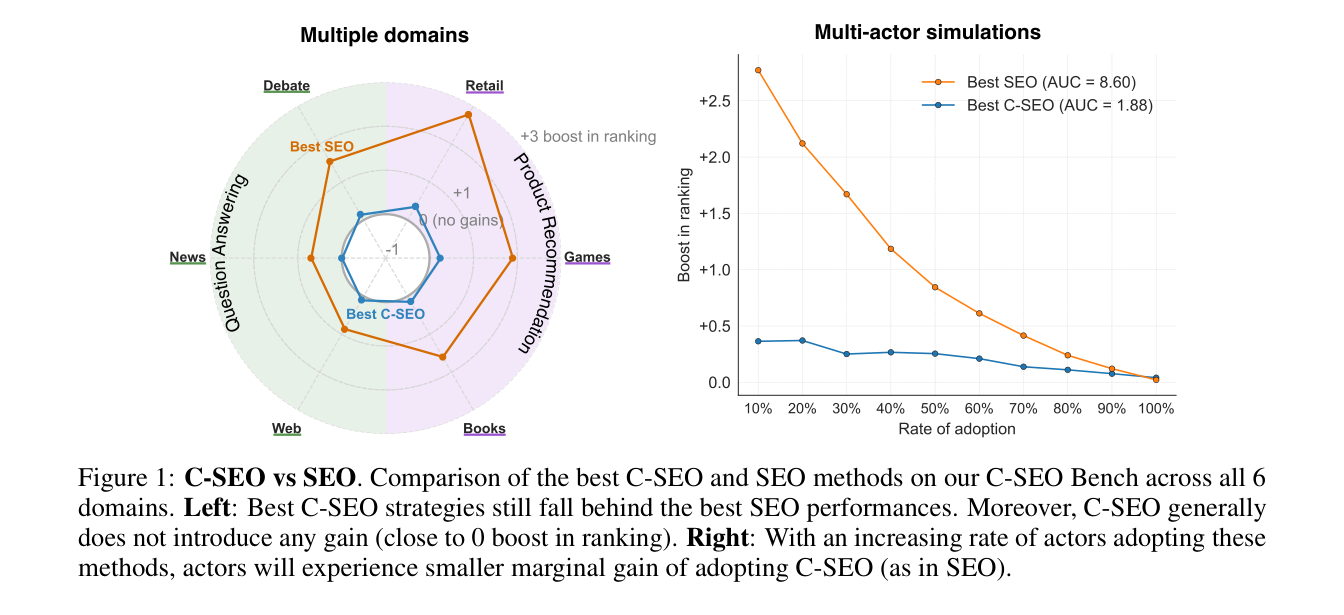
Source: Puerto et al., C-SEO Bench, Figure 1.
In its GPT-4o-mini comparison, first context position beat the tested rewrites in all 6 domains. The best retrieval-side AUC was 8.60 versus 1.88 for the best tested conversational rewrite in the multi-actor simulation. The setup supplied candidate documents to answer models, so it does not reproduce live AI search. It does show that wording changes cannot repair every selection problem.
What is the smallest repair that fits the diagnosis?
Choose one accountable change that makes the correct fact easier to find, verify, and maintain. Do not change five surfaces at once if you want to learn anything from the rerun.
Use this decision path:
- If the canonical fact is wrong, correct that page and preserve the before-and-after text.
- If the fact is missing, add it to the page that should own it.
- If proof is weak, attach a dated primary source, method, or product record.
- If pages conflict, consolidate or redirect before publishing something new.
- If the break is external, request a factual correction with the canonical evidence.
- If the product does not meet the need, route the issue and stop the content work.
Record the changed URL, exact claim, owner, timestamp, approval, and expected review date. That receipt is more useful than a vague note saying the brand narrative was improved.
How does Trovance turn a wrong answer into governed work?
Trovance begins with the observed answer and keeps the evidence decision attached to the action that follows. It helps a team inspect how AI systems explain, cite, compare, and recommend the company, then diagnose whether the wrong answer comes from a source conflict, missing evidence, unclear positioning, inaccessible proof, product truth, or fit.
The next step may be to produce a proof-backed asset, repair an owned source, or route the issue to Product, Engineering, Communications, or another accountable owner. Humans retain truth, permission, taste, spend, and publication. Trovance does not guarantee that a model will change its answer, and an answer change does not prove which intervention caused it.
The value is the visible chain: observed claim, supporting sources, diagnosis, approved action, public receipt, and comparable rerun. Start a free Trovance trial to find the answer and source break worth investigating first.
How do you verify the repair without claiming causation?
Rerun the original test after the changed source is publicly available, using the same prompt and recorded conditions where possible. Compare the full answer, citations, disputed claim, and date rather than asking only whether a score moved.
Use four terminal results:
Corrected: the comparable answer now states the fact accurately.
Mixed: some runs corrected while others remain wrong.
Unchanged: the same false claim remains.
Not comparable: the model, retrieval mode, prompt, or source environment changed materially.
A corrected answer is evidence that the observable state changed. It is not proof that your edit caused the change. Search indexes, source competition, model updates, and answer variance remain confounders.
The business boundary stays separate too. A corrected description does not establish exposure, buyer trust, qualified traffic, pipeline, or revenue. Connect those outcomes through analytics and CRM events with named cohorts and windows. Keep the correction receipt even when the answer improves, because the fact can drift again.