
An AI visibility score can tell you that your company appeared less often than a competitor. It cannot tell you why, whether the difference is stable, or what your team should do on Monday morning.
That missing decision is why we built Trovance.
Visibility tools made an important problem measurable. They showed companies that buyers can now meet an AI-generated explanation, comparison, or shortlist before reaching a website. But a score ends at the exact moment the expensive work begins: deciding whether the result points to weak evidence, unclear positioning, stale product facts, inaccessible pages, thin third-party proof, a real product gap, or honest bad fit.
Trovance is the system after the score. It begins with the observed answer and ends with an accountable action, a published or routed artifact, and a record the team can inspect.
What does an AI visibility score actually measure?
An AI visibility score summarizes selected observations under one provider's prompt set, engines, sampling method, and weighting rules. It does not represent one universal market reality.
The industry's own measurement vocabulary is becoming more specific. IAB's August 2026 framework separates visibility into Presence, Prominence, Portrayal, and Persuasion. Presence asks whether the brand appears. Prominence asks where.
Portrayal asks how accurately or favorably the brand is described. Persuasion covers recommendation strength and post-citation behavior.
Those are 4 different measurement classes, not four interchangeable ingredients in a single score. A company can gain mentions while losing citation quality. It can rank higher in an answer that describes the product incorrectly. It can receive more citations without entering a buyer's shortlist.
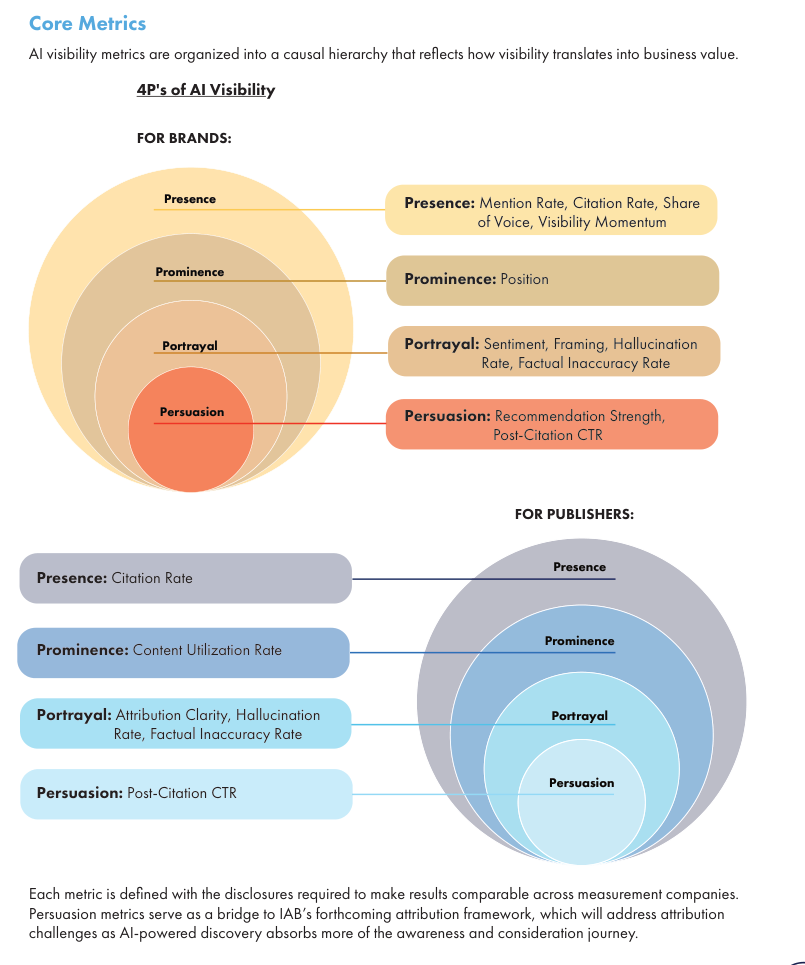
Source: IAB, Measuring Visibility in the AI Era, page 4.
IAB also proposes 2 quality tiers: directional and decision-grade. Its criteria call fewer than 50 queries exploratory. Directional coverage includes at least 2 intent types, while decision-grade coverage includes all 4 named intent types and segments results by intent.
That framework does not certify Trovance or any other vendor. It does establish a useful refusal: do not treat every visible number as fit for every decision.
Why can the same score point to different problems?
The same low score can come from several different breaks, and each break has a different owner.
A company may be absent because the model could not retrieve an accessible page. The page may be easy to retrieve but lack the proof required for a specific buyer question. The proof may exist while the positioning fails to connect it to the buyer's job.
The product may not support the requested use case. The answer may simply be correct that another vendor fits better.
| Observed result | What to inspect | Accountable action |
|---|---|---|
| Brand is absent from the answer | Crawlability, retrieval, entity clarity, source set | Repair access or canonical facts before drafting |
| Brand is mentioned but not cited | First-party proof and third-party source coverage | Strengthen the evidence path |
| Brand is cited but described incorrectly | Product facts, pricing, integrations, positioning | Correct the accountable source |
| Competitor is recommended instead | Buyer criteria, comparative proof, legitimate fit | Build a fair comparison or accept bad fit |
| Score changed without a clear reason | Prompt set, engine mix, repeated runs, methodology | Re-observe before acting |
| Gap is real but no owned page can answer it | Existing inventory, proof permission, buyer job | Produce the missing proof-backed asset |
The score alone cannot choose among those routes. It compresses the symptom and hides the diagnosis.
Why should repeated runs come before a production brief?
Repeated runs should come first because the apparent winner in one sample may sit inside ordinary answer variance.
Ronald Sielinski's 2026 arXiv preprint sampled the same queries repeatedly across Perplexity Search, OpenAI SearchGPT and Google Gemini on three consumer product topics. Citation distributions follow a power law, bootstrap confidence intervals place many apparent domain differences inside the noise floor, and rank order is unstable from one sample to the next.
Independent work points the same way. The SparkToro research found AI systems highly inconsistent when recommending brands or products, and Search Engine Land's write-up of that work reports that AI recommendation lists rarely repeat.
That preprint is not peer reviewed, and it yields no universal threshold. The useful mechanism is narrower: a single answer or score can look more precise than the underlying system is.
Why is publishing more content often the wrong response?
Publishing more content is wrong when the actual break is retrieval, product truth, positioning, third-party reputation, or legitimate bad fit.
C-SEO Bench gives this distinction teeth. The NeurIPS 2025 benchmark tested 2 tasks across 6 domains, using more than 1,900 queries and 16,000 documents. It compared conversational rewrites with retrieval-side SEO changes in controlled answer contexts.
Under the corrected tests, most rewrite methods were largely ineffective, and many lowered citation rank. In the GPT-4o-mini comparison, the first context position beat the tested rewrites in all 6 domains. In the multi-actor simulation, the best retrieval-side approach produced an AUC of 8.60 versus 1.88 for the best conversational-rewrite approach.
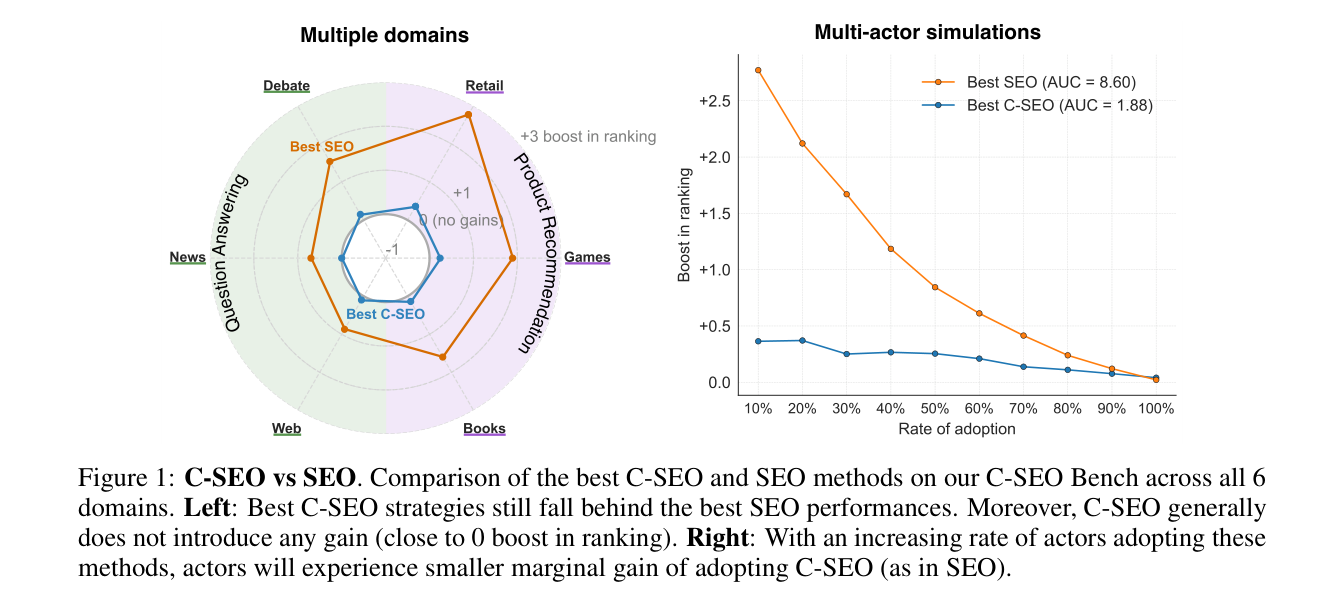
Source: Puerto et al., C-SEO Bench, Figure 1.
The benchmark does not reproduce live Google, ChatGPT, Perplexity, Claude, or Gemini systems. It measures citation rank with candidate documents supplied to answer models. It does support a practical warning: better wording cannot repair every selection problem.
That is why Trovance does not convert each red indicator into a content assignment.
What should happen after a score finds a gap?
After a score finds a gap, the team should preserve the underlying answer, diagnose the break, assign the right owner, and verify the resulting action.
The operating loop has 9 steps:
| Step | Decision | Receipt |
|---|---|---|
| Observe | What did the system say, cite, compare, or recommend? | Raw answer, prompt, engine, sources, time |
| Diagnose | Is the break evidence, positioning, retrieval, product, reputation, or fit? | Named gap with supporting records |
| Decide | Which action is justified, and which is not? | Ranked action, owner, reason |
| Produce or route | Does this need an asset or a different team? | Draft or routed task |
| Approve | Are the claim, evidence, permission, and risk acceptable? | Human decision and exceptions |
| Publish or execute | What changed in the public or operating system? | URL, object, or action receipt |
| Verify | Did the intended state actually change? | Live-state check |
| Re-observe | How does the market answer now? | Comparable rerun |
| Learn | What can the team carry into the next cycle? | Bounded finding with caveats |
The sequence matters. Production before diagnosis makes the system efficient at solving the wrong problem. Measurement without action leaves a marketing team staring at a number it cannot use.
Is tracking AI visibility enough on its own?
Tracking is not enough on its own, because a monitor reports the state of the answer market without changing any input that produced it. A tracker covers the observe step. The other eight steps still need an owner and a budget.
51% of software buyers now start research with an AI chatbot more often than with Google, and G2 found that AI chatbots and review sites are now the two biggest influences on B2B shortlists. The same research reports that one in three buyers said an AI chatbot led them to choose a vendor they hadn't considered. Watching that surface is worth the money, and changing the evidence behind what it says is a separate job with a separate owner.
A tracker is good at a short list of jobs. It flags a drop worth re-observing faster than a person checking answers by hand, it benchmarks a fixed competitor set on a cadence, and it produces the reporting artifact leadership asks for. Those jobs justify the subscription at the point where manual checking breaks. None of them produce a page or a corrected product fact.
The inputs that move the answer sit outside the dashboard. Google states there are no special optimizations or new machine readable files that admit a page to its AI features, and that pages must be indexed and snippet-eligible. Seer Interactive matched a sample of 500 SearchGPT citations against Bing's top results and found the large majority already ranking there. Retrieval is doing much of the selecting, and a monitor records where it landed.
That retrieval layer does not stop at the top 10. Ahrefs found 38% of AI Overview citations ranked in the organic top 10 in March 2026, across 4 million AI Overview URLs and 863,000 SERPs. A tracker will show the consequence inside your own numbers. It will not tell you which of your pages is missing the proof a favored source already carries.
So the work after monitoring is supply-side work. Make the page retrievable, correct the product facts at the accountable source, earn third-party proof where buyers and models both look, and answer the question a real buyer typed. Profound's citation research attributes more than 4 in 10 AI citations to sources a brand does not control, which is why the third-party share of that list is not optional.
Budget follows the same logic: a founder with five hours a week can spend them watching a number or improving the evidence underneath it. Monitoring produces monitoring. A tracker earns its place once there is production underneath it to act on what the tracker finds.
When is no action the right answer?
No action is right when the answer is accurate, the buyer is a poor fit, the evidence is insufficient to justify a public claim, or the proposed content would duplicate a stronger existing page.
This morning offered a small example inside our own editorial system. The campaign selector said the Trovance comparison with AirOps and Jasper was unfinished. The live article, generated route, sitemap, and publication receipt all showed that it had been published and verified on August 28.
The wrong response was to produce the comparison again. The correct response was to reconcile the stale publication ledger, run the selector tests, and let the normal editorial system choose a new topic.
That is not glamorous, but it is the product belief in miniature. A visible gap can be caused by stale state. More content would have created a duplicate while leaving the underlying break untouched.
What does Trovance do after the score?
Trovance connects the observed AI answer to the evidence decision, accountable action, and verifiable result.
A team begins with a real buyer question and the answers, citations, comparisons, and recommendations that follow. Trovance helps diagnose whether the break sits in evidence, positioning, product truth, retrieval, third-party reputation, or fit. It can then help produce the proof-backed asset or route the issue to the person who owns it.
Humans retain truth, permission, taste, spend, and publication. Trovance does not guarantee a citation or make every company the correct recommendation. It makes the work after observation visible enough to review: what the system said, why the team acted, what changed, and what the comparable rerun showed.
That is why a team would use Trovance instead of stopping at a dashboard. The score identifies a place to investigate. The product carries the investigation into governed work. Start your free trial and inspect what should happen next.
Reading the score correctly
There Is No Such Thing as an AI Visibility Score - why one number cannot stand in for one market reality.
Six Signals That Beat A Single AI Visibility Score - the separate signals worth tracking instead of a composite.
A Visibility Gap Is Not a Content Brief - how to diagnose a gap before assigning anyone to write.
From AI Visibility To Revenue - keeping the denominators honest between exposure and pipeline.
Fixing the evidence behind the answer
A Relevant Page Can Still Miss The Evidence AI Needs - what a page needs beyond topical relevance to be cited.
Why ChatGPT Recommends Your Competitor Instead of You - the comparative proof behind a recommendation you lost.
How to Build a Competitor Comparison Page - building a fair comparison that survives review.
An Agent-Ready Website Can Still Miss the AI Shortlist - why clean access does not settle the shortlist question.