
Choose the tool that completes your next unresolved job. If your team cannot see what AI says, start with monitoring. If you already have the answers but cannot turn a gap into approved work, buy for diagnosis and production instead.
The wrong buying process starts with model counts and dashboard screenshots. The useful one runs a single buyer question through the whole system, then records where a human still has to export data, interpret the gap, find proof, write the asset, approve the claim, publish it, and measure what happened.
What problem should the tool solve first?
Name the first broken handoff in your current process. "We need AI visibility" is too vague to buy against.
A lean team usually has one of four problems:
| Current problem | What the tool must do next | Bad proxy |
|---|---|---|
| We do not know how AI describes us | Preserve prompts, answers, sources, dates, and comparison context | One blended score |
| We can see the gap but do not know why it exists | Separate missing proof from poor fit, stale facts, unclear positioning, and retrieval problems | A generic recommendation list |
| We know what should change but cannot produce it reliably | Turn evidence into a brief, draft, review path, and publishable asset | Raw article volume |
| We publish changes but cannot judge the result | Preserve before and after observations, then connect them to owned analytics | A single rerun or public view count |
This framing keeps a buyer from paying for a wide platform that misses the actual bottleneck. A monitoring product can be exactly right for a team with strong strategists and an established production engine. A workflow platform can be right when the brief is clear but execution is slow. An evidence-to-production system fits when the handoff between the two is the problem.
Which workflow does a monitoring-first tool support?
A monitoring-first tool should preserve what appeared, where it appeared, which sources were cited, how the answer changed, and what comparison set produced the result.
Profound's public Answer Engine Insights page names four top-level jobs: track presence, analyze responses, uncover citations, and check accuracy. Its interface example adds model, region, and time filters. That makes the product contract legible: observe the market answer and make differences inspectable.
Evidence at readable size. Swipe or scroll horizontally to read all columns; keyboard users can focus the image and use arrow keys.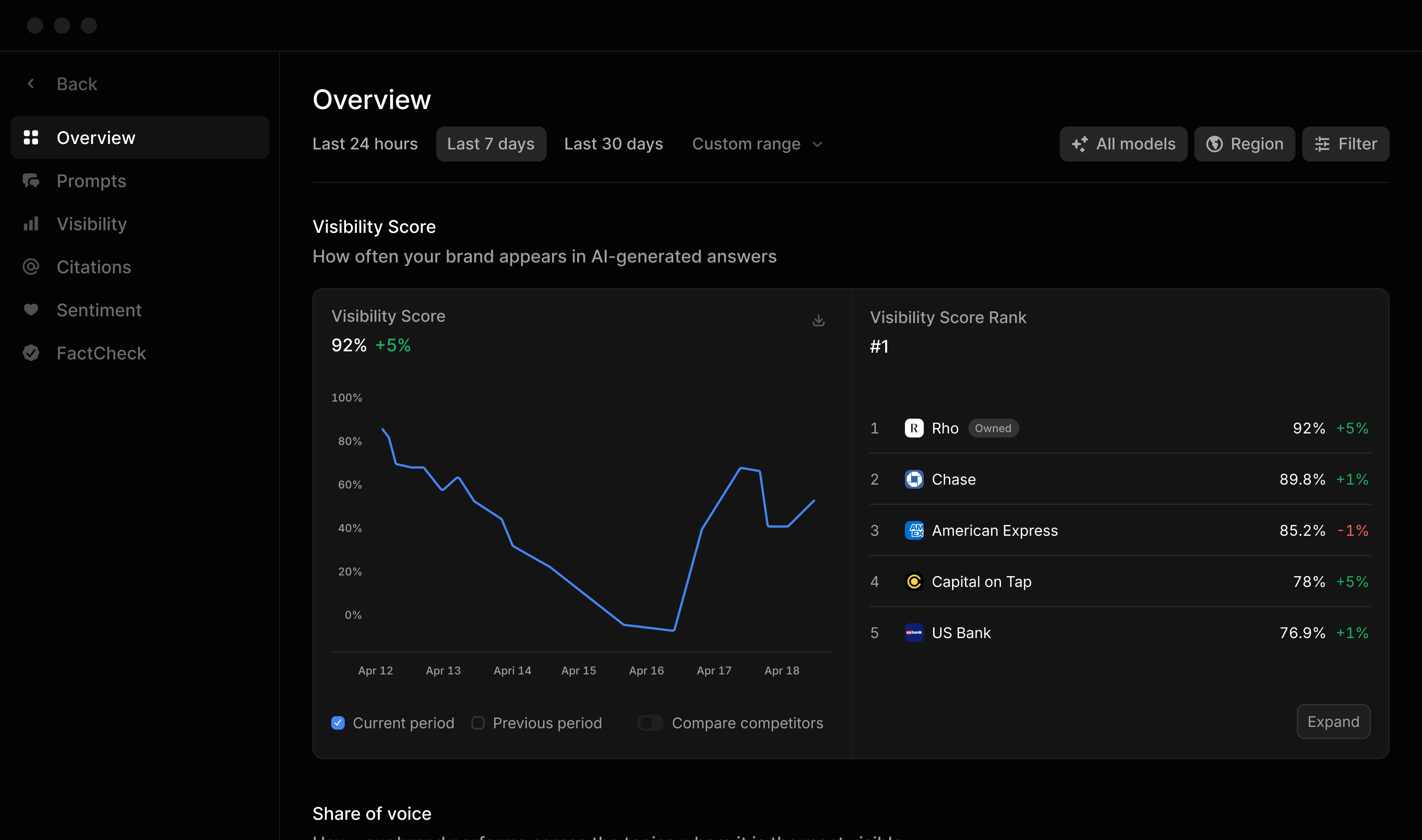 Source: Profound.
The screenshot uses an illustrative visibility score, displayed change, rank, and competitor comparison to show how the interface organizes monitoring. Those values explain the interface; they are not benchmarks. The public example does not reveal the full prompt set, denominator, weighting, run variance, or connection to business outcomes. A polished chart can show what the product measures without proving that the measure is the right decision unit for your company.
Choose monitoring first if your team already knows how to interpret evidence gaps and can move qualified findings into its content, product marketing, PR, technical, or customer-proof workflows. If every finding dies in an export, monitoring is only the first half of the purchase.
Which workflow does a production-first platform support?
A production-first platform should turn an approved strategy into repeatable research, drafting, review, and publishing steps while preserving the handoffs a team must govern.
AirOps now describes agents that can pause execution, route work to a Human Review Inbox, and resume after a reviewer edits or approves. Its public platform contract also covers creating, refreshing, and publishing owned content through CMS integrations that preserve field mappings, content structure, and item IDs. The operating model is broader than a writing assistant: it connects governed execution, review, publishing, and an evidence trail across actions and results.
Evidence at readable size. Swipe or scroll horizontally to read all columns; keyboard users can focus the image and use arrow keys.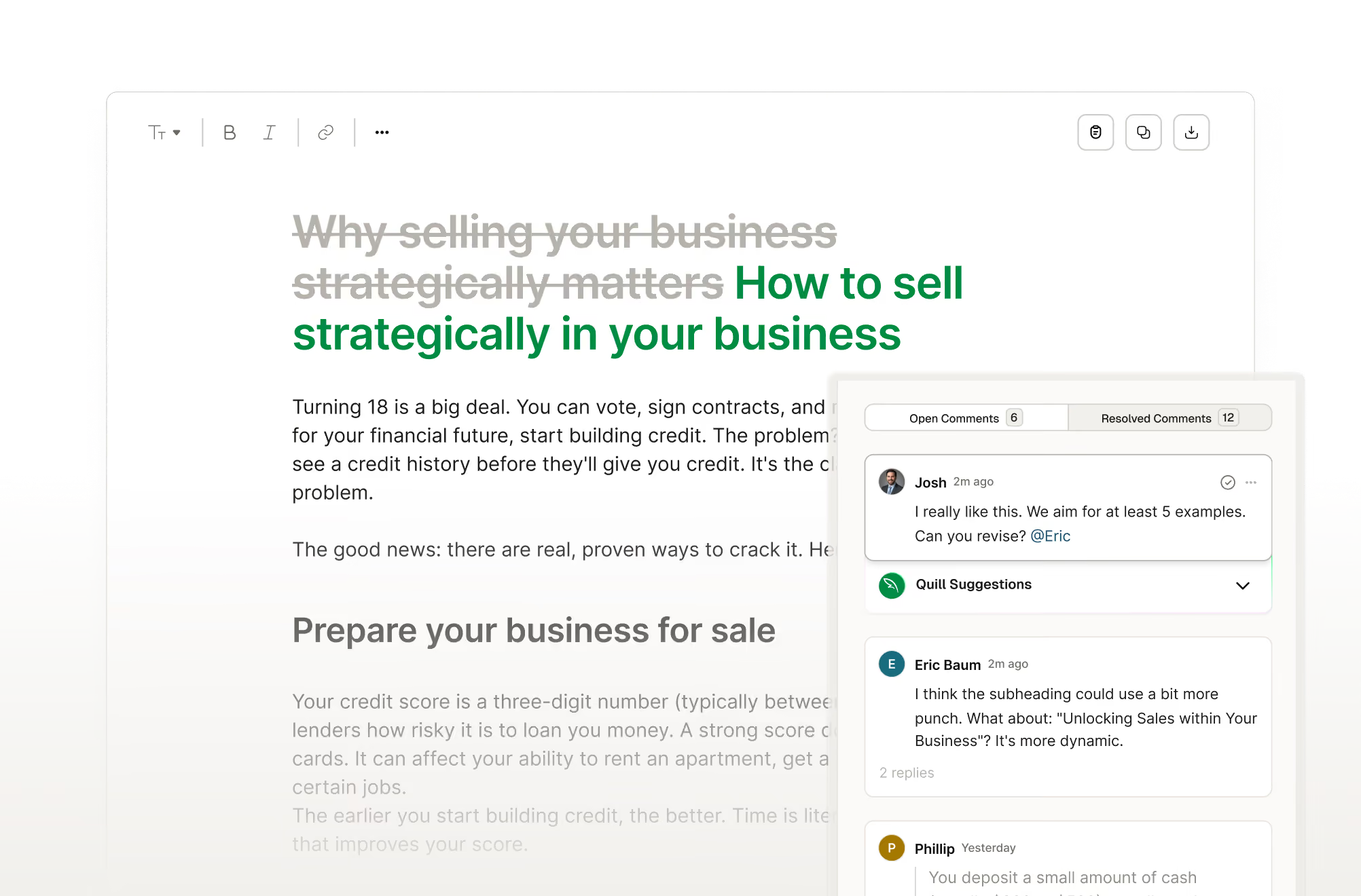 Source: AirOps.
That picture is useful because it exposes the operating primitive: a workflow is a sequence with conditions and review, not a magic content button. The current page makes the review contract explicit: reviewers can comment on passages, suggest edits, compare versions, accept or reject changes, and restore earlier content.
The screenshot cannot tell us whether the research is good, the setup is easy, the draft is accurate, or the publishing path is safe in a buyer's environment. It shows the designed workflow, not production reliability or business impact.
Choose production first when your team has a defensible brief and approved source material but lacks throughput, consistency, or governed execution. If the team still cannot explain why a brand is absent from an AI answer, faster production may automate the wrong response.
How should you test diagnosis before buying?
Give each vendor the same raw answer and ask it to separate observation from inference.
Use one commercially important buyer question. Preserve the exact prompt, engine, date, region, answer, cited URLs, and comparison set. Then ask the platform to classify the gap:
| Possible diagnosis | What you can observe | What still requires judgment |
|---|---|---|
| Missing first-party proof | The answer cites competitors or third parties while your relevant page lacks the fact | Whether the fact is publishable and strong enough to matter |
| Stale or conflicting information | Sources disagree on a product fact, price, integration, or policy | Which source is canonical and who owns the correction |
| Retrieval or access problem | The relevant page is absent, blocked, or hard to crawl | Whether access caused the model's choice |
| Weak positioning | The answer describes the company vaguely or puts it in the wrong category | Which positioning change is true and useful |
| Legitimate bad fit | Competitors match the stated constraints better | Whether any content action is justified |
A useful tool must say "unknown" when the evidence stops. It should not convert every absence into an article brief.
The current vendor pages and both product images were inspected in context on November 4, 2026. The strongest difference was not the number of AI labels on the page. It was where each public workflow placed the handoff between observation, production, and human review.
What should a live buying test include?
A live buying test should follow one real question from raw answer to approved next action, with every export and manual handoff recorded.
Use this checklist during a trial or demo:
Can you inspect the raw answer, prompt, model, date, sources, and comparison context?
Can you rerun the same question without pretending repeated answers will be identical?
Does the system distinguish a mention, citation, comparison, recommendation, and business outcome?
Can it explain why it recommends content, a refresh, a technical fix, third-party proof, or no action?
Can your team attach approved claims and sources before drafting?
Is human review explicit before publication?
Can the system preserve a decision receipt after the work moves to another tool?
Can you connect downstream traffic, leads, and revenue through your own analytics and CRM?
Classify each step as native, integrated, manual, services-led, or unavailable instead of merely calling it supported. Setup and exception work can still break the workflow for a two-person marketing team.
The test should end with a visible artifact: an evidence-backed brief, a corrected page, a decision not to publish, or a clearly assigned non-content action. A better dashboard is useful, but it is not automatically the completed job.
What can an AI visibility tool prove?
An AI visibility tool can prove what it observed under a defined test. It cannot prove why a model selected a source, that a content change caused the answer to move, or that the movement created revenue.
Keep four evidence classes separate:
- Observed: the prompt, answer, citation, model, date, region, and repeated-run result.
- Inferred: the likely evidence gap or reason a competitor appeared.
- External analytics: resource visits, CTA clicks, scan starts, leads, pipeline, and revenue.
- Human judgment: whether the claim is true, publishable, differentiated, on-brand, and worth the risk.
The boundary matters during procurement because vendors often combine these layers in one story. A visibility score may summarize observations. A recommendation may encode an inference. Neither becomes attribution because it sits beside a traffic chart.
Public view counts and engagement do not close the gap. Without a cohort, denominator, observation window, and attribution method, they do not establish acquisition or revenue. Treat vendor outcome claims the same way: ask for the starting population, baseline, test window, prompt protocol, excluded failures, and business-event definition.
When should your team use Trovance for this decision?
Use Trovance when the unresolved job sits between seeing an AI visibility gap and getting a verified action across the line. Its current public workflow begins with the buyer's question and preserves the answer, citations, and sources. It then names the break as evidence, positioning, retrieval, product, or fit; ranks what is worth doing; and either produces an asset or routes the fix to the team that owns it.
The important difference is the decision trail. A new page is only one possible result. The evidence may call for a refresh, clearer product facts, technical repair, third-party proof, distribution, monitoring, or no action. A human approves what moves forward, publication or execution carries a receipt, and the question can be rerun against the saved record.
Run the buying test on your own company rather than a vendor's demo account. See which answers and sources shape the market story, then use the same evidence to judge and route the next action. Text Trovance to inspect the question, evidence, and next action with a human in the loop.