
B2B brands should consider LinkedIn articles when a knowledgeable author can answer a buyer question with useful evidence and a distinct explanation. Start with a maintained resource on your website, then give the LinkedIn article a narrower job. Choose the person who can stand behind the advice, rather than assigning authorship from a chart of historical citations.
The useful deliverable is a publishing packet: question, source material, author, explanation, reader action, and correction owner. That makes LinkedIn an intentional distribution choice instead of another calendar to fill.
What does the research justify publishing on LinkedIn?
The research justifies considering LinkedIn as a place AI systems can find useful B2B explanations. It does not settle which author or format will work for your question. Use the studies to open the distribution decision, then choose an article only when the subject needs a developed explanation and an expert has something specific to contribute.
Goodie's September 10, 2026 public study summary describes 1,856,259 social citations across 10 AI surfaces and 29 social domains, observed from January 19 through August 25. It reports LinkedIn growing from about 8% to roughly a fifth of pooled social citations over three months. That is a share within social citations, not a share of all buyer answers.
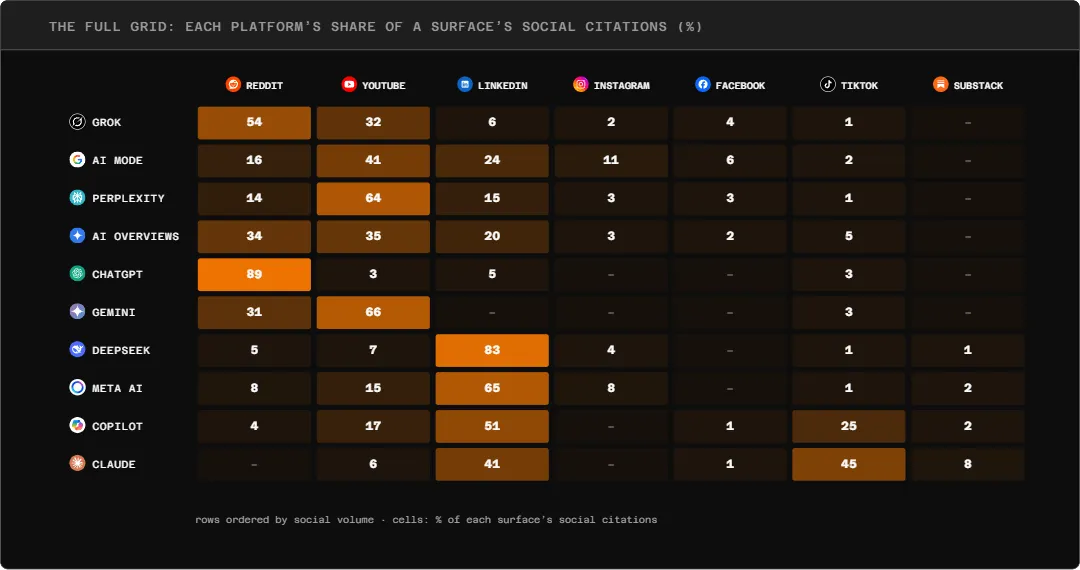
Source: Goodie's social-citation study. Reported social-citation mix by AI surface; percentages are within social citations, not all answers or all citations. The public article describes a January 19–August 25, 2026 study; the figure does not independently label its aggregation dates.
The broad pattern makes a practical case for evaluating the channel. The exact mix also changes by surface and period. Goodie's full report requires a lead form; the evidence here is its public summary and public figure, not an inspection of the gated methodology.
Semrush's March 10 study provides another view: 325,000 unique prompts across 3 AI search tools and 12 industry categories in January–February 2026. Researchers identified 89,000 unique cited LinkedIn URLs and collaborated with LinkedIn for deeper analysis. Those cited URLs establish that LinkedIn material entered the sampled answers; they do not describe every article that was published and never cited.
That distinction matters when choosing a format. Otterly's June 3 research explicitly says its dataset includes only already-cited URLs and explains repeated citation behavior, not initial eligibility. A large share of citations going to articles would not, by itself, tell you the probability that your next article gets cited.
I recommend using that evidence to justify a bounded editorial test, then evaluate the piece on its usefulness and observed response. The publishing plan below is an editorial recommendation, not an experimentally proven ranking technique.
Should the expert or the company publish the article?
Choose the author who owns the knowledge and can approve the explanation. A subject-matter expert is a strong fit for practical judgment, trade-offs, and lessons they can substantiate. A company voice fits official facts or a distinct organizational position. Historical author shares help challenge assumptions, but they should not assign the byline for you.
In Semrush's sample, company pages accounted for 59% of Perplexity's LinkedIn citations. Individual creators accounted for 59% on ChatGPT Search and Google AI Mode. The same study therefore gives no basis for a blanket rule that company pages are irrelevant.
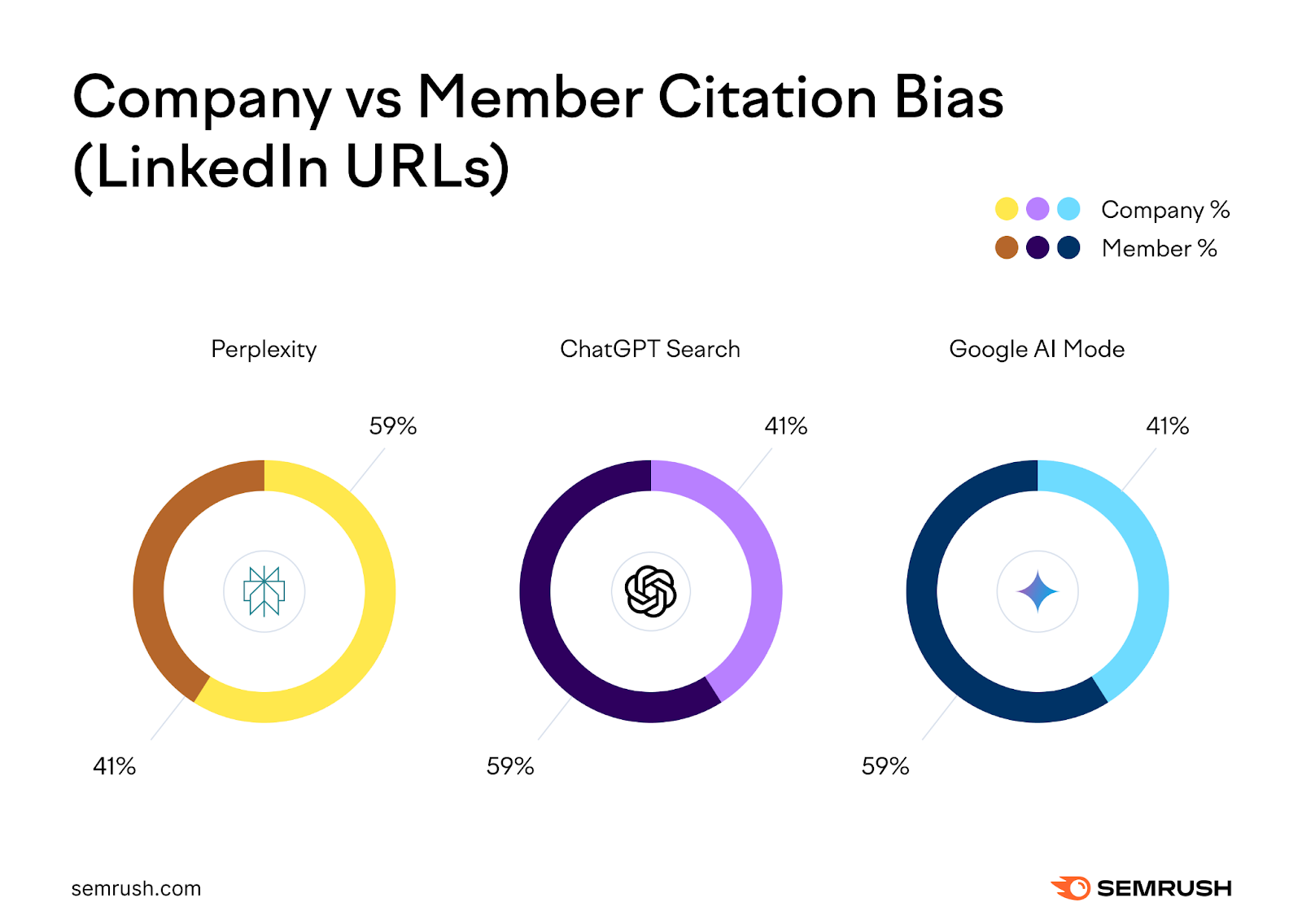
Source: Semrush's LinkedIn visibility study. Historical company/member proportions within LinkedIn citations in the January–February 2026 sample across ChatGPT Search, Google AI Mode, and Perplexity; not an author-choice intervention.
Meltwater's May 21 LinkedIn-hosted summary reports a pooled split of 75% individual members and 25% company pages. Keep those figures in their own sample. Averaging them with Semrush would hide differences in engines, observation windows, and classification rather than resolve them.
Ask who can explain the buyer's uncertainty without borrowing someone else's authority. An implementation lead might be better placed than a chief executive to explain integration dependencies. An executive may be the right author for a decision about organizational priorities that they actually made.
Obtain the author's consent and review. State their relevant role and affiliation accurately, and agree who maintains the article if responsibilities change. Employee expertise is a contribution to develop with the person, not a distribution asset to commandeer.
The company page can maintain accurate facts or introduce a separate company perspective. Duplicating the expert article automatically adds another version to maintain without establishing another reader benefit.
What belongs on your website versus in the LinkedIn article?
Keep the maintained evidence and complete buyer resource on your website. Let the LinkedIn article explain a narrower decision with the author's own reasoning, examples, and useful checks. Use a short post when a smaller point can stand alone. If the adaptation adds no practical value, keep the original resource and skip the extra piece.
This is an editorial source-of-truth policy. Calling your website the maintained version does not set a cross-domain technical canonical tag or determine how a search system treats either URL.
For an implementation guide, the website might hold supported integrations, requirements, documentation links, and revision history. The expert article could explain which dependencies buyers should settle before signing. The source resource supports the details; the article helps the reader use them.
A short post could answer a single smaller concern, such as which team should confirm a data-export requirement. It should deliver that answer in the post rather than withholding the useful part behind a link. Link to the full resource when the reader needs deeper evidence or the maintained specifications.
Avoid copying an entire resource and merely changing its introduction. Instead, mark the passages that need expert interpretation, identify a question the original page leaves difficult to apply, and build the LinkedIn version around that gap. Readers should understand why both versions exist.
How do you build a publication-ready LinkedIn packet?
Fill out the packet before drafting and use it as the author's approval document. It connects the buyer's question to a maintained resource, a distinct explanation, and a correction owner. Missing evidence should become an explicit research task; missing expertise should change the author choice. Neither problem is solved by producing a longer article.
Copy these fields into your editorial brief and replace each instruction with an actual decision:
- Buyer question: State the specific choice the reader needs to make and who is making it. Avoid a broad topic such as "AI and marketing."
- Owned source of truth: Add the maintained resource URL, its owner, and the last factual review date. Identify any documentation that takes precedence over the article.
- LinkedIn-specific promise: Describe the explanation or decision aid this version adds. Make the difference from the owned page visible in a single sentence.
- Expert author: Record the person's name, relevant experience, affiliation, approval, and availability to review corrections. Confirm permission for any example attributed to them.
- Format choice: Choose an article for a developed explanation, a post for a complete smaller point, or no new piece when the existing resource already does the job.
- Claim record: For each reusable factual statement, retain the approved wording, original source passage, date, scope, and limitations. Flag examples as illustrative when they are not observed events.
- Company-page role: Specify an accurate company fact, separate announcement, or distinct organizational view. "No duplicate needed" is a valid decision.
- Reader action: Name the practical next step, whether that is checking a requirement, discussing a trade-off, or opening the maintained resource.
- Maintenance trigger: Assign someone to correct the article when its underlying facts change. Include a route for the author to flag uncertainty or request removal of outdated advice.
- Observation and review: Record the answers, referrals, and human responses you will inspect; choose a review date and who decides to continue, revise, or stop.
For an illustrative B2B software team, the owned resource is a buyer guide to implementation requirements. The implementation lead's article explains the integration questions buyers should settle before signing: data access, responsibility for configuration, and what must be tested before launch. These are proposed teaching choices, not findings from a customer experiment.
The writer starts with documented requirements and asks the lead to explain why each check matters. A permissioned example can show how to use the checks; if no suitable example exists, keep the scenario explicitly hypothetical. Never turn a plausible failure into a claimed customer story.
The short post explains a single integration mistake and the check that could prevent it. The company page points readers to correct documentation and carries a separate announcement only when there is real news. A changed supported integration triggers review of both the guide and the expert article.
The packet is ready when the author can approve the facts, the reader can perform the next action, and the owner knows what would require a correction. A polished draft without those decisions is still unfinished work.
How will you know whether to keep publishing?
Review separate observations rather than combining them into a single success score. Preserve dated AI answers and exact cited URLs, then inspect human responses, tagged referrals, and relevant business actions separately. Continue when the work helps the intended readers and earns enough useful response to justify maintenance. Revise or stop when the explanation or distribution choice fails that test.
Before release, save the buyer questions you intend to observe, the AI surface, the date, and the full answer where available. Record whether the answer cites a LinkedIn URL, describes your brand, or recommends it. Those are different events, and a source link can appear without a favorable brand recommendation.
After release, retain the same context alongside new observations. Verify the exact URL before crediting your article: a citation to another employee's profile or someone else's post is a different result. Record changed conditions rather than treating repeated queries as a controlled experiment.
For human response, look at substantive replies, useful prospect conversations, and visits from tagged links where available. Keep relevant business actions separate from clicks and reactions. A buyer explaining that the integration checklist clarified a requirement is a different kind of evidence from a like.
I would choose the next piece based on the unresolved question those observations reveal, not a preset publishing quota. If the article draws interested readers who still cannot act, improve the explanation or destination. If maintaining another version costs more than its demonstrated usefulness, retire the distribution experiment without turning a quiet post into a verdict on the entire channel.
How can Trovance help choose the next useful article?
Trovance connects the question worth answering to the evidence and drafting work behind it. Its ranked content queue starts from observed answers and gaps, so a team can inspect why a recommendation deserves attention before producing another article. That gives the LinkedIn publishing packet a useful starting point: an evidence-backed question rather than an empty calendar slot.
The proactive content workflow lets you follow a recommendation into its sources, carry saved voice and editorial guidance into the draft, and review the work before publication. Compare the recommendation with the resource you already maintain, then decide what an expert-led explanation should add. The question, source material, and review decision can stay connected as the draft develops.
For a lean B2B team, that means less time rebuilding context for each writer and a clearer final review. Use the evidence to prioritize the owned answer, prepare the author with approved material, and choose the distribution version that serves the reader. Start a free Trovance trial to see how AI describes your brand and identify the next question worth answering.