
ChatGPT can get information about your business from two different layers: patterns learned during model development and current pages retrieved when Search is used. The practical move is to inspect which layer you can see, check the public evidence behind the answer, and fix the smallest source problem you can prove.
Your website matters, but it is not the only input. Public profiles, documentation, independent coverage, partner data, community discussions, and learned model patterns can all affect the explanation a user receives. A visible citation gives you a useful lead. It does not give you a complete record of why ChatGPT wrote each sentence.
Which source situation describes your business?
Most confusing ChatGPT answers fall into four recognizable situations, and each one calls for a different first check.
If this describes you | Check this | Take this action |
|---|---|---|
ChatGPT describes an old product, price, category, or location | Open the visible citations and compare dates across your site, profiles, documentation, and independent sources | Correct the canonical source first, then update the dependent surfaces you control |
The answer names your company but explains it badly | Compare the answer with your clearest product and positioning pages | Rewrite the strongest existing page around the buyer's actual decision, with checkable claims and limits |
A competitor or directory supplies the decisive facts | Check whether your public evidence is missing, vague, gated, or harder to verify | Publish or repair the proof-backed owned page that should answer that point |
No citations appear, or the answer seems to rely on older knowledge | Run Search explicitly, ask the same buyer question again, and preserve both results | Treat the uncited answer as a clue, not a source audit; investigate public evidence before changing content |
Do this diagnosis before opening an editorial calendar. A stale profile needs correction. A weak comparison needs better decision evidence. A fair exclusion may need product work or no content action at all.
I compared the assigned topic against the refreshed Framer inventory and sitemap before drafting. The site already has a detailed citation-mix benchmark, so this article does not recreate it. Where Do AI Citations Come From Across Industries? remains the deeper resource for source-distribution research.
Where can ChatGPT get information about your business?
ChatGPT can draw from learned model patterns, current web search, and context supplied in the conversation, but those paths should not be collapsed into one source list.
OpenAI says the models that power ChatGPT are developed from three primary classes of information: material publicly available on the internet, material accessed through third-party partnerships, and material provided or generated by users, human trainers, and researchers.
The policy does not disclose a business-level inclusion list, source weights, or a way to trace one sentence back to one training item.
That is the learned layer. OpenAI describes model training as adjusting numerical parameters from patterns in data, rather than storing a browsable copy of every sentence. The same question can also produce different wording across runs. An uncited answer may reflect learned patterns, conversation context, or a mix of signals that the interface does not expose.
Search is different. ChatGPT may search automatically when a question needs current information, or the user can select Search. OpenAI says the system can rewrite one prompt into one or more targeted queries, review the first results, and send more specific queries to search providers.
That means your original prompt may not be the only wording used to find pages. A buyer asking about the best tool for a job can trigger searches around category terms, features, alternatives, location, freshness, or constraints. You can observe the answer and its visible citations. You cannot see every ranking factor or prove that one retrieved page caused the final wording.
What can you check in a ChatGPT answer now?
You can check the exact prompt, whether Search ran, the response date, visible citations, the Sources panel, and whether each cited page supports the sentence attached to it.
Source: OpenAI Help Center.
OpenAI's Help Center tells users to open citations, review publication or update dates, and prefer authoritative sources when accuracy matters. It also warns that search results and citations can be incomplete, outdated, or incorrect. That warning is part of the product contract, not fine print to ignore.
Use this seven-step source audit:
Save the exact buyer question, full answer, date, and product surface.
Record whether Search was used and whether citations appeared.
Open every visible source instead of trusting the source label.
Mark which claims each page supports, contradicts, or leaves unresolved.
Separate your owned pages from competitor pages, directories, independent reporting, and community sources.
Check dates, scope, methodology, authorship, and whether the cited text is still visible.
Choose the smallest correction that addresses the first supported gap.
I opened the current OpenAI Help Center page during this run and checked the Sources control in its original section. The image is deliberately narrow: it shows where a reader can open sources, not a complete list of everything that influenced the answer.
Run the same question in at least two fresh conversations when the decision matters. Two runs can reveal obvious instability, but they are not a representative benchmark. Preserve disagreement rather than choosing the answer that makes the company look best.
How should you decide which source to fix first?
Fix the 1 strongest public source that is wrong, missing, or unable to prove the claim a buyer needs. Do not spread the same answer across five thin pages.
Observed problem | Best first source to inspect | Why this comes first |
|---|---|---|
Wrong identity, category, or core use case | Canonical homepage or product page | This is the clearest owned statement of what the company is and who it serves |
Stale price, feature, integration, or policy | Current documentation, pricing, release notes, and structured feeds | Operational facts need a maintained source of truth |
Weak comparison or recommendation | Comparison page, customer evidence, limitations, and independent proof | A buyer decision needs fit criteria, trade-offs, and evidence, not another category definition |
Third-party source dominates the answer | The cited third-party page plus the proof it relies on | You need to know whether the outside claim is accurate before trying to displace it |
Search cannot surface the relevant page | Robots rules, server response, rendered text, internal links, and crawl logs | Content quality cannot help a page that is not eligible or reachable |
The company is a legitimate bad fit | Product and buyer criteria | No source rewrite should manufacture a recommendation the evidence does not support |
Keep the full answer on your owned domain, where it can be corrected and maintained. The canonical version of this source audit belongs on trovance.ai. A LinkedIn post, newsletter excerpt, or short video can distribute it, but social should not become a competing canonical article.
A source fix is still a hypothesis. After the change, rerun the same question under the same protocol and record what changed. Do not convert one favorable screenshot into proof that the edit caused a citation, qualified visit, or sale.
Do crawler settings decide what ChatGPT says?
Crawler settings decide part of eligibility and data-use preference; they do not decide the wording, citation, ranking, or recommendation in a ChatGPT answer.
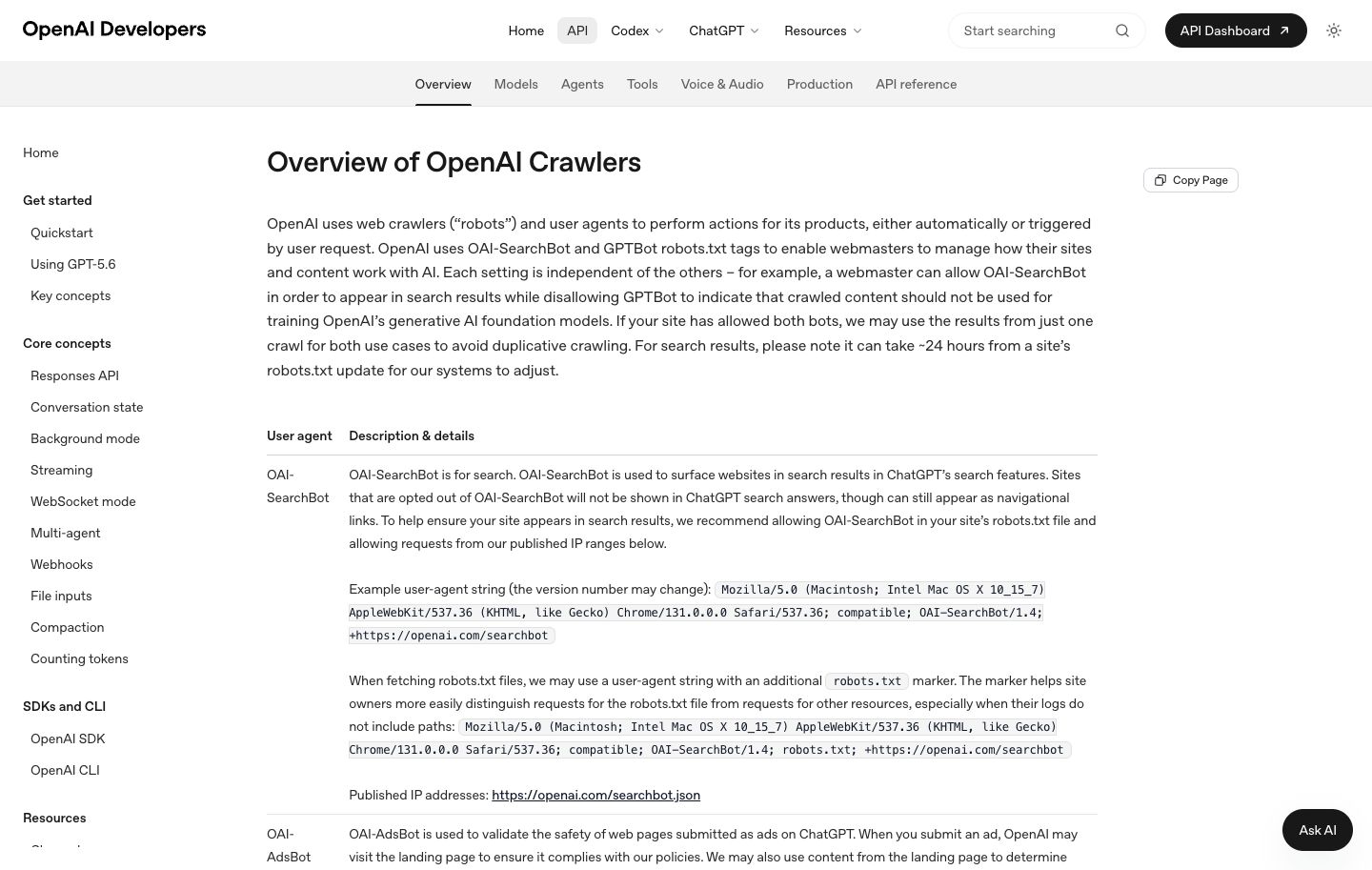
Source: OpenAI Developers.
OpenAI documents four relevant user agents on its crawler page. OAI-SearchBot is used to surface websites in ChatGPT search. GPTBot crawls content that may be used in foundation-model training. ChatGPT-User can visit a page after a user action, while OAI-AdsBot checks submitted ad pages.
For most business source audits, the important distinction is between two independent settings. You can allow OAI-SearchBot for search eligibility while disallowing GPTBot for training preference. Blocking GPTBot does not manage Search inclusion. Allowing OAI-SearchBot does not guarantee that a page will be retrieved, cited, or recommended.
OpenAI estimates that a robots.txt change can take about 24 hours to affect its search systems. Treat that as a propagation estimate, not a performance promise. After the window, verify access and inspect the answer again.
This is why a crawler log is evidence of a request, not evidence of buyer visibility. AI Crawler Traffic Does Not Prove Buyer Visibility owns that deeper measurement boundary.
What can you observe, infer, and prove?
You can observe a dated answer and its visible sources, infer a likely evidence problem, and prove business effects only with separate analytics and a defined measurement design.
Evidence state | What you can say | What you still need |
|---|---|---|
Observed | This exact prompt produced this answer, these citations, and this mention or comparison on this date | Repeated runs across the questions and product surfaces that matter |
Inferred | The pattern may point to an identity, freshness, access, evidence, reputation, comparison, or fit gap | Competing explanations and direct review of the public sources |
Business outcome | A person visited, activated, qualified, bought, or retained | Analytics, product events, CRM records, a cohort, an observation window, and attribution rules |
Human judgment | The answer is accurate, fair, material, risky, or worth correcting | An accountable reviewer who understands the product, buyer, proof, and public claim boundary |
Keep at least four evidence states separate: observed, inferred, externally measured, and judged. A mention is not a citation. A citation is not a recommendation. None of those is revenue.
Public view and engagement counts are not acquisition proof without a cohort, denominator, attribution method, and time window. The same rule applies to a high-performing social adaptation of this article. Reach can justify another look; it cannot establish pipeline or revenue by itself.
How can Trovance inspect the sources shaping your market story?
Trovance can inspect the sources shaping your market story by preserving the buyer question, answer, visible citations, comparison, and recommendation before diagnosing the evidence gap behind them.
Observation alone does not tell a team whether to rewrite a page. Trovance helps distinguish a missing owned fact from stale documentation, weak third-party proof, unclear comparison language, a technical access problem, or legitimate bad fit. It can then help produce and publish the proof-backed asset that should exist, with human review intact.
It does not expose model weights, reconstruct a complete causal audit log, or guarantee a ranking, citation, recommendation, or business result. The value here is a defensible source-to-action trail. See which answers and sources are shaping your company's market story.