
AI changes the buyer journey by moving research, comparison, and recommendation into the same conversation. It does not remove the buyer's need to explore options, evaluate proof, take an action, and decide whether the product delivered value.
That distinction changes the marketing job. Do not build an AI funnel around mentions alone. Map the decision the buyer is making, the evidence they need, the action you can observe, and the business outcome you must verify somewhere else.
What actually changed in the buyer journey?
The interface changed first. A buyer can now ask a broad question, refine the criteria, request a shortlist, challenge the recommendation, and ask for sources without opening a new tab for every step.
The decision process did not disappear. Google's consumer-decision research describes the path between a trigger and a purchase as non-linear, with a web of touchpoints that differs from person to person. Its model names 2 recurring mental modes: exploration expands the set of possible brands or products, while evaluation narrows the options.
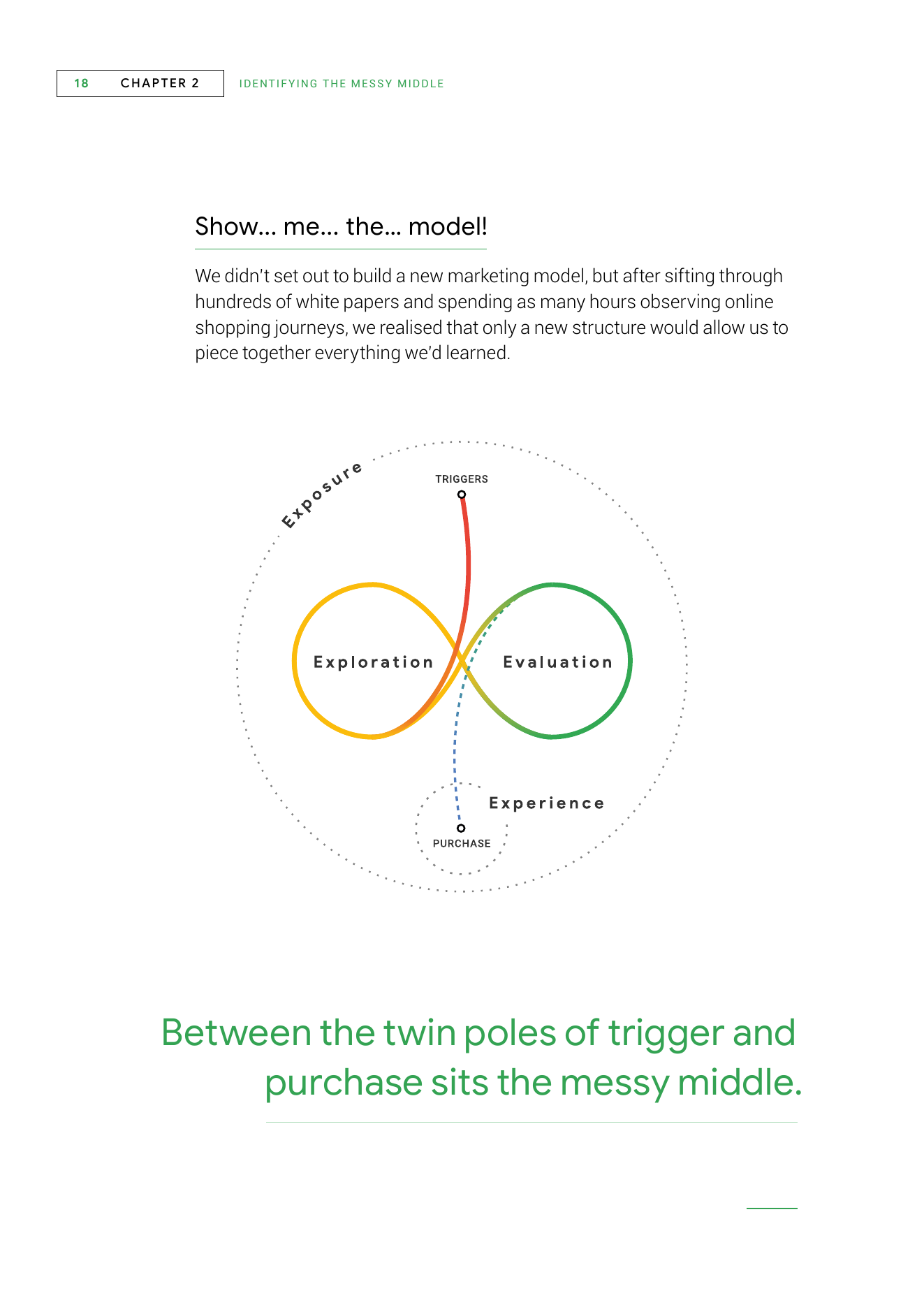
Source: Google, Decoding Decisions, page 18.
The report predates mainstream generative-AI assistants. It should not be presented as a study of current ChatGPT behavior. Its durable value is the decision model: buyers expand possibilities, reduce them, and repeat the loop until they are ready to act.
AI can compress that loop into fewer visible surfaces. It can also hide parts of the path from your analytics. A buyer may learn your category, encounter your company, and rule you out without visiting your site.
Another buyer may arrive through a direct URL after a long AI conversation that leaves no clean referrer. The practical response is better stage definitions, not a more confident attribution story.
Which situation describes your buyer?
Start with the job inside the AI conversation. Most teams will recognize one of these situations:
| Buyer situation | What the buyer is doing | Evidence marketing must make available |
|---|---|---|
| What are my options? | Exploring categories or approaches | Clear category definition, use cases, and alternatives |
| Which one fits me? | Evaluating a shortlist | Fit criteria, limitations, proof, and trade-offs |
| Can this solve my problem? | Testing a claim | Product documentation, methods, examples, and current capability boundaries |
| What should I do next? | Preparing to act | A low-friction, intent-matched product or sales action |
| Was this worth it? | Validating the choice | Product outcomes, adoption evidence, retention, and commercial results |
If buyers do not know the category, a comparison page is premature. If they already have a shortlist, a category explainer may be too broad. If they need implementation proof, another opinion piece creates noise instead of confidence.
The question tells you the stage. The stage tells you what evidence has to exist.
Should you use a 5-stage map instead of an AI funnel?
A useful map keeps model behavior and business behavior separate:
Trigger: The buyer recognizes a problem, goal, or decision.
Explore: The buyer expands possible categories, approaches, and vendors.
Evaluate: The buyer narrows options using fit, proof, constraints, and trade-offs.
Act: The buyer clicks, starts a scan, signs up, books, buys, or takes another observable step.
Validate: Product and CRM data show activation, qualification, retention, expansion, or revenue.
For each stage, document 3 fields:
- Buyer question: What is the person trying to decide?
- Required evidence: What would make a responsible answer possible?
- Observable event: What can your systems actually record?
Here is the decision path:
- If the AI answer never names the company, inspect presence and source eligibility.
- If the company appears but the description is wrong, inspect portrayal and conflicting evidence.
- If the description is fair but the company loses the shortlist, inspect fit, proof, and comparison clarity.
- If the company is recommended but nobody acts, inspect the next step, offer, and measurement path.
- If people act but do not activate or qualify, stop treating visibility as the constraint and inspect the product or audience fit.
This sequence prevents the team from prescribing content before it knows which decision is broken.
How should you measure discovery, action, and value?
IAB's August 2026 working-group framework gives marketers a useful vocabulary for the model-facing part of the journey. It separates 4 classes: Presence, Prominence, Portrayal, and Persuasion.
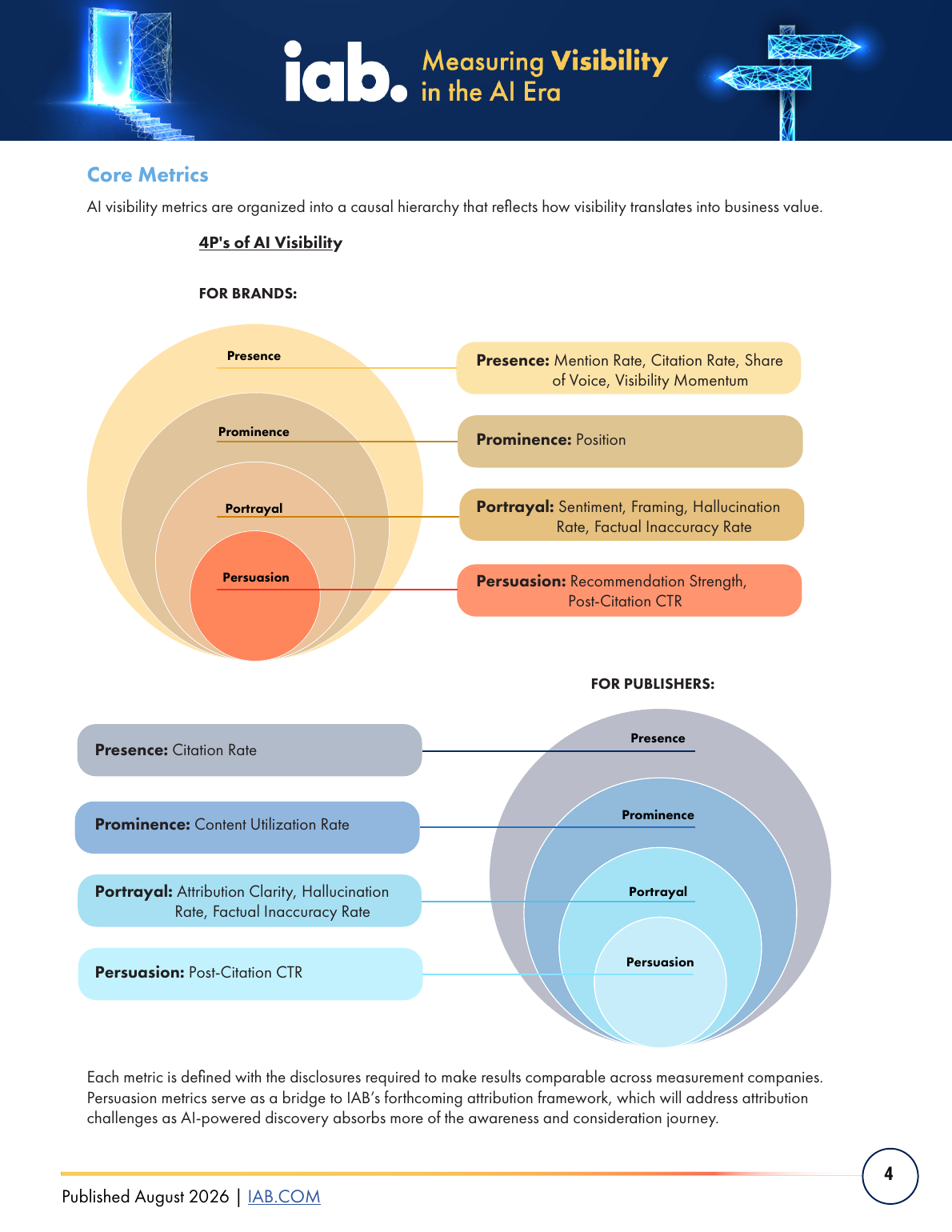
Source: IAB, Measuring Visibility in the AI Era, page 4.
That separation matters. Being present in an answer is not the same as being described accurately. Accurate portrayal is not the same as a strong recommendation. A recommendation is not the same as a click, and a click is not the same as a qualified account.
Use a measurement chain with explicit denominators:
| Event | What it establishes | What it does not establish |
|---|---|---|
| Mention or citation | The company or source appeared in a defined answer set | A buyer saw it or trusted it |
| Accurate portrayal | The answer represented a defined claim correctly | The company entered the shortlist |
| Recommendation | The system recommended the company under recorded conditions | The buyer acted |
| CTA click or product start | A person took an observable next step | The account activated or qualified |
| Activation or qualified account | The account reached a defined value or sales threshold | Retention or revenue |
| Retention or revenue | A downstream business outcome occurred | That one AI answer caused it |
IAB describes persuasion metrics as a bridge to a forthcoming attribution framework, not a finished causal link. That is the honest boundary for a marketing team too. Visibility data can diagnose discovery and decision problems. Product analytics and CRM records must carry the downstream proof.
What should marketing change now?
First, rewrite the journey around buyer decisions rather than channels. Search, social, review sites, AI assistants, sales conversations, and the product can all support the same exploration or evaluation job.
Second, make the evidence portable. A core claim should have an accountable source, a clear date, a maintainer, and enough context to survive outside the page where it was written. This improves ordinary buyer research even when no AI system cites it.
Third, give each intent a next step that matches its risk. A broad category question may lead to a checklist. A company-specific diagnostic may lead to a scan. A high-stakes implementation question may require documentation, a sandbox, or a human conversation.
Fourth, preserve the handoff. Record the answer or source that created the hypothesis, the page or proof changed, the approved action, and the downstream event definition. Without that chain, a team can report activity but cannot explain what it learned.
How does Trovance connect the AI answer to the next accountable action?
Trovance starts with observable market evidence: how AI systems explain, cite, compare, and recommend a company. It helps a team preserve that answer, inspect the supporting sources, identify the decision or evidence gap, and route a governed action instead of stopping at a score.
The workflow keeps the buyer question attached to the evidence and the owner. If a buyer is exploring, the gap may be category clarity. If the buyer is evaluating, the gap may be proof, fit, limitations, or an outdated comparison. If the model-facing evidence is healthy but qualified accounts do not move, the next investigation belongs in the CTA, product, audience, analytics, or sales handoff rather than another content brief.
The next action may be a source repair, a proof-backed asset, a clearer comparison, a product escalation, or no content change at all. Humans retain truth, permission, taste, spend, and publication. Trovance cannot prove that an answer caused a sale, guarantee a ranking or recommendation, or replace product analytics and CRM data.
Start your free trial to establish the observable answer and source baseline before choosing what to change.
How do you know whether the journey map is working?
Choose one buyer question and one stage before you run an experiment. Preserve the starting answers, citations, claims, and date. Make one justified change, then compare the same observable layer under recorded conditions.
Use 4 terminal states:
Improved observation: The defined answer set shows the intended presence, portrayal, or recommendation change.
No observed change: The same gap remains under comparable conditions.
Mixed: Results vary across prompts, platforms, or runs.
Not comparable: The model, prompt set, source environment, or measurement method changed materially.
Then inspect the next layer separately. Did more people take the intended action? Did those accounts activate or qualify? Did a named cohort retain or produce revenue inside a defined window?
A better answer may contribute to those outcomes. It does not prove causation by itself. The journey map is working when it helps your team choose the right evidence, preserve the handoff, and stop confusing one layer of the decision with the whole decision.